
Top 6 Cross Platform App Development Tools of 2023
Elevate your app development game, discover the best cross-platform tools of 2023


Creating mobile applications to boost productivity within a time frame can be challenging for app developers; that’s why software development companies have developed tools/frameworks that can create apps to simplify the whole smartphone app development process.
In a highly competitive market, app developers are looking for cross-device app development tools while businesses are looking for ways to improve their revenue. Cross mobile application development is time-consuming and resource crunching.
Thanks to some popular cross-platform mobile application creators that have gained center stage to work on multiple platforms, including Android, Blackberry, Windows Phone, iOS, and many more.
To help you get the idea of these frameworks, I have winded up some best cross-platform development tools with the latest technology upgrades.
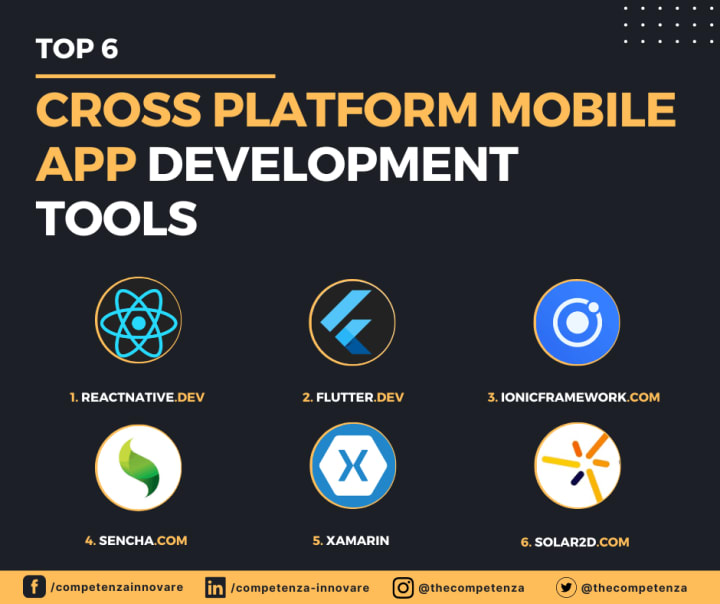
1. React Native
React Native is an open-source cross-platform app development tool developed by Meta Platforms, Inc and launched in 2015. Developers can build mobile apps for platforms like Android, iOS, macOC, Windows, Web, tvOS etc.
React Native uses JavaScript to build hybrid mobile apps with true native capabilities. Because of this, React Native is one of the most popular framework used by thousands of mobile app developers.
Features – Native look and feel, Code Reusability, Cost efficient
2. Flutter
Flutter is an open-source cross-platform app development tool developed by the tech giant Google. It was launched approximately 2 years after React native in 2017.
With Flutter you can develop hybrid apps for Android, iOS, Windows, macOS etc. To develop apps with Flutter, you have to use a programming language called Dart.
Features – Less code development time, Own rendering engine, Platform-Specific Logic Implementation
3. Ionic
Ionic is an open-source framework that provides platform-specific UL elements with a library of native components. It uses front-end technologies like Javascript, CSS, and Angular for app development. It uses an HTML5 framework that needs a wrapper like Cordova or Phone Gap as native.
Developers have the flexibility to access more than a hundred design and functional elements with various components and plugins. The mobile development lifecycle can quickly create powerful apps for iOS, Android, Electron, and PWA. It provides pre-designed components, interactive paradigms, extensive themes, and typography.
Features – Javascript components, Framework compatibility, mobile-optimized UI components.
4. Sencha
Sencha allows you to build apps with modern Java and JavaScript frameworks. With about 115+ fully supported and tested UI components, you can easily integrate them into your app. Developers use HTML5 for creating apps and convert them to other platforms with Adobe PhoneGap. Deploying a single script enables developers to create iOS, Windows, Blackberry, and Android apps. With adaptive layouts, fluid animations, and smooth scrolling features, it makes apps more engaging and user-friendly.
The platform ensures that the overall look of the app is uniformly maintained across all platform apps. It comes with high-performance UI widgets, toolbars, forms, menus, and lists. It also allows you to access design tools, create reusable themes without adding lengthy code.
Features – Code compatibility of new with an old library of prebuilt UI components, custom modules.
5. Xamarin
One of the leading solutions for native cross-platform application development allows developers to use a single C# codebase for Android, iOS, and Windows. Xamarin gives you the flexibility to add components directly from an interface, native API access, integration with backends, interfaces for sharing code, and much more. Developers can use APIs, language, IDE everywhere. With a good set of features, developers can reuse up to 70% of code when adapting to other platforms.
Features – Single technological stack, simplified maintenance, time, and cost-saving.
6. Solar 2D (Formerly Corona)
Solar 2D is a cross-platform development framework for 2D games and mobile apps. Launched in 2009 with open GL hardware acceleration for graphics and animation, it is considered a high-performing multimedia development tool. It includes more than 1000 apps and plugins that make it easy for developers. Paired with IDE, it changes code instantly and provides a real-time preview of your app.
The apps are optimized for higher performance due to the lightweight script power of Lua language. It is a free-to-use tool primarily used in 2D games and supports HD graphics and high-speed development games. No matter if you are a pro or novice app developer, the entry-level of development allows you to access the core functionality of the framework.
Wrapping Up
Today, businesses face tough competition, and it has been imperative to provide top-notch technology for smooth performance. Cross mobile app development offers server advantages, including budget reduction, less time, and the possibility to expand the targeted audience outreach. The advantage of cross-development tools becomes popular with time and stimulates further development.
Source: This article was originally published here.
About the Creator
Competenza Innovare
Competenza Innovare is our name. Custom ASP.NET solutions, Android app development, iOS app development, and web development are our specialties. Through our technological solutions, we assist people in growing their businesses.
Keep reading
More stories from Competenza Innovare and writers in Journal and other communities.
Top 10 Digital Transformation Companies and Consulting Firms
Every business wants to strive toward continuous growth by implementing new and innovative tactics to run its business operations. Nowadays, the term “digital transformation” is gaining global popularity among companies to enhance their operational efficiencies.
By Competenza Innovare3 years ago in Journal



Comments
There are no comments for this story
Be the first to respond and start the conversation.