
The World’s Top 50 Economies by GDP in 2026
: A comprehensive look at the global economic landscape as perennial giants and rising powers shape the world’s economic order in 2026.

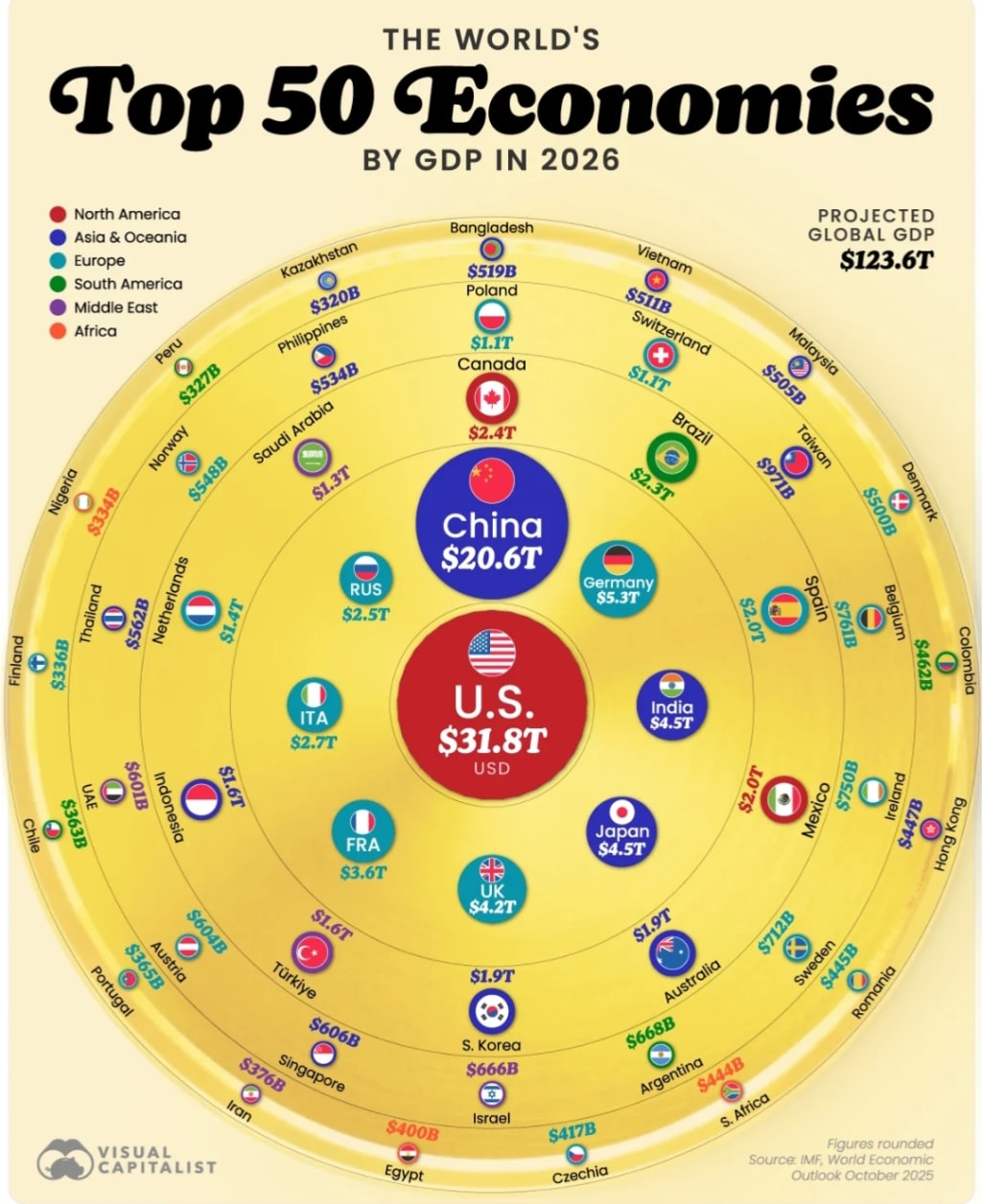
As the world economy evolves amid technological shifts, demographic changes and geopolitical tensions, the ranking of the world’s largest economies by nominal Gross Domestic Product (GDP) in 2026 offers a powerful snapshot of global economic power. These rankings, drawn from International Monetary Fund (IMF) projections, show not only where economic output is concentrated but also how emerging markets are reshaping the global stage.
---
What GDP Tells Us
GDP measures the total economic output of a country — the value of all goods and services produced in a given year. Nominal GDP rankings provide insight into overall economic size and global influence, impacting trade, investment flows and geopolitical weight. Countries with large GDPs often wield significant influence in international forums such as the G20, the World Bank and the IMF itself.
In 2026, the world’s total GDP is projected to reach around $123.6 trillion, with the top 50 economies accounting for the vast majority of this output.
---
The Global Leaders: Top 10 Economies
At the peak of the 2026 rankings, long‑standing economic powerhouses continue to dominate:
1. United States – ~$31,821 billion: The U.S. remains the world’s largest economy by a wide margin, supported by its diversified services sector, innovation economy and consumer spending.
2. China – ~$20,651 billion: Second globally, China consolidates its economic heft despite slower growth, driven by manufacturing, exports and expanding tech sectors.
3. Germany – ~$5,328 billion: Europe’s largest economy benefits from strong industrial output and export competitiveness.
4. India – ~$4,506 billion: India edges ahead of Japan to become the fourth‑largest economy — a marker of its rapid growth and demographic advantage.
5. Japan – ~$4,464 billion: Despite demographic challenges, Japan retains a leading position with high‑tech industries and global brands.
6. United Kingdom – ~$4,226 billion
7. France – ~$3,559 billion
8. Italy – ~$2,702 billion
9. Russia – ~$2,509 billion
10. Canada – ~$2,421 billion
These top economies are hubs of consumption, innovation and investment, anchoring global supply chains, finance and trade networks.
---
Emerging Powers and Shifting Dynamics
Beyond the top ten, the economic landscape highlights the rise of significant emerging economies:
Brazil ($2,042B) and Mexico (~$2,031B) solidify their roles as major Latin American players.
Australia ($1,937B) reflect strong innovation and export‑oriented manufacturing.
Türkiye ($1,550B) demonstrate Asia’s widening economic influence beyond China and India.
Saudi Arabia ($1,110B) illustrate how energy and regional integration can bolster growth.
Later in the top 50, economies like Switzerland, Taiwan, Singapore, UAE, Thailand, Bangladesh and Vietnam make notable appearances, showcasing how diverse economic models — from financial services centers to export‑oriented industrial hubs — contribute to global output.
---
Regional Highlights
Asia’s Expanding Footprint
Asia’s presence is unmistakable — with China, India, Japan, South Korea, Indonesia and Turkey ranking high among the world’s top economies. India’s ascent to the fourth‑largest economy underscores the region’s demographic and consumption‑driven dynamism.
China remains a critical engine of global growth, even as it transitions toward higher‑value industries and grapples with slower but more sustainable expansion patterns. Global forecasts estimate moderate GDP growth around 4.5% for China in 2026 — responding to structural shifts and fiscal policy.
Europe’s Stability Amid Challenges
Europe retains substantial economic weight. Germany, the United Kingdom and France are all major contributors to global GDP. Their economies combine manufacturing, services and technological innovation, even as demographic stagnation and energy policy transitions pose ongoing challenges.
Poland’s rise into the top 20 reflects Eastern Europe’s modernization and expanding domestic markets.
---
What This Ranking Means for 2026
The 2026 GDP rankings highlight several broader trends:
Consolidation of Economic Power: The U.S. and China maintain dominant positions, accounting for a substantial portion of global output.
Emerging Market Momentum: Countries like India, Indonesia and Türkiye are gaining ground, indicating a gradual shift in economic gravity toward Asia and beyond.
Resilience and Diversification: Mid‑tier economies such as Mexico, Australia and South Korea exemplify diversified economic structures that balance technology, services and manufacturing.
GDP rankings also underscore how economic growth is tied to broader global forces — from technology adoption and workforce trends to trade policies and geopolitical tensions. Countries that manage structural reforms, invest in innovation and foster inclusive growth are well‑positioned to climb the economic ladder in coming years.
---
Looking Ahead
While 2026 GDP figures offer a snapshot of current economic standings, the future trajectory of global economies will hinge on emerging trends such as automation, renewable energy, geopolitical engagement and demographic shifts. Nations that adapt proactively to these forces could alter their ranking trajectories by 2030 and beyond.
In conclusion, the 2026 top 50 economies reveal a world where longstanding powers coexist with rising challengers — reflecting a complex and interconnected global economic system that continues to evolve and expand.
---
Projected Top 10 Economies by GDP in 2026 (Billions USD, IMF):
1. United States – $31,821
2. China – $20,651
3. Germany – $5,328
4. India – $4,506
5. Japan – $4,464
6. United Kingdom – $4,226
7. France – $3,559
8. Italy – $2,702
9. Russia – $2,509
10. Canada – $2,421
About the Creator
Keep reading
More stories from Salaar Jamali and writers in Journal and other communities.
Pakistan, Australia Eye Mining Partnership
In a significant move signaling deepening economic ties, Pakistan and Australia are actively exploring a structured mining partnership that could transform Pakistan’s under‑developed mineral sector while offering Australian firms new avenues for investment and collaboration. High‑level talks between Pakistani officials and Australian diplomatic representatives have set the stage for what could become a long‑term bilateral engagement in mining, gemstones and technical cooperation.
By Salaar Jamaliabout 3 hours ago in Journal
3 Misconception I Made before I Understood Online Entrepreneurship
For a long time, I believed that making money by set up my online business simply wasn’t meant for me. I watched people who seemed to figure things out faster. They built audiences, found direction, and slowly turned their work into something sustainable. I followed them closely, studied their paths, and tried to replicate their actions.
By Lady Alkaid6 days ago in Journal



Comments
There are no comments for this story
Be the first to respond and start the conversation.