
The War for Water: Why the Next Global Conflict Won’t Be About Oil
Rivers, glaciers, and aquifers are vanishing — and nations are preparing for a new kind of battle.
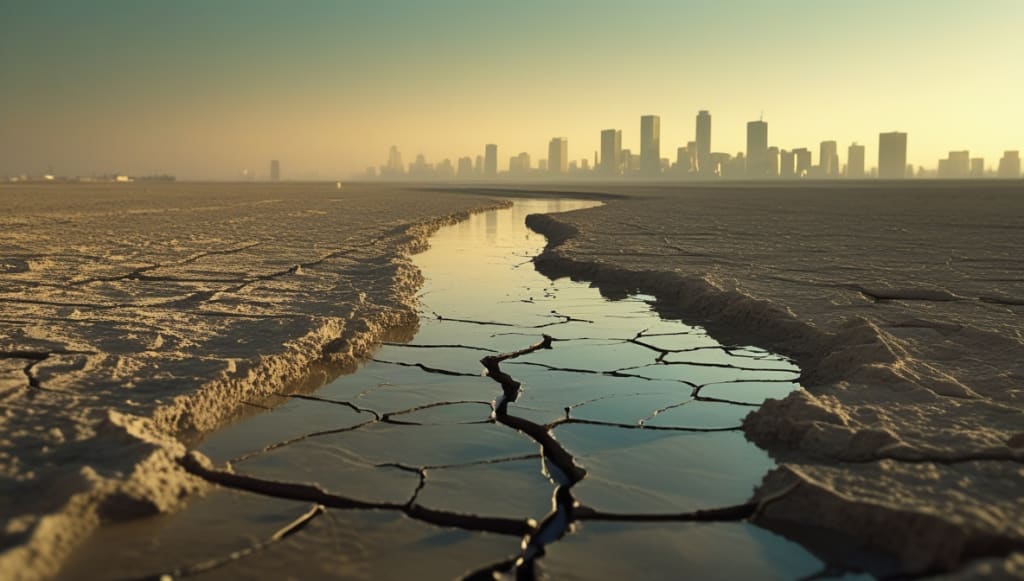
For over a century, oil has greatly changed the global power dynamics. It has started wars, constructed empires, and defined riches. As global temperatures increase and water resources run out, though, a more muted but still urgent conflict is rising for blue assets instead of black gold.
Future wars won't center around barrels of oil. They will focus on droplets rather.
The new scarcity
Water pours from the sky, fills our oceans, and flows from our taps; it is plentiful. But the perception that there is plenty is fading. Globally, the pace at which aquifers are being depleted is greater than their natural recharge rate. Once a powerful river, the Colorado River now hardly makes the ocean after skillfully shaped gorges. Asia's most important rivers, the Indus, Ganges, and Yangtze, are fed by glaciers that are vanishing at startling rates.
According to the United Nations, about half of the world's people would be severely water deficient in metropolitan areas like Chennai, Cape Town, and others by 2030. São Paulo has already experienced Day Zero events, which are situations where the water supply was nearly depleted. This is not in the future; it is happening right now little by tiny drop.
Switch from Resources to Weapons
Water becomes an energy source when it becomes less available. Moreover, conflict follows from any kind of power. Countries with shared rivers, such as Egypt and Ethiopia with the Nile or India and Pakistan with the Indus, view water as more not only as a resource but as a method of leverage. Dams become politically powerful instruments. Lifelines evolve into pipelines.
One instance of how a regional development plan can become geopolitical strife is the Grand Ethiopian Renaissance Dam (GERD). While Ethiopia views it as evidence of progress, Egypt is worried it may limit the river that feeds its people. Managing survival in a warming world is comparable to water management, hence neither party can afford to fail.
Even within particular countries, the conflict worsens. Western states of the United States disagree over shrinking reservoirs. Middle Eastern water shortages exacerbate underlying divides. Drought and inadequate precipitation are becoming more and more linked to migration and conflict in sub-Saharan Africa.
The battleground of tomorrow may be at the bottom of dry wells rather than in oil fields.
The Price of Ignoring the Obvious
Both companies and governments, who have been funding energy independence for several years, have somewhat ignored the need for water safety. Though big dams and desalination facilities were erected, the delicate ecosystems they damaged were ignored. Even in dry regions, we offered funding for crops that use a lot of water like rice, cotton, and almonds.
As the consequences of climate change grow worse, the effects are becoming clear. Aquifers that took thousands of years to recharge are depleting within a few decades. Earlier and at a quicker rate, the snowpack feeding the rivers is melting. Moreover, the monsoons, formerly dependable, are now unpredictable, causing famine as well as floods.
This state is known by academics as the worldwide water crisis. Still, the language we use to portray our circumstances sounds too official and cold. The problem at hand concerns the very character of life; it goes beyond merely a lack of supplies.
The Economic Worth of Thirst
Just like oil, water is progressively becoming a prized commodity traded, speculated upon, and even fought over. Beginning on Wall Street in 2020, water futures trading gave investors the opportunity to wager on the market value of scarcity. This was a terrifying turning point when the most precious asset for mankind became a trading good.
Still, unlike oil, water has no substitute. It is impossible to extract or manufacture too much of it. Once it is not accessible—whether because of pollution, contamination, or depletion—it is lost forever.
Certain nations are starting to recognize the need. Over 85% of Israel's wastewater is reused. Every possible drop of rain is captured by Singapore. Los Angeles, Dubai, and other cities are looking into cloud seeding and desalination technologies in the meantime. Technological breakthroughs alone cannot fix, though, the more basic issue: our past perspective of water as an inexhaustible resource, which we are now seeing to be incorrect.
Hope in a Drop
Still, even with the bleak predictions, there is cause for optimism. Communities are returning to time-honored techniques including rainwater gathering, wetlands restoration, and revitalizing conventional irrigation techniques that fit with rather than against the environment. Farmers are adopting drought-resistant crops. Young activists are transforming water equity into a worldwide movement by demanding that the right to clean water be recognized as a fundamental human right rather than a luxury.
The approaching large-scale conflict has no need. If we begin to view water not only as a resource, we might prevent it. By the time the last river runs dry, the outcome of the oil wars or the pace of our gear will be irrelevant.
The future will be determined eventually by those who know how to live on less and are prepared to share their possessions.
About the Creator
Keep reading
More stories from Shahjahan Kabir Khan and writers in Journal and other communities.
The AI Prophets: When Algorithms Start Making Predictions About the End
Once, prophecies came from great summits—a period when visionaries saw fires, floods, and final judgment. Data hubs—articulated not by seers but by computational algorithms—emerge in the present in those forecasts. Artificial intelligence has taken on an odd, nearly prophetic role: our modern messenger of disaster, from foreseeing financial market downturns to projecting crucial worldwide climate thresholds.
By Shahjahan Kabir Khan3 months ago in Journal
The goals I did not achieve
Every writing goal I made for the year is a wash. It has been this way for a while, but I think it's important to be open about my failures and the reality of how life can get in the way. This is especially true considering the several times I have posted on Vocal about my writing goals, how I was changing my approach, and where I was hoping to be for the upcoming year. I will probably do that again in a couple months, but for now, it is time to acknowledge where I am today.
By Kay Husnick22 days ago in Journal


Comments
There are no comments for this story
Be the first to respond and start the conversation.