
Why Trump Wants Greenland Now
Why Everyone Is Talking About Greenland

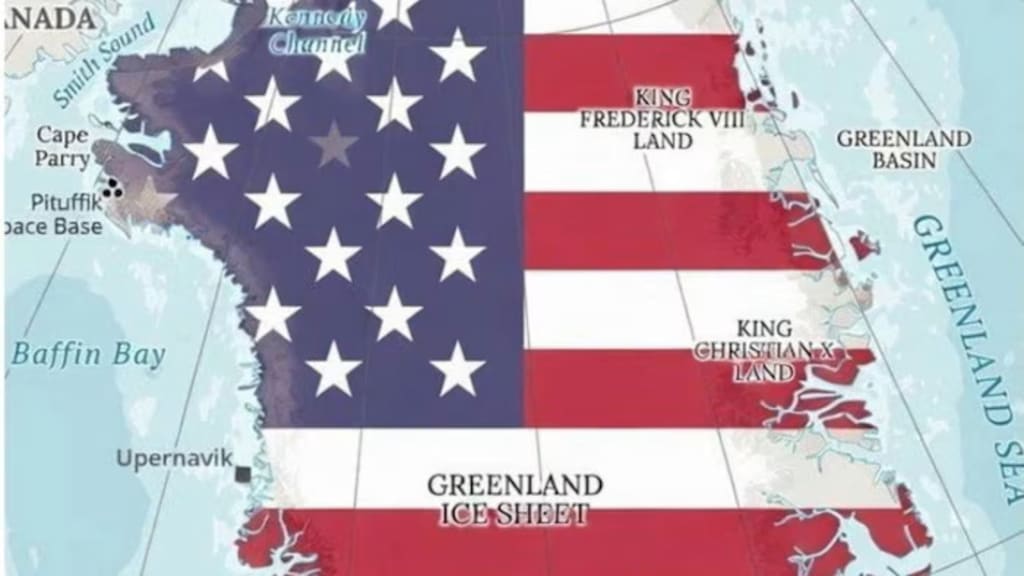
For years, Donald Trump’s comments about buying Greenland were treated as a punchline — an unserious obsession from a president known for saying unserious things.
But in Jan 2026, that joke curdled into a more coherent argument, repeated openly by senior figures in a potential Trump administration, that the United States has the right to take Greenland by force.
When asked directly whether the US could rule out taking Greenland by force, Miller argued: "Greenland should be part of the US. By what right does Denmark assert control over Greenland? The US is the real power of NATO. Nobody's going to fight the US militarily over Greenland."
This is the stated position of multiple senior officials in the current administration. Trump himself has been increasingly explicit about it. Miller's wife was making jokes about it on Twitter.
At a certain point, when people tell you exactly what they're going to do, over and over, you have to take their word for it.
I never thought I'd be writing this sentence, but I genuinely believe there's a greater than 50 percent chance the United States will attempt some form of intervention in Greenland this year.
Why Greenland, and why now?
Greenland is strategically valuable. It sits astride Arctic shipping routes that are opening rapidly due to climate change. It hosts critical US military infrastructure. It is rich in rare earth minerals. And as competition with China and Russia accelerates, the Arctic has become a central theater of 21st-century power politics.
But the argument being made is not that Greenland should be negotiated over, purchased, or brought into closer alliance. The argument is that might makes right — that because the US is the dominant military power in NATO, it can unilaterally decide the fate of a territory governed by a NATO ally.
The likelihood of this scenario increased dramatically the moment US forces entered Venezuela and detained its president. We are not at war with Venezuela. We sent troops into a sovereign nation and extracted its head of state.
There is no pretense of international consent. No effort to persuade allies. No appeal to Congress. Instead, the justification is the US can do this, therefore it may.
Why This Time Is Different
Compare this to Iraq. Whatever you think about that invasion, there was at least a pretense of process. The administration built a coalition. They went to Congress. They manufactured a justification about WMDs and sold it to the public. France opposed it, but most allies went along. There was theater, even if it was just theater.
Now, we've stripped away the coalition part. We've eliminated the Congressional approval part. We've abandoned the pretense entirely. Stephen Miller just "swags out on CNN," and says yeah, we can do it, and by the way, we have the right to do it.
The administration isn't even bothering with maybes anymore. Russia and China are national security threats. Greenland is in our sphere of influence. We deserve it. We have the right to it. These are the exact talking points you establish before an intervention.
The NATO problem
If the US takes Greenland by force, that is the end of NATO as we know it. Not a strain on the alliance. Not a diplomatic crisis. The end.
The post-World War II security architecture of the Western world has been built on the idea that liberal democracies don't invade each other's territories.
That the United States, whatever its flaws, operates within a framework of international norms when it comes to its closest allies. That framework has already been fraying. This would shatter it completely.
We would be looking at a genuine military standoff between Europe and America. Denmark is a NATO member. An attack on Denmark is, by treaty, an attack on all NATO members. The alliance would either have to respond or admit it's meaningless. There is no middle ground here.
This isn’t just about Greenland
Greenland is best understood as a test case. The same language has been used toward Cuba, Colombia, and Venezuela — places framed as existing within an American “sphere of influence.”
This reflects a broader global trend. Russia’s invasion of Ukraine, China’s posture toward Taiwan, and now American rhetoric about Greenland all point toward a world where great powers openly assert territorial claims without bothering to justify them beyond national interest.
That world is more unstable, more violent, and harder to reverse once entered.
Why I Hope I'm Wrong
I'm making a prediction here that I desperately want to be wrong about. But I can't ignore what's right in front of us.
When senior officials repeatedly state their intention to do something, when they're building the rhetorical and legal justification for it, when they've already demonstrated a willingness to violate sovereignty in other contexts, dismissing it as impossible seems foolish.
The danger isn’t that the US will wake up tomorrow and invade Greenland. It's that we're at a point where we have to seriously consider that it might happen. That alone tells us something has fundamentally changed.
The danger is that Americans — and US allies — are being slowly acclimated to the idea that international rules are optional, alliances are conditional, and force is a legitimate first resort rather than a last one.
The real question isn't whether the administration wants to take Greenland. They've told us they do. The question is whether anything will stop them.
About the Creator
Arsalan Haroon
Writer┃Speculator
Keep reading
More stories from Arsalan Haroon and writers in Journal and other communities.
What happened in Minneapolis ICE Shooting
On 7 Jan, Wednesday morning in Minneapolis, 37-year-old Renee Nicole Good dropped her six-year-old child off at school. Shortly after, federal agents in unmarked vehicles confronted her. Within moments, an agent fired three shots into her maroon SUV. Good, a mother of three and U.S. citizen, died at the scene.
By Arsalan Haroon2 months ago in Journal


Comments
There are no comments for this story
Be the first to respond and start the conversation.