
Dopamine Agonist Market Grows to $1.83 Billion Amid Rising Parkinson’s Cases – Led by Pfizer, Novartis, and Teva Pharmaceuticals | The Research Insights
North America dominates the dopamine agonist market due to the high incidence of Parkinson’s in the region, the presence of favorable reimbursement policies and drug pricing models, and the presence of multinational pharma companies.

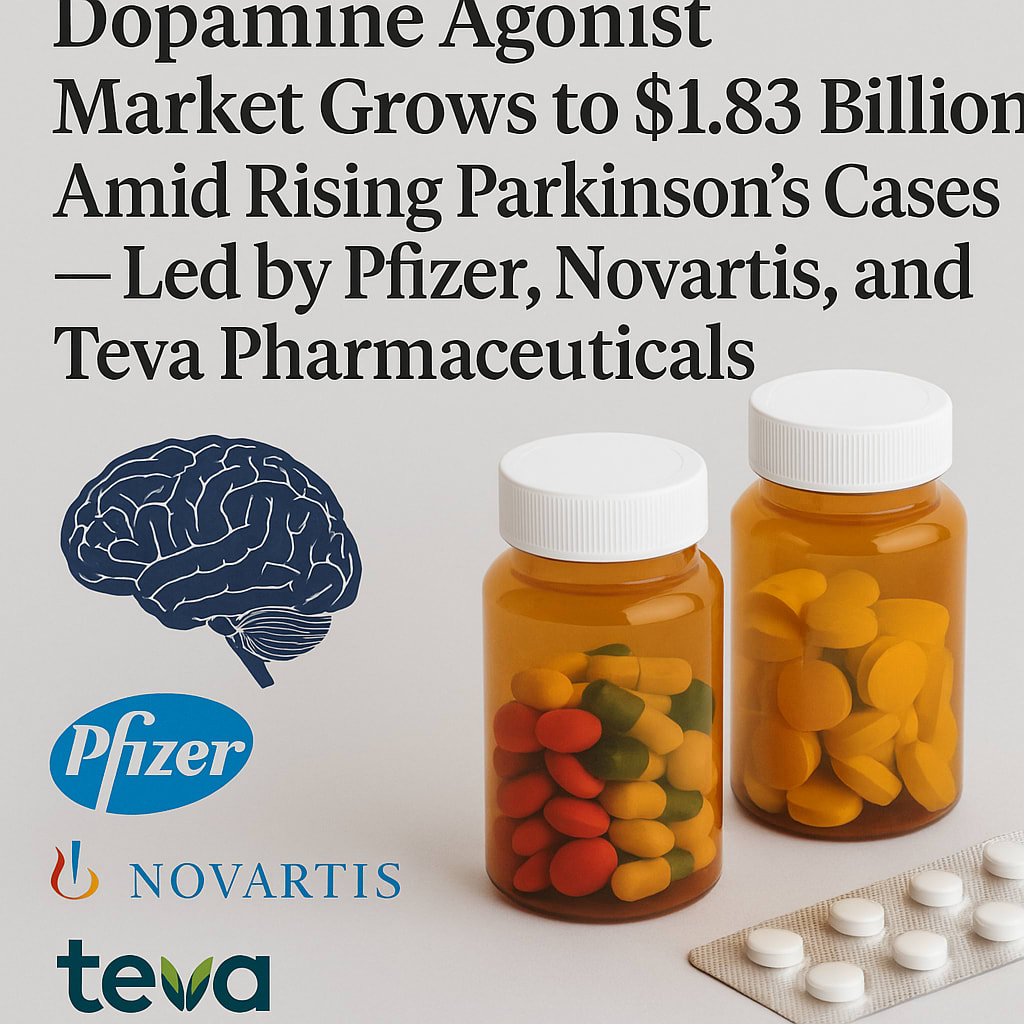
The global dopamine agonist market is anticipated to grow to 1.83 billion by 2030 with the rapid increase in Parkinson’s cases and an expanding focus on neurological care worldwide. Dopamine agonists drugs or therapies work to mimic the neurotransmitter dopamine in the brain. The medications are now used to manage restless legs syndrome, Parkinson’s disease, hyperprolactinemia, and pituitary prolactin-secreting tumors. Key manufacturers, such as Pfizer, Novartis, and Teva Pharmaceuticals, are currently focusing on R&D and modernizing distribution to improve product accessibility and therapy outcomes for patients globally.
Get Sample Pages at https://www.theresearchinsights.com/request_sample?id=66
High Parkinson’s Incidence Rates Boosting Market Demand
Parkinson’s disease (PD) is a chronic neurological condition marked by symptoms such as tremors, stiffness, and slowness of movement, and it has become a major driver of demand in the dopamine agonist market. Parkinson’s Foundation estimates that more than 10 million people are living with Parkinson’s disease worldwide. Furthermore, their incidence rate is predicted to double by 2040, primarily as a result of aging populations and better diagnosis in high-income regions.
Dopamine is a chemical that allows people to move around. Parkinson’s patients frequently suffer from dopamine depletion, which is one of the main reasons why they experience tremors and stiffness. Dopamine agonists help to decrease these symptoms by stimulating dopamine receptors directly. This lessens the body’s reliance on levodopa and reduces adverse symptoms in earlier phases of Parkinson’s disease.
As dopamine agonists imitate the effects of dopamine and have a more direct impact on receptors, many of the adverse effects of dopamine deficiency are avoided. Ropinirole, pramipexole, and rotigotine are three of the most frequent and effective dopamine agonists.
Parkinson’s disease has received a lot of attention recently. Dopamine agonists are the first or adjunct therapies used to manage dopamine deficiency symptoms. They are most often used by younger people, as they are more likely to develop long-term complications caused by levodopa usage. Dopamine agonists are now a cornerstone of PD therapy because they delay the onset of motor fluctuations.
Market by Drug Type and Drug Pipeline
The dopamine agonist market is broadly classified by drug type, indication, distribution channel, and region. In terms of drug classification, the market is segmented as follows:
- Ergoline derivatives (e.g., bromocriptine, cabergoline)
- Non-ergoline agonists (e.g., pramipexole, ropinirole, rotigotine)
While both classes of medications have been shown to be effective, non-ergoline agonists (NEAs) are the most widely used class of dopamine agonists on the market today, owing primarily to their improved side effect profile and increased tolerability across patient populations.
Parkinson’s disease, restless legs syndrome (RLS), and prolactin-secreting tumors are the main medical indications for dopamine agonist prescription and consumption.
In terms of the route of administration, dopamine agonists are available in capsule, tablet, injection, oral solution, and patch form. Distribution channels include hospital pharmacies, retail pharmacy chains, independent pharmacies, and online pharmacies.
In the dopamine agonist drug pipeline, the companies are working on:
- New delivery systems and formulations
- Improving bioavailability
In the hospital pharmacy segment, government hospitals, private hospitals, and nursing homes have the largest market share, while online pharmacies are seeing rising shares due to the convenience of digital ordering and mail-order shipment for chronic patients.
Top 5 Key Players in the Market
Leading companies are advancing the dopamine agonist market, with a particular focus on improving drug accessibility and reducing side effects. Some of the market leaders are:
Pfizer: As a leader in neurological drug development, Pfizer is driving dopamine agonist market sales via its robust R&D capabilities and distribution channels. The company is particularly focused on enhancing the bioavailability of these drugs.
Novartis: The company has made strides in identifying novel agonist combinations to treat the symptomology. Novartis is also working to offer extended-release formulations of dopamine agonists to improve patient compliance.
Teva Pharmaceuticals: Through its extensive generics manufacturing operations, Teva Pharmaceuticals is driving dopamine agonist market expansion by making these drugs more cost-effective and accessible in emerging economies.
Other notable companies include UCB Pharma, GSK, AbbVie, Sun Pharma, etc. UCB Pharma is most famous for its dopamine agonist, rotigotine, which is commercially available as a transdermal patch (Neupro) and offers a continuous drug release over three days of usage.
Market Size by Region
Europe is the second-largest market and is also driven by the high geriatric population.
Asia-Pacific, on the other hand, is a high-growth market, thanks to:
The rapidly increasing elderly population in Japan and China
Rising diagnosis rates and awareness for neurological diseases
The expanding healthcare infrastructure, government initiatives, and rising investments in India, the Middle East, and Southeast Asia.
Market Challenges and Opportunities
As is true for the majority of other pharmaceutical markets, the dopamine agonist market is not without its obstacles and issues:
The presence of side effects such as nausea, hallucinations, excessive sleepiness, weight gain, and impulse control disorders can all have an impact on patients’ adherence to their drugs.
Generics have flooded the market following the expiration of patents, driving down prices and making it more difficult for market leaders to make sales.
Drug development, such as clinical trials, can also be held up by regulatory red tape.
In terms of opportunities, the dopamine agonist market is poised to expand in areas of personalized medicine, transdermal delivery systems, and companion combination therapies that lower side effects and improve overall treatment efficacy and tolerance.
Conclusion
In sum, the dopamine agonist market is expected to reach 1.83 billion by 2030. The growing number of Parkinson’s disease cases is a major factor that is fueling demand. Dopamine agonists also have the advantage of being used to treat Parkinson’s disease and prolactin-secreting tumors. Market leaders in the space, such as Pfizer, Novartis, and Teva Pharmaceuticals, are expanding their portfolios of drugs and further innovating via R&D to improve the cost-effectiveness and delivery systems of dopamine agonists.
Restless leg syndrome and dopamine agonist-resistant cases of Parkinson’s are likely to offer considerable expansion potential in the future, as is the continued expansion of regional markets and the increasing acceptance of generics. Overall, the dopamine agonist market is expanding due to investments in R&D and a rise in Parkinson’s disease diagnosis and treatment awareness.
About the Creator
Silvie Karson
Passionate storyteller exploring the world of trends. With a background in digital marketing, I craft compelling narratives that inform and inspire. Whether diving into deep-dive features, growth analysis, or trend analysis.
Keep reading
More stories from Silvie Karson and writers in Journal and other communities.
Medical Device Clinical Trials | A $23.53 Bn Market by 2030 | How Digital Tools and Globalization Are Accelerating Device Approvals
Medtech innovation is booming, and the spotlight is now on clinical trials for medical devices. This is the crucial step where new technology moves from the prototype stage to tangible products that can save lives. In a global landscape of increasing demand for safe, effective, and connected technologies, the medical device clinical trials market is growing as well, powered by regulation, digitization, and a pipeline of new products.
By Silvie Karson7 months ago in Journal
What are the top strategies for insurance compliance management in 2026?
Many insurers still rely on fragmented processes, manual reviews, and reactive controls; approaches that create blind spots, slow response times, and expose the business to regulatory and reputational risk. At the same time, digital distribution, AI-driven decision-making, and growing volumes of customer data are reshaping how insurance products are built, sold, and serviced.
By Fusion Business Solution P Limitedabout 16 hours ago in Journal


Comments
There are no comments for this story
Be the first to respond and start the conversation.