
The Quiet War of the Machines: How AI Became the World’s New Superpower Weapon
Nations once fought with armies. Now they fight with datasets — and the most dangerous battles never make the news.
The War We Don’t See
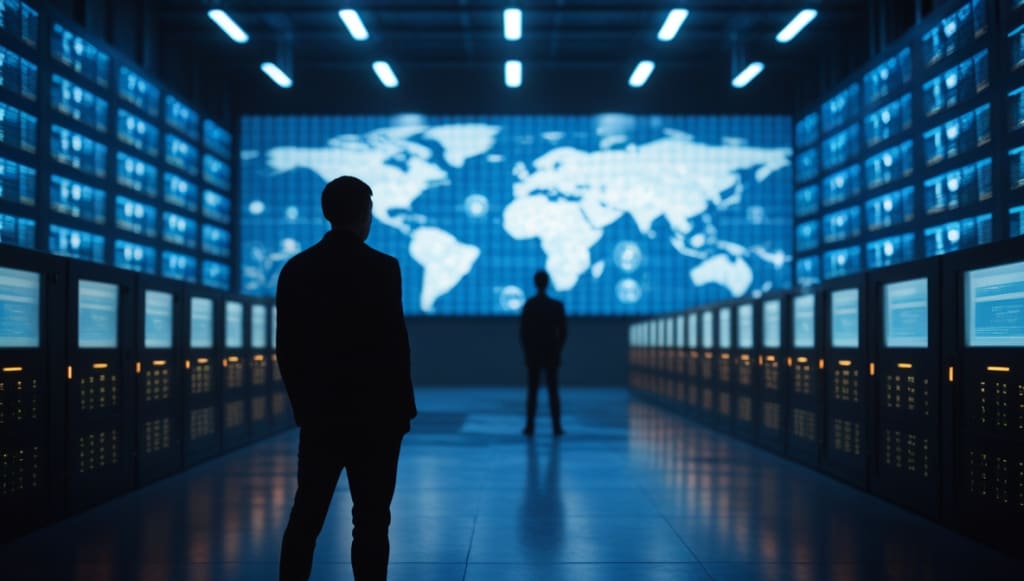
Fights were loud most of our time on Earth. These were battles carried out on terrain altered by bloodshed, explosions, and loss of life. Conversely, the most fighting currently going on goes mostly unnoticed. There is no movement of soldiers, missiles, or army vehicles. Rather, it takes place in computer centers, scientific research institutions, and intelligence groups.
Countries fight for knowledge rather than land in this global war called the Silent Technology War. But for mathematical equations, not for fossil fuels. For the ability to forecast, control, and affect events before they happen, not for weaponry.
The tools are invisible. The risks are great. Most individuals, however, are still unaware of it.
From Neural Intelligence to Nuclear Energy
Having the biggest military forces or the most nuclear weapons qualified one as a superpower in the twentieth century. However, nuclear deterrence led to a standstill, an unsteady form of equilibrium. A fresh standard for dominance that has developed in this century is artificial intelligence's potential.
AI is more than merely another tool. Acting as a force multiplier, it helps to boost a nation's intelligence capabilities, economy, military strength, and propaganda initiatives.
A country with advanced artificial intelligence has the ability to:
1. Expect opponents' behavior.
2. International conversations on shape
3. unsettling the financial markets
4. Shape the outcomes of elections
5. cease essential services
6. Analyze the opposition's tactics.
7. Control the digital space.
8. Increase the effectiveness of every battleground scene.
This is not a science fiction idea. It denotes the leading edge of contemporary international politics.
One in which nations are developing machine-learning technologies instead of enriching uranium, the globe has entered a new kind of arms race.
Data: The New Oil, The New Ammunition
Countries possessing significant coal and steel reserves developed empires during the Industrial Revolution. The digital era's most powerful influencers are those who manage data.
Artificial intelligence builds on data as its foundation.
The more data reserves a country has, the more complex its systems grow.
Intelligence shows domination in the continuing Silent War.
China's enormous population data gives it a special strategic advantage in the development of artificial intelligence. The United States stands out for its cutting-edge research, leading technology companies, and global software presence. High emphasis is given on digital ethics and governance by the European Union. Simultaneously, India, Russia, Israel, South Korea, and other countries are developing specialized artificial intelligence for use in defense and intelligence.
This goes beyond mere technological advancement.
Making it through is all it is.
The invisible battlefield
Artificial intelligence has fundamentally changed the battlefield by creating a terrain far beyond just missile targeting or troop movement administration. The new conflict zone includes:
1. Cyberfight
Carried out without shooting a single round, AI-enabled attacks can cripple financial systems, immobilize defensive networks, and compromise energy grids.
2. Psychological Manipulation
Deepfakes and artificial intelligence-produced false information might sway elections, cause public outcry, and undercut social cohesion. Public attitude can be changed by one viral video, whether actual or made up.
3. Autonomous weaponry
Drones are able to choose targets independently of human oversight. Methods of real-time examination of people Border defense robots or intelligence gathering robots.
4. Monetary Turmoil
Artificial intelligence might forecast financial patterns and trigger crashes. It may find flaws in supply networks, influence stock values, and inundate financial institutions.
This is a portrayal of conflict without clothes.
Conflict devoid of certified declarations.
Warfare is executed using algorithms rather than military troops.
The Fight for Cognitive Dominancy
The unsaid fight focuses on the AI's intellect rather than just its number.
The United States spends a lot of money on DARPA-led projects that center on autonomous intelligence. China's AI 2030 Initiative seeks to become world leaders in artificial intelligence norms. With a military orientation, Russia is aggressively engaged in cyberwarfare and artificial intelligence research.
Every country hopes to create the ideal machine:
An artificial intelligence with greater ability for real-time response, result prediction, and information processing when compared to human intellect.
In geopolitics, timing is crucial.
Artificial intelligence can alter millions of lives by detecting dangers in parts of a second.
This goes past a basic competition.
It represents a philosophic argument about the direction of the technical growth of the globe.
The Disappearance of Human Decision-Making
As artificial intelligence grows, people have less space for decision-making.
Historically, decision-makers relied on intuition, intelligence analysis, and advice. Military commanders today depend on machine forecasts. Algorithms for politicians give way to data analysis. Businesses need automatic insights.
From What should we do? The question has changed.
The algorithm suggests what?
What is the threat here?
Machines lack moral sensitivity.
Machines lack understanding of the consequences.
Machines cannot understand the worth of human life.
Rather than loss of life during the Silent War, overall system breakdown will assess errors.
why this conflict is quite hazardous
Traditional warfare follows agreed-upon conventions, treaties, and borders.
Machines' Silent War has none.
The Geneva Convention does not include artificial intelligence.
Regarding self-operating weapons, no worldwide consensus exists.
There is no legislative framework guiding algorithmic warfare.
Everything is moving too fast for diplomatic efforts to catch up.
Machines create the narrative, free of responsibility, ethics, or empathy, when people lose command of it.
This silent threat is present in all countries.
The Future of Power
Not the one with military bases or nuclear weapons, but rather the one with the following qualities will be the leading superpower in the future:
1. The most extensive databases
2. AI technology that is most developed
3. The quickest computing systems
4. The most secure cyber defense
5. Artificial intelligence is the most perfect.
And maybe the most vital thing is that
The public's faith in actual events.
Not a missile will be the strongest weapon in the war era of the future.
It will be capable of altering reality itself.
One Conflict We Have to Know Before It's Too Late
This fight isn't in the cards.
It is already here.
Every search, click, and scroll enhances a computer user's experience.
Every online activity helps to build a country's intelligence network.
Every piece of content serves as ammunition for the invisible digital battlesgrounds.
Even if you don't hear explosions, the results are yet terrible.
The silent war of the machines will shape the rest of this century.
The important issue is not whether nations would thrive or fail.
Only if mankind can keep control over the technology it has invented, though.
About the Creator
Keep reading
More stories from Shahjahan Kabir Khan and writers in Journal and other communities.
The Minerals That Built America—And the Strategic Mistake That Gave Them Away
For a long stretch of modern history, the United States held something most superpowers could only envy: near-total control over the essential minerals that make our 21st-century world function. From the iPhone screens we tap to the F-35 jets that dominate the skies, America once sat at the center of the supply chain that powered everything.
By Shahjahan Kabir Khan2 months ago in Journal
The goals I did not achieve
Every writing goal I made for the year is a wash. It has been this way for a while, but I think it's important to be open about my failures and the reality of how life can get in the way. This is especially true considering the several times I have posted on Vocal about my writing goals, how I was changing my approach, and where I was hoping to be for the upcoming year. I will probably do that again in a couple months, but for now, it is time to acknowledge where I am today.
By Kay Husnick24 days ago in Journal
The Eucharist: Why Catholics Believe in the Real Presence
The Eucharist is the center of Catholic life and worship. At Mass, Catholics receive the Body and Blood of Christ under the forms of bread and wine, a belief that sets Catholicism apart from many other Christian traditions. This doctrine, known as the Real Presence, teaches that Jesus Christ is truly present in the Eucharist, not symbolically or metaphorically, but in reality. Understanding why Catholics believe this and how it impacts their lives can deepen appreciation for this sacred sacrament.
By Sound and Spirit6 days ago in Journal


Comments
There are no comments for this story
Be the first to respond and start the conversation.