
The Minerals That Built America—And the Strategic Mistake That Gave Them Away
How the U.S. surrendered control of the metals behind smartphones, fighter jets, and clean energy—and why the race to rebuild has become a national emergency.
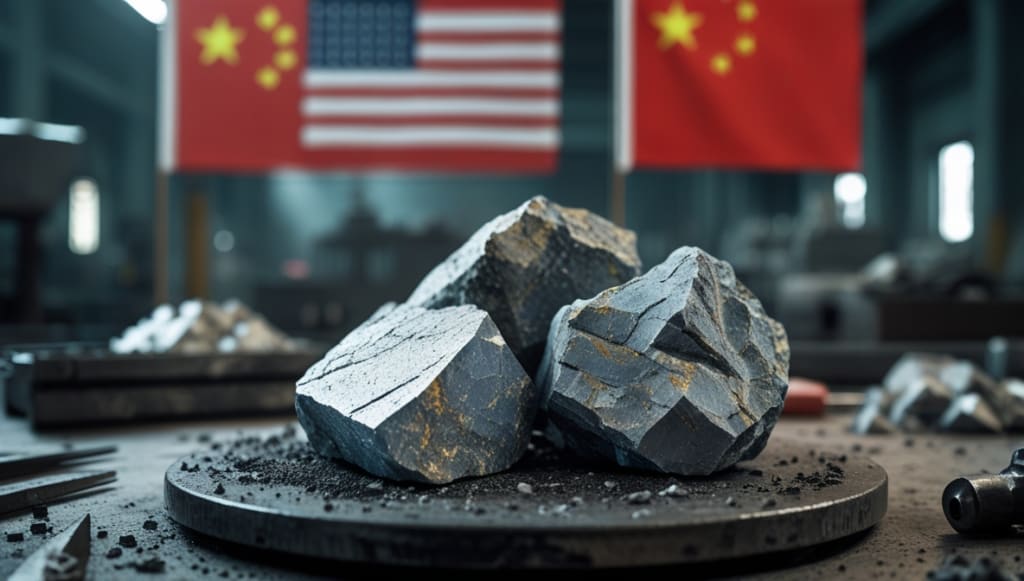
For a long stretch of modern history, the United States held something most superpowers could only envy: near-total control over the essential minerals that make our 21st-century world function. From the iPhone screens we tap to the F-35 jets that dominate the skies, America once sat at the center of the supply chain that powered everything.
And then, almost quietly, we gave it away.
Not in a single catastrophic decision, but through a series of small, shortsighted choices that spanned decades. Choices rooted in convenience, cost-cutting, and the comforting illusion that globalization promised endless stability. The result was a strategic blunder so deep that the richest, most technologically advanced nation in history now finds itself dependent on its biggest geopolitical rival for minerals it once controlled.
This is the story of how the U.S. lost the rare earth race—and why the country is now scrambling to undo a mistake that could define the next century.
The Elements That Power Modern Life
“Rare Earth Elements” is a misleading name. These 17 metals are not particularly scarce, but they are extraordinarily valuable. Their magic lies in their unique magnetic and optical properties:
• The colors on your smartphone screen exist because of them.
• Electric vehicle motors rely on magnets built from them.
• Wind turbines, fiber optic cables, MRI machines—all require rare earths.
But their significance extends far beyond consumer gadgets.
They are the backbone of modern military power.
An F-35 fighter jet—one of the most advanced aircraft ever built—requires nearly half a ton of rare earth materials. Precision-guided missiles, submarine sonar, long-range radar: none can function without these elements. If the supply were disrupted, America’s technological military edge would collapse almost instantly.
That vulnerability is the foundation of today’s crisis.
China’s Quiet, Calculated Takeover
China now mines about 70 percent of the world’s rare earth ores. But mining was never the real goal. Processing—turning raw ore into usable, purified elements—is where true power lies. China controls around 90 percent of that global capacity.
By comparison, the United States has almost none.
The absurdity becomes clearer when you look at America’s only major rare earth mine, Mountain Pass in California. For years, the U.S. extracted ore from its own soil—only to ship it to China for processing. By the mid-2000s, roughly 70 percent of America’s rare earth materials were mined on U.S. land but processed in China and then imported back.
This wasn’t just dependence. It was surrender.
What makes it worse is that America once dominated this industry. Throughout the 20th century, Mountain Pass was the world’s leading rare earth supplier. The U.S. had the minerals, the scientists, the engineers, and the refining technology.
So how did the pioneer of rare earths fall so far behind?
The Fall: Complacency vs. Strategy
In the 1980s and 1990s, American complacency collided with China’s long-term strategic vision. Chinese leader Deng Xiaoping made the country’s intentions clear in 1992:
“The Middle East has oil; China has rare earths.”
China began subsidizing mining, cutting prices, and building processing plants. Their approach was not driven by profit—it was driven by power. American companies, tied to market economics, could not compete with China’s state-supported pricing. Buying Chinese rare earths became cheaper than producing them at home.
At the same time, processing these elements created toxic waste—radioactive slurry and acid byproducts. As U.S. environmental regulations tightened, costs soared. Instead of innovating cleaner methods, America outsourced the “dirty work” to China.
By the late 1990s, Mountain Pass shut down its processing facilities. America didn’t just step back; it dismantled an entire industrial ecosystem. Scientists retired. Engineers changed fields. The knowledge—perhaps even more valuable than the minerals—evaporated.
Meanwhile, China consolidated hundreds of small mines, nationalized the industry, and invested billions in refining technology. By the 2010s, its dominance was absolute.
And then it began using that dominance as leverage.
The Moment the World Woke Up
In 2010, during a dispute with Japan, China abruptly halted rare earth exports. The tech world panicked. Automakers panicked. Governments panicked.
The message was clear: China’s dominance was not just economic—it was geopolitical.
But Beijing was only beginning. In 2023, China banned the export of advanced rare earth processing and magnet-making technologies. The ladder it had climbed for three decades was pulled up behind it.
For the United States, the alarm bells were deafening.
America’s Race to Catch Up
By 2025, the U.S. no longer had the luxury of ignoring experts. China tightened export licenses again—this time affecting not just minerals but magnets and even parts made with Chinese rare earths. It amounted to an economic blockade.
Washington finally acted.
The Pentagon launched a sweeping Mine-to-Magnet strategy, investing heavily to restore the supply chain:
• $400 million investment in MP Materials (Mountain Pass), becoming the company’s largest shareholder.
• $35 million in loans to rebuild heavy rare earth processing.
• A 10-year contract to buy magnets from MP’s new plant in Texas.
• $620 million in federal grants and $40 million in loans to launch Vulcan Elements, a new magnet manufacturer.
• $80 million for ReElement Technologies to expand processing.
• USA Rare Earth developing a major Texas deposit and building a factory in Oklahoma.
These are massive moves—the largest rare earth investments in American history.
By the end of 2025, MP Materials expects to deliver the first U.S.-made magnets in decades. General Motors will be its first major customer.
But the scale of the challenge remains enormous. Even after all these investments, the U.S. will still produce less than one percent of China’s processing output. Rebuilding what was lost may take a decade or more.
This is not just an industrial race. It is a race against time.
The Road Ahead
America’s renewed push is promising. But it is also fragile. Deals must be renewed annually. Supply interruptions remain a real threat. And China still holds the most powerful piece of the supply chain.
This moment is not victory—it is a breathing space.
The story of rare earths is ultimately the story of how a superpower underestimated the geopolitical value of its own resources—and how its rival recognized that value with absolute clarity.
Now, the United States faces a defining question:
Is this the beginning of a new era of American industrial vision?
Or a desperate attempt to fix a mistake decades too late?
Share your thoughts in the comments below.
About the Creator
Keep reading
More stories from Shahjahan Kabir Khan and writers in Journal and other communities.
The Age of Synthetic Reality: When Real and Fake Become Impossible to Tell Apart
The Disappearing Border Between Real and Fake We relied on what was actually not too long ago. Images offered proof. Verification came from movies. Certainly the sounds were clear. We accepted something as fact when we saw it firsthand. That faith is, however, fading nowadays.
By Shahjahan Kabir Khan2 months ago in Journal
The goals I did not achieve
Every writing goal I made for the year is a wash. It has been this way for a while, but I think it's important to be open about my failures and the reality of how life can get in the way. This is especially true considering the several times I have posted on Vocal about my writing goals, how I was changing my approach, and where I was hoping to be for the upcoming year. I will probably do that again in a couple months, but for now, it is time to acknowledge where I am today.
By Kay Husnick23 days ago in Journal
How to Begin a Relationship with Jesus
A Step-by-Step Guide to Faith, Presence, and Transformation in Everyday Life Step 1: Find a quiet space Begin in a place where you can notice yourself. This could be a room, a park, or the space between heartbeats. The quiet is not about absence of sound but about presence of attention. Bring no agenda, only awareness. The first step is to show up.
By Sound and Spirita day ago in Journal




Comments
There are no comments for this story
Be the first to respond and start the conversation.