
The Only War Which Gave Best Development to the World
How the Fierce Rivalry Between Nikola Tesla and Thomas Edison Sparked the Technological Revolution That Powers Our Modern World

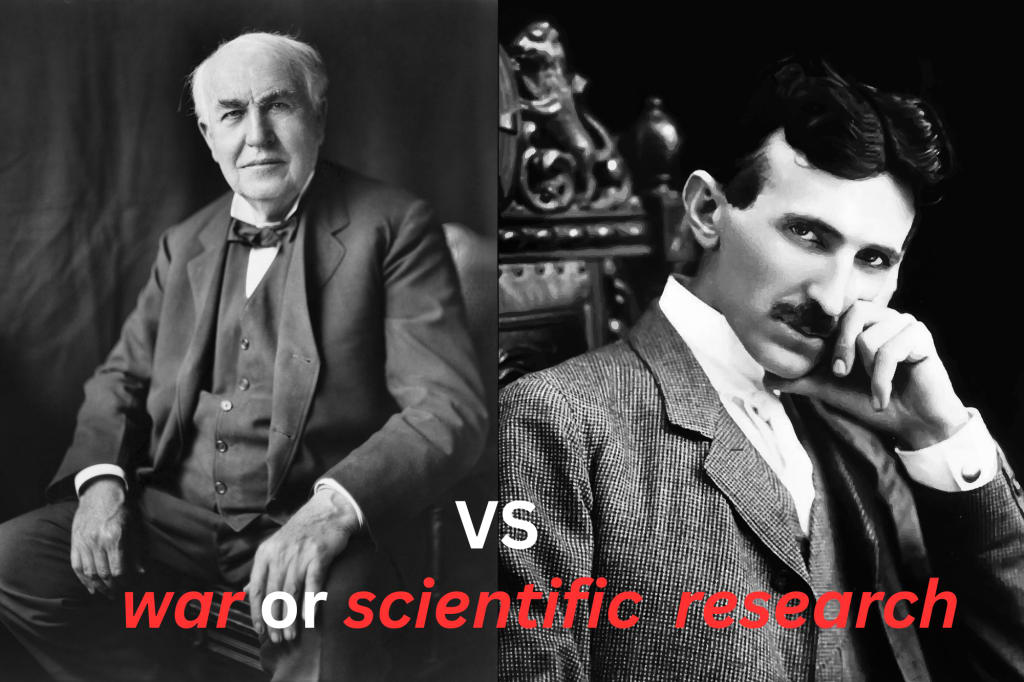
In the chronicles of human innovation, few rivalries have been as electrifying—literally and figuratively—as that of Nikola Tesla and Thomas Edison. Their clash was not a war fought with weapons or armies, but with ideas, inventions, and an insatiable drive to power the world. It was a war of vision—one that birthed some of the most transformative technologies of the modern age. Though their methods, motives, and morals were vastly different, both men left behind a legacy that continues to shape our world. If history ever had a war that resulted in immense development rather than destruction, this was it.
The Battle of Currents: AC vs DC
At the heart of the Tesla-Edison rivalry was what came to be known as the War of Currents—a scientific and commercial battle over which electrical system would power the modern world.
Thomas Edison, the already-famous inventor of the light bulb and phonograph, championed Direct Current (DC). It was simple, stable, and worked well over short distances. He had the backing of powerful investors, a booming company (General Electric), and a reputation for turning ideas into practical inventions.
Enter Nikola Tesla, a Serbian-born inventor and visionary with a mind that danced ahead of his time. He advocated for Alternating Current (AC)—a system that could transmit electricity over vast distances with far less loss of power. Though Tesla initially worked for Edison, their relationship soured due to fundamental differences in vision, ethics, and respect.
With backing from industrialist George Westinghouse, Tesla’s AC system gained momentum. The War of Currents became fierce: Edison waged a smear campaign, demonstrating that AC was dangerous by electrocuting animals in public. But science eventually won—AC proved more efficient, and it became the standard for power transmission across the globe.
The Inventor vs. The Visionary
Edison was the epitome of the practical inventor. He once famously said, “Genius is one percent inspiration and ninety-nine percent perspiration.” He built laboratories, hired skilled workers, and patented over 1,000 inventions. He was driven by commerce and control—he wanted to be the name on every household product.
Tesla, in contrast, was a dreamer who envisioned wireless energy, limitless power, and machines that tapped into the very energy of the universe. He saw technology not just as a business, but as a bridge to a more enlightened world. Unfortunately, Tesla was a poor businessman, often taken advantage of and forgotten in his later years. He died alone in a New York hotel room, while Edison died a wealthy titan of industry.
But today, the story is changing.
Technologies Born from the Rivalry
This "war" between Edison and Tesla sparked a golden era of invention. Here are just a few examples of how their conflict birthed world-changing advancements:
Electric Power Systems: Thanks to Tesla’s AC system, we have the power grids that light up our cities and homes.
Electric Motors and Transformers: Tesla’s work laid the groundwork for every electric motor that runs in our appliances and factories.
X-Rays and Radio Waves: Tesla’s experiments in high-frequency electricity were foundational for later breakthroughs in radio, radar, and even X-ray imaging.
Mass Production and Patents: Edison’s business model became a blueprint for industrial innovation, emphasizing mass production and commercial viability.
Their competition created a crucible in which innovation thrived. Rather than stalling each other, their rivalry forced each man to push the boundaries of possibility.
A Legacy of Progress
Today, the names Tesla and Edison are etched into the bedrock of science and technology.
Tesla has become a symbol of genius unrecognized in its time. Elon Musk’s electric car company proudly bears his name—Tesla, Inc.—as a tribute to the man who dreamed of a world powered by clean, boundless energy.
Edison, too, remains a towering figure. His inventions—like the phonograph, motion picture camera, and practical electric light—transformed how we live, communicate, and entertain ourselves.
But perhaps the greatest legacy of their battle is not just the inventions themselves, but the idea that rivalry can drive progress. In competing for the future, they helped build it.
The War That Never Truly Ended
In many ways, the Tesla vs. Edison conflict lives on today in debates about innovation: open-source vs. proprietary software, sustainability vs. profitability, vision vs. execution. Tesla represents the dreamer in all of us—the one who sees the invisible. Edison represents the doer—the one who turns vision into reality.
We need both.
Without Tesla, the dream would be too far away to reach. Without Edison, it might never leave the drawing board.
Conclusion: From War to Wonder
In a world filled with destructive conflicts, the "war" between Tesla and Edison stands out as one that gave the world more than it took away. It gave us electricity, engineering marvels, a lesson in ethics, and an enduring story of two men who shaped the 20th century—and beyond.
So, the next time you flip a light switch, stream music, or charge your phone, remember: it’s not just electricity flowing through those wires—it’s the legacy of a battle that lit up the world.
About the Creator
Doctor Strange
Publisher and storyteller on Vocal Media, sharing stories that inspire, provoke thought, and connect with readers on a deeper level
Keep reading
More stories from Doctor Strange and writers in Journal and other communities.
Ego: Your Greatest Ally or Silent Enemy? The Truth About Self-Sabotage and Growth
The word ego carries heavy baggage. For some, it’s the voice that pushes us toward greatness. For others, it’s the inner saboteur that causes relationships to fall apart, careers to stagnate, and peace to vanish. So which is it? Is ego our friend — the motivator, protector, and confidence-builder? Or is it our enemy — the deceiver, divider, and destroyer?
By Doctor Strange10 months ago in Journal
The Couple We All Watched Grow Up
I didn’t know them. But I felt like I did. For over a decade, they were part of my life—not as celebrities, but as characters in a story I watched unfold in real time. I saw them at seventeen, awkward and bright-eyed on red carpets, fumbling through interviews, hiding smiles behind their hands. I saw them navigate fame, heartbreak, and the slow, steady work of becoming adults—all while the world watched, judged, and claimed ownership of their journey.
By KAMRAN AHMAD5 days ago in Journal




Comments
There are no comments for this story
Be the first to respond and start the conversation.