
Ego: Your Greatest Ally or Silent Enemy? The Truth About Self-Sabotage and Growth
Understanding Ego: The Dual Nature of Self A deep dive into what ego is and how it influences our thoughts, actions, and decisions.

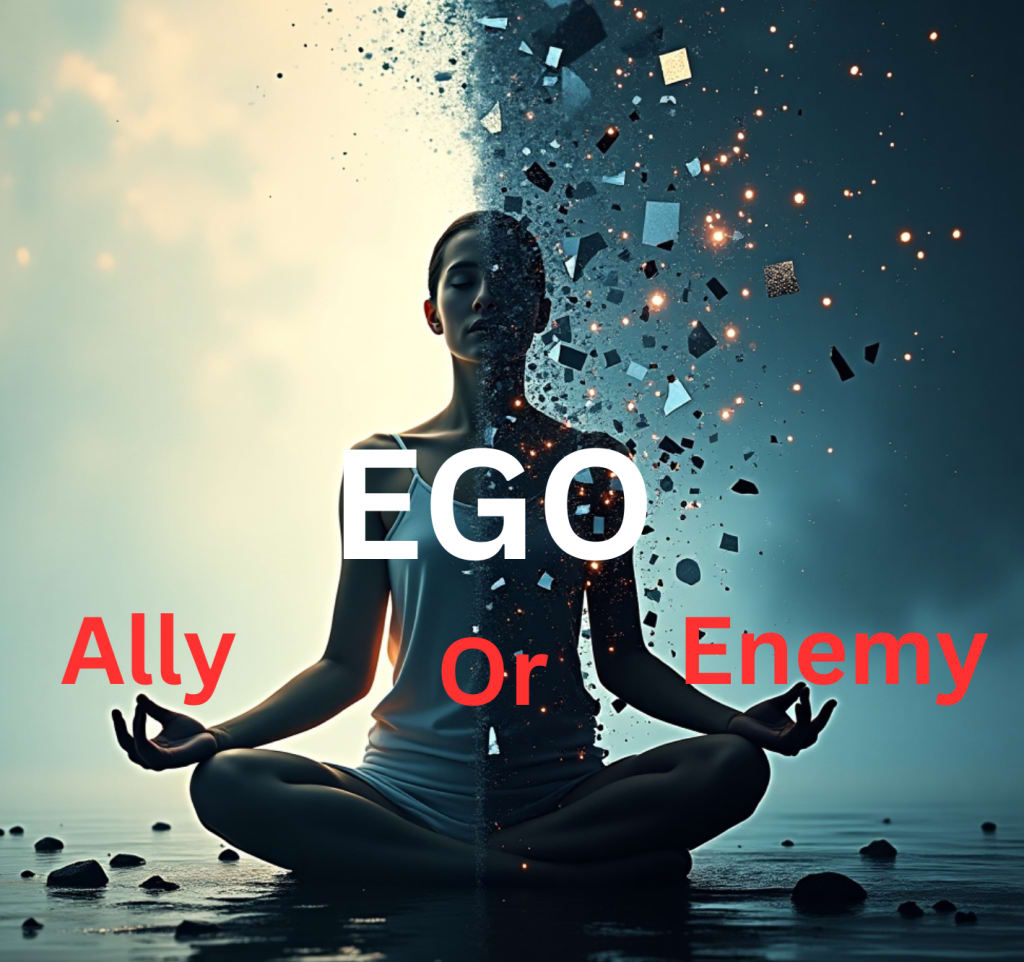
The word ego carries heavy baggage. For some, it’s the voice that pushes us toward greatness. For others, it’s the inner saboteur that causes relationships to fall apart, careers to stagnate, and peace to vanish. So which is it? Is ego our friend — the motivator, protector, and confidence-builder? Or is it our enemy — the deceiver, divider, and destroyer?
The answer, like most things in life, isn’t black and white. Ego is both. And our ability to understand, manage, and occasionally silence it might be the key to unlocking a healthier, more grounded version of ourselves.
🔍 What Is the Ego, Really?
At its core, ego is our sense of self — our identity. The word comes from Latin, meaning simply “I.” In psychology, especially in Freud’s model, the ego is the mediator between our primal desires (id) and our moral compass (superego). It helps us function in the real world.
But outside academic definitions, “ego” often refers to inflated self-importance — the part of us that seeks validation, control, superiority, and safety through status or external approval.
This dual nature of ego — as both self and self-deception — is what makes it so complicated.
🧠 When Ego Is a Friend
Despite its bad reputation, ego isn't all bad. In fact, in many situations, ego is what keeps us going.
1. Confidence in Crisis
When you're standing on a stage, walking into an interview, or launching a business, it's the ego that whispers, "You can do this." Without that self-belief, rooted in ego, we might never take the leap.
2. Protection from Abuse
Ego also serves as a boundary builder. If someone mistreats us, ego can provide the inner voice that says, “You deserve better.” It shields us from being perpetual doormats and reminds us of our worth.
3. Motivation to Improve
The ego often pushes us to improve ourselves — to gain skills, work hard, and reach for goals. Ambition and drive, when channeled with humility, are not toxic — they are tools for growth.
🔥 When Ego Becomes the Enemy
Ego becomes dangerous when it stops us from growing, loving, or seeing clearly.
1. It Craves Control
Ego hates uncertainty. It clings to being right, being dominant, being in control. In doing so, it resists change and rejects any ideas or people that challenge its narrative.
Ever notice how hard it is to admit you're wrong in an argument? That’s ego, fighting for its life.
2. It Fears Vulnerability
True connection — with others or ourselves — requires vulnerability. But ego is terrified of being seen as weak. So it wears masks: arrogance, sarcasm, detachment. These might protect us from judgment, but they also isolate us.
3. It Seeks Validation
One of ego’s favorite addictions is external validation. Whether it's likes on social media, praise from a boss, or admiration from peers, ego craves attention. The problem? This leads to a fragile identity that rises and falls with others’ opinions.
As Ryan Holiday wrote in his bestselling book Ego Is the Enemy:
“Ego is the enemy of what you want and of what you have: of mastering a craft, of real creative insight, of working well with others, of building loyalty and support.”
🧘♂ Ego and Spirituality: Dissolving the Illusion
Many spiritual traditions — from Buddhism to Stoicism — see ego not as a friend, but as an illusion to be transcended.
Buddhism teaches that ego is the source of suffering because it creates a false sense of separation from others and from reality.
Stoic philosophy reminds us that fame, status, and personal identity are fragile. As Marcus Aurelius said, “You are a soul carrying a corpse.”
In meditation, we practice becoming the observer of our thoughts — stepping outside the ego’s constant narrative to glimpse something deeper.
The more we observe our ego instead of identifying with it, the more freedom we gain.
🧭 So, Is Ego a Friend or an Enemy?
The real answer is: It depends on who's in charge.
If we let ego drive the car, it takes us to places like jealousy, rage, pride, and delusion. But if we let ego sit in the passenger seat, it can provide useful maps, fuel, and motivation — without taking over the wheel.
Ego is a tool. Like fire, it can warm or destroy. Like a knife, it can heal (as in surgery) or harm. It's neither good nor evil — it's how we use it that matters.
🛠 5 Ways to Keep Ego in Check
1. Practice Humility
Stay curious. Be open to feedback. Remember that you’re always a student, never the finished product.
2. Embrace Failure
Ego fears failure because it sees it as proof of unworthiness. But failure is just feedback. It's growth in disguise.
3. Detach from Outcomes
Work hard, but don’t tie your self-worth to the results. Whether you succeed or fail, you remain whole.
4. Spend Time in Silence
Solitude and meditation allow us to hear the voice underneath ego — the deeper self that doesn’t need applause.
5. Serve Others
Ego is self-centered. Service is other-centered. When we help others without expecting anything in return, ego loosens its grip.
💬 Final Thoughts: The Inner Balance
We all have an ego. The goal isn't to kill it — it's to understand it, to use it without being used by it. There are times when ego gives us strength. There are times when it leads us astray. The trick is knowing the difference.
So, is ego your friend or your enemy?
It’s both.
But with awareness, discipline, and humility — you can be the master of it, not the servant.
If this article resonated with you, share it with someone who's navigating their own battle with ego. Let’s grow — not just louder, but deeper.
About the Creator
Doctor Strange
Publisher and storyteller on Vocal Media, sharing stories that inspire, provoke thought, and connect with readers on a deeper level
Keep reading
More stories from Doctor Strange and writers in Journal and other communities.
The most avoided topic in asia
Masturbation is a topic often shrouded in myths, misconceptions, and taboos. One persistent claim is that it causes infertility—a fear that has lingered in cultural narratives for generations. But what does science actually say? Spoiler alert: the idea that masturbation leads to infertility is a myth with no credible evidence. Let’s dive into the facts, bust some myths, and explore why this topic deserves a clear, shame-free discussion.
By Doctor Strange10 months ago in Journal
Author’s Advice
If you would’ve asked me 20 years ago did I know I’d become a writer and an author, I would’ve said “nope, ain’t happening”. As fate would have it I did become an author and I can honestly say I’m loving it so far. It really does feel good to be a writer. I’ve learned a lot on this journey and I feel like with even me being as new to this world as I am, there’s some wisdom I need to share with every other aspiring author.
By Joe Patterson5 days ago in Journal
How Much Does It Cost to Start a Rehab Center and Get Licensed
Introduction to the Cost of Starting a Rehab Center The addiction treatment industry has evolved into a highly structured healthcare sector requiring significant capital, regulatory compliance, and operational planning. Establishing a rehabilitation center involves more than leasing a building and hiring counselors. It requires adherence to healthcare regulations, clinical staffing standards, and licensing requirements designed to ensure patient safety and effective treatment outcomes. The financial commitment can vary dramatically depending on the scale of services offered, the type of facility, and the regulatory environment in which the center operates. Some small outpatient programs may begin with modest budgets, while comprehensive residential treatment facilities can require multimillion-dollar investments. Understanding these cost components is essential for entrepreneurs, healthcare investors, and nonprofit organizations seeking to enter the behavioral health field.
By Fida Hassainabout 2 hours ago in Journal
My First Time Skiing and I Got Lost, Alone, in the French Alps
Looking back, I can trace some of my life’s biggest adventures to a simple action from my sister. She’d introduced me to Tommy (a very long time ago), a colleague of hers, who had overshared his penchant for Italian-looking women, and I ticked that box.
By Chantal Christie Weiss3 days ago in Humans




Comments
There are no comments for this story
Be the first to respond and start the conversation.