
The Mount of Olives: Where Ancient Prophecy Meets Today’s Jerusalem
How the world’s most famous hillside—and its growing cemetery—points to promises yet to be fulfilled
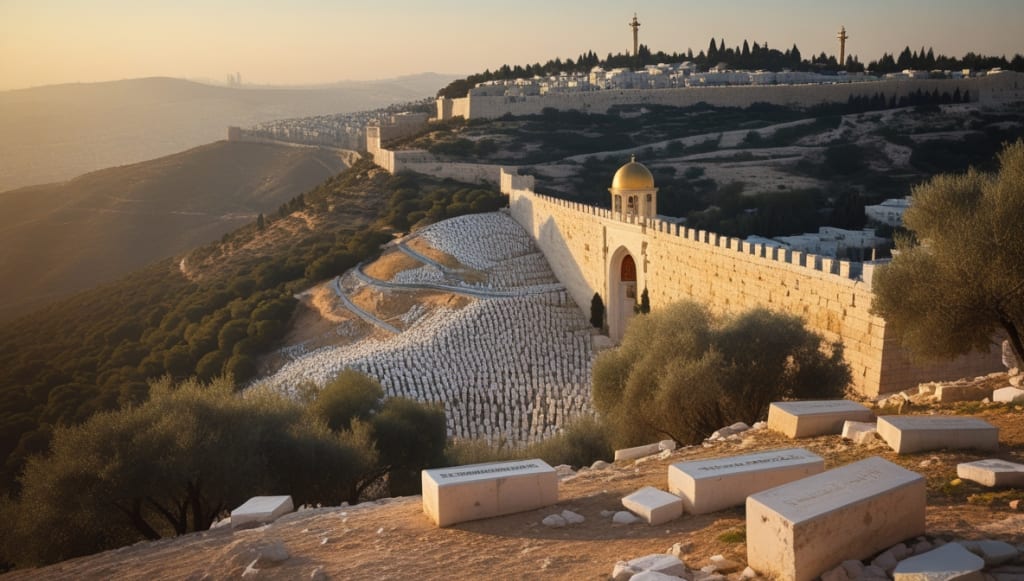
Among the most spiritually important locations in the world is the Mount of Olives. More than just a scenic viewpoint set amid olive trees, this ridge lies directly east of Jerusalem's ancient city. It serves as a strong reminder of millennia of belief, anticipation, and prophecy. Every stone, every grave, every path contains the expectancy of what will be in the future as well as biblical stories.
A Mountain Entwined with the Old Testament
In the Hebrew Scriptures, the Mount of Olives is very important for Israel's story. King David crossed this ridge grieving as he ran away from Absalom, his son (2 Samuel 15:30). Ezekiel 11:23 says the prophet Ezekiel saw the Lord's glory leave the temple and descend on this mountain. Most notably, the prophet Zechariah foretold a day when the Messiah would walk upon the Mount of Olives, thereby causing the mountain to fracture and form a great canyon (Zechariah 14:4). This description is not only metaphorical; it portrays the height of history, when God's dominion overwhelms the earth.
An Important Turning Point in Jesus's Life
Against the setting of the Mount of Olives also occur many major events recorded in the New Testament. Jesus instructed his disciples about the end of the world in the Olivet Discourse, as recorded in Matthew 24, Mark 13, and Luke 21. From the mountaintop, he prayed, surveyed Jerusalem, and wept over its impending devastation (Luke 19:41), before finally ascending to heaven from its heights (Acts 1:9–12). The angels there said at that exact second he would come back the same way he had gone up. Christians link the Mount of Olives to the Second Coming of Christ right away. It is thought Jesus left from the place prophesy claims he would return.
The Eastern Gate and Its Unopened Promise
The Kidron Valley, often known as under the Mount of Olives, runs up to the eastern wall of Jerusalem and the enshrined Eastern Gate. called the Golden Gate. According to Ezekiel 44:1–2, this entrance will remain closed until the prince, the Messiah, crosses it. With stones, it still today remains very closed off, providing a spectacular view for both believers and historians. Muslim officials created a cemetery in front of it centuries ago, thinking it would impede the arrival of the Jewish Messiah. But for those who trust God's promises, neither graves nor stones can stop the King of Kings' arrival. Anticipating the day it will be opened, the sealed Eastern Gate is a silent sentinel.
The Most Ancient Active Jewish Burial Ground
With more than 150,000 graves strewn down its hills, the Mount of Olives also houses the largest Jewish cemetery currently known. Jewish families have buried their loved ones here for more than three millennia, facing toward Jerusalem and the Temple Mount while hoping for the arrival of the Messiah. Jewish traditions hold that here will be the first resurrection of the dead when the Messiah comes. Being buried on the Mount of Olives is regarded as a great honor, comparable with being at the front of the line for resurrection, because of this belief.
New graves have started to stretch farther down the slopes toward the sealed Eastern Gate and Old City walls in recent years as the cemetery has grown. This could seem like standard urban planning to individuals not knowledgeable of the background. For anyone familiar with prophecy, though, it has great symbolic value: thousands of freshly dug graves set as though waiting for the trumpet to announce the resurrection.
A Shared Vision Among Christians and Jews
For the Jewish community, this enormous cemetery represents the expectation of the Messiah and the revival of the virtuous. Christians see in it the certainty guaranteed in 1 Thessalonians 4:16: "For the Lord Himself will come down from heaven... and the dead in Christ will rise first." Christians also see the Mount of Olives stretching toward the Eastern Gate and understand that death cannot stop the arrival of the approaching King.
Prophecy in Real Places
Currently, the world is once again centered on Jerusalem. The Bible says that in the end times all countries will congregate against Jerusalem (Zechariah 12:2–3). Nevertheless, the same scriptures give hope when the Messiah comes. Every new burial on the Mount of Olives proves this expectancy. Every Eastern Gate rock suggests rebirth. Every angle of the closed gate reminds us, too, that it is expecting the King of Glory.
Livelihood in expectation
Matthew 24:36: Jesus cautioned his disciples against speculating about when he would return. Still, he told us to stay attentive and prepare (Luke 12:40). This command is powerfully reminded by the Mount of Olives. This is not only symbols or mythology; it's a genuine mountain with actual graves that faces a genuine gate in a genuine city. Prophecy is unfolding before our eyes right now; it is not an old tale limited to historical writings.
A Message Penned in Stone
We are watching an active expression nowadays as we stand on the Mount of Olives, not only tourists marveling at a historic scene. of faith. Though they are silent, the graves loudly proclaim the promise of resurrection. Though the Eastern Gate is still closed, it Psalm 24:7 reads, Lift. You gates, raise your heads; you old doors, be lifted up—that heralds a future opening for the King of Glory, who could come in.
This embodies the hope of Israel, the hope of the church, and the hope of everyone who believes in Jesus Christ. Whether one visits the Mount of Olives as a pilgrim, a scholar, or just as a casual observer, the message is clear: God's promises still hold. From David to Ezekiel, Zechariah to Jesus, from the first burial on this hill to the last one resting in our day, they reach.
A Call to Readiness
The question is about our preparedness rather than just whether Jesus is about returning. Along with its ever expanding cemetery, the Mount of Olives invites us to keep a vigilant belief, not out of fear but from a place of joyful expectation. It invites us to align our lives with the reality that history is heading towards a major conclusion. One day, the same Jesus who left this mountain will come once more and set his feet upon it. The king will return exactly as the messengers said.
Final Thought
More than only a geographical location, the Mount of Olives stands for many things. It provides a prophetic background for the biggest event mankind will ever witness. We are reminded as the burial site draws closer to the Eastern Gate that heavenly guarantees are grounded in place and time, not only ideas. The elevation is not changing. The doorway is still unaffected. The tombs are waiting. We too, with elevated spirits expecting something.
About the Creator
Keep reading
More stories from Shahjahan Kabir Khan and writers in Journal and other communities.
🚀 3i Atlas: The Interstellar Visitor That Shouldn’t Exist
A Routine Observation Turns Uncanny Astronomy thrives on routine. Astronomers spend nights staring at flickering dots, logging orbital data, and refining models. Comets and asteroids mostly behave the way textbooks say they should. But in this imagined scenario, routine observation gave way to something unprecedented.
By Shahjahan Kabir Khan4 months ago in Journal
The Evolution of Aerospace Connectors From Analog to Digital
The aerospace industry has undergone a remarkable transformation over the past few decades, driven by a relentless pursuit of efficiency, reliability, and innovation. One of the unsung heroes of this revolution is the humble aerospace connector a component so small yet essential to the safe and seamless operation of modern aircraft. From the early days of aviation to today’s digital, highly automated aircraft, aerospace connectors have evolved significantly. Let’s take a journey through this evolution, exploring how they’ve progressed from analog simplicity to the sophisticated digital systems that power today’s aircraft.
By Beckett Dowhan4 days ago in Journal
Wild Card Weekend Recap: What Happens Now?
I think I figured out why I love Wild Card Weekend so much. It's because it's the first playoff anything of the calendar year. The NFL season starts in the fall, and once upon a time, the champion was crowned either on or slightly before New Year's. The evolution of the NFL schedule has resulted in the playoffs starting just into the New Year, and currently, the final week of the season falls on the first weekend of the New Year, with Wild Card Weekend coming a week after that. So yes, chronologically, the NFL's Wild Card Weekend serves as the first playoff anything of the calendar year.
By Clyde E. Dawkins6 days ago in Unbalanced




Comments (1)
This is powerful and beautifully written. It captures both the weight of prophecy and the tenderness of hope. The Mount of Olives here becomes more than stone and soil — it’s a living reminder of God’s promises, steady and unchanging. I especially love how you frame readiness not as fear, but as joyful expectation. That shift makes the return of Christ feel less like a looming event and more like a long-awaited homecoming.