
🚀 3i Atlas: The Interstellar Visitor That Shouldn’t Exist
When the James Webb Space Telescope turned its golden mirrors on a mysterious object, what it saw could rewrite everything we know about life in the universe.
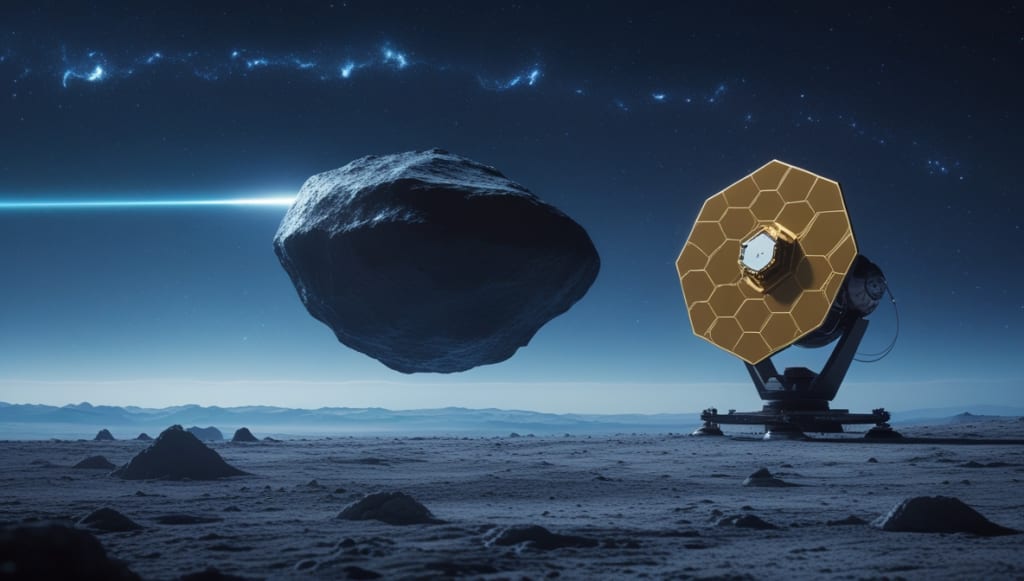
A Routine Observation Turns Uncanny
Astronomy thrives on routine. Astronomers spend nights staring at flickering dots, logging orbital data, and refining models. Comets and asteroids mostly behave the way textbooks say they should. But in this imagined scenario, routine observation gave way to something unprecedented.
The James Webb Space Telescope (JWST) — humanity’s most advanced window into the cosmos — wasn’t looking for aliens. It was simply tracking a new interstellar object dubbed 3i Atlas, an icy wanderer drifting in from beyond the solar system. At first it seemed like another footnote in the growing catalog of interstellar visitors. But then the data came back.
Thrusters from the Void
Comets behave like dirty snowballs. As sunlight heats them up, frozen gases sublimate into vapor, creating a tail and giving the comet a faint, uneven push — a process called outgassing. It’s chaotic and weak, barely measurable.
But 3i Atlas, as imagined here, refused to follow the script. Instead of random spurts of acceleration, it appeared to be firing a mysterious force — not like a rocket, but with a focused, consistent thrust strong enough to shift its trajectory. A Manhattan-sized mass maneuvering with that kind of grace boggles the mind. Outgassing simply can’t explain it.
Even the chemical composition detected in its gas trail didn’t perfectly match water ice or common frozen gases. Something exotic seemed to be at work. Was it a natural phenomenon we’d never seen, or something far more deliberate?
The Oumuamua Connection
This isn’t the first time the solar system has hosted an enigma from beyond the stars. In 2017, the real object Oumuamua (Hawaiian for “scout”) swept past the Sun. It was cigar-shaped, accelerated mysteriously, and lacked a visible cometary tail. Scientists scrambled for explanations: a nitrogen iceberg, a shredded exoplanet, a bizarrely porous “dust bunny.” None fit perfectly.
Harvard astronomer Avi Loeb even suggested Oumuamua could be an alien probe or a fragment of advanced technology — an idea dismissed by many at the time. But in our speculative story, 3i Atlas is behaving even more dramatically than Oumuamua. If one weird object is an anomaly, two suggest a pattern.
Natural or Technological?
Could Atlas be powered by exotic ices or internal explosions of volatile material? Maybe. But natural processes are messy. They produce unpredictable bursts, tumbling motions, and irregular trajectories. Atlas, in this scenario, moves with unnerving precision — as though executing a flight plan.
That’s what makes astronomers whisper in the hallways. Physics loves symmetry and predictability. Nature rarely produces steering corrections measured down to fractions of a degree. Yet that’s exactly what the JWST data implied in this imagined case.
A Perfect Tour of the Solar System
The trajectory adds to the intrigue. Atlas didn’t just stumble into our cosmic neighborhood; it approached the Sun at exactly the distance to gain a massive gravity assist, flinging it toward the outer planets at over 130,000 miles per hour. It’s the interstellar equivalent of a tourist hitting all the best landmarks on a planned itinerary.
If this were real, it would mark one of the most extraordinary moments in scientific history. Either we’re watching a natural object powered by forces we can’t yet explain, or we’re witnessing the first unmistakable evidence of extraterrestrial technology.
The Dark Forest Theory: A Chilling Context
All of this speculation connects to a provocative concept known as the dark forest theory. Popularized by author Liu Cixin, it imagines the universe as a silent, shadowed forest. Every civilization is a hunter, creeping quietly, uncertain whether the others are friend or predator. The safest strategy? Stay silent. Observe. Strike first if necessary.
For decades, Earth has been broadcasting radio signals into space, loudly announcing our presence. But if the dark forest theory holds, this might be reckless. Civilizations that survive don’t shout; they send stealthy probes. They gather intelligence first.
Within that framework, Atlas becomes more than a cosmic snowball. It’s a reconnaissance drone. It’s the quiet footsteps of a hunter on a forest floor.
Once Is Chance, Twice Is Pattern
When Oumuamua passed, it could have been dismissed as a fluke. Now, in this speculative scenario, Atlas appears and repeats the behavior on a grander scale. The odds of two unrelated interstellar visitors both accelerating mysteriously are vanishingly small.
Either we’ve discovered a brand-new class of interstellar objects — one that challenges the foundations of astrophysics — or we’ve encountered technology from beyond Earth. Both possibilities are staggering.
The Scientific Earthquake
If Atlas is natural, our understanding of comets, propulsion, and interstellar debris needs a major overhaul. We’d be forced to account for new types of ice, unknown outgassing mechanisms, or exotic materials capable of controlled thrust.
If Atlas is artificial, then we’ve answered the oldest question in science: “Are we alone?” And the answer comes not as a radio signal, but as a silent visitor already within our solar system.
Either way, the discovery would be the scientific equivalent of a tectonic shift, rewriting textbooks overnight and reframing our cosmic self-portrait.
Proceed with Caution
In the imagined aftermath of Atlas’s arrival, policymakers and scientists debate how to respond. Do we send probes? Attempt communication? Or do we stay silent, wary of the dark forest’s rules?
Our search for life beyond Earth has always assumed friendly neighbors, a Star Trek-style federation of planets. But stealthy probes and silent observations hint at a far colder reality. Maybe we’re not in a cosmic playground — we’re in a cosmic wilderness.
Looking Up, Looking Inward
Even though 3i Atlas is fictional here, the questions it raises are real. The mystery of Oumuamua remains unresolved. Interstellar objects will continue to pass through our solar system, and future telescopes will track them with unprecedented detail. We’re living at the dawn of a new era, where visitors from other stars are no longer science fiction but a regular feature of astronomy.
Whether these objects are alien spacecraft, exotic comets, or something stranger still, they remind us how small we are and how much we have yet to learn. They force us to confront our assumptions about the universe — and about ourselves.
The Final Frontier
Atlas represents the perfect storm of wonder and dread. It’s a mirror reflecting our deepest hopes for contact and our darkest fears of the unknown. Perhaps the greatest revelation isn’t about the object at all, but about us: how ready (or unready) we are to face the possibility that we are not alone.
Until then, we watch the skies. We listen. We imagine. And we prepare for the moment when the next interstellar traveler appears — real or speculative — carrying with it the secrets of the wider universe.
About the Creator
Keep reading
More stories from Shahjahan Kabir Khan and writers in Journal and other communities.
Beneath the Marble: The Day Christ’s Tomb Was Opened After 500 Years
For centuries, people have shown great love, respect, and debate about the Church of the Holy Sepulchre in Jerusalem. Millions of Christians see it as the hallowed ground of Jesus Christ's execution, burial, and resurrection, and its limestone design has witnessed many prayers, pilgrimages, and historic fights. But beneath its renowned domes and flashing lights resides a far bigger enigma: the enclosed grave purportedly bearing Jesus' remains.
By Shahjahan Kabir Khan4 months ago in Journal
The goals I did not achieve
Every writing goal I made for the year is a wash. It has been this way for a while, but I think it's important to be open about my failures and the reality of how life can get in the way. This is especially true considering the several times I have posted on Vocal about my writing goals, how I was changing my approach, and where I was hoping to be for the upcoming year. I will probably do that again in a couple months, but for now, it is time to acknowledge where I am today.
By Kay Husnick24 days ago in Journal
AI-Powered Website Design and Development: The Future of Smart Business Websites
In the rapidly changing digital world today, a website serves not just as a face of business on the internet but also as a business facilitator. Customers want quick, personalized, safe, and smooth experiences across all their devices. Older ways of website design and development, though still valid, generally have a hard time meeting the increased customer demand. This is exactly what AI-powered website design and development is introducing to the market - a game-changing approach in how business websites are smart, built, optimized, and used.
By Swati Lalwani4 days ago in Journal
Ludacris and Nelly draw backlash over bookings at MAGA-coded music festival
Ludacris and Nelly headlining a mostly right-wing event is good for them. It’s also great for the genre of hip hop. The two rap veterans have showcased their talents on other stages. Why can’t they perform for mostly MAGA folks and grab that bag?
By Skyler Saunders4 days ago in Beat



Comments
There are no comments for this story
Be the first to respond and start the conversation.