
The Midnight Economy: Why the World No Longer Sleeps
Online markets, crypto, and 24/7 trading are creating a planet that never turns off — but at what cost?
Once determined by fixed lines over the world, time stores would close after dark. Banks only worked throughout daylight. On their phones, families could have their evening meals together without being distracted by communications from all around the world. Natural pauses were offered by the evening, which let one unwind, ponder, and recharge.
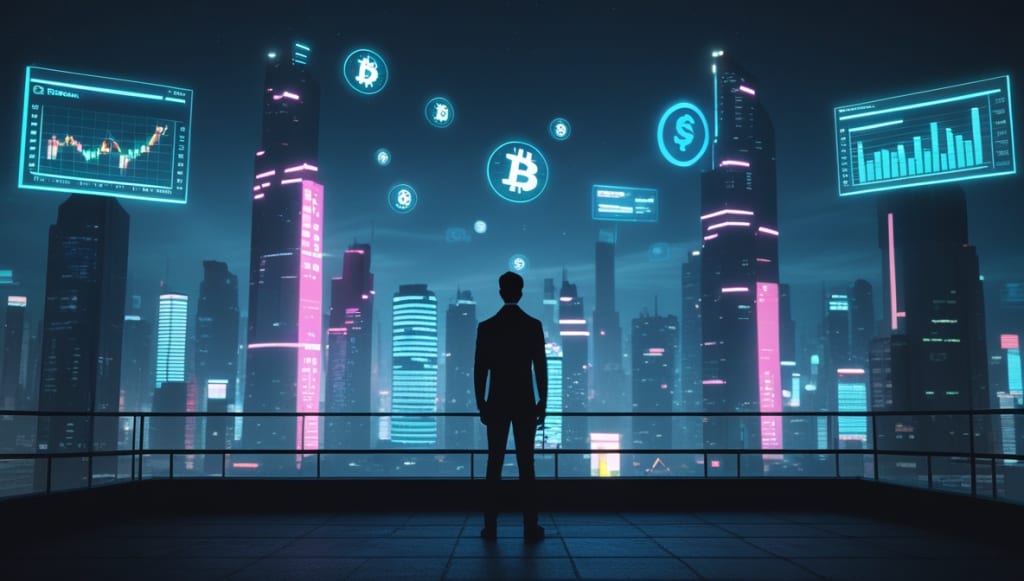
That age is now over, though. The world economy has become one that never sleeps, never pauses, never stops, always operates. The availability of cryptocurrency trading at any time and the overnight delivery provided by online companies have pushed society into an unending demand and fulfillment cycle. The question is not whether or not this is advantageous—undoubtedly it is—but rather what the consequences are for us now that the world has no means to shut down.
The Rise of the 24/7 Market
The midnight economy started subtly, with humble beginnings that seemed extravagant. Originally, late-night restaurants, gasoline stations, and convenience stores abounded. People appreciated this flexibility since they could get meals or necessities at irregular hours. Then the internet arrived, completely altering those constraints.
Online buying let one buy whenever. Streaming services made entertainment always available, no longer limited by broadcast times. Financial transactions started to extend their operating hours, therefore enabling "after-hours" trading. Globalization meant there was always a market somewhere active.
Cryptocurrency helped this change even more. Unlike traditional marketplaces that close on weekends or holidays, crypto runs constantly, around the clock, with billions being traded even at 3 a.m. Late at night, merchants verify their monitors. Business owners start businesses out of their own houses. Opportunities are always only a mouse click away. Many see this as perfection, a reality where financial activity never stops.
This perfect has several difficulties, though.
The Cost of Never Turning Off
Behind the alluring allure of convenience lies fatigue, which is growing issue. As the issue has grown increasingly prevalent all around the world, the World Health Organization has cautioned of the relationship between inadequate sleep and heart disease, depression, and anxiety disorders. Many people living in a society that is always-on, where the pressures of job, finances, and entertainment mask the natural cycles of the human body,
Fears of missing deals among customers and employees of major corporations drive the demand for responses to emails at 2 in the morning. Late at night, students browse and binge, thereby conditioning their brains to overcome the urge to sleep. Even the most perfect homes are disturbed by the glow of screens as family meals are interrupted by urgent news from far-off time zones.
Though the late-night economy relies on getting our attention, time is the only resource we cannot retrieve.
Economic Pressure and Inequality
Disparity is yet one more feature of the midnight economy. For people with resources and contacts, a continuous accessibility equates to unlimited access to possibilities. Investors can trade at any time; entrepreneurs can immediately access global markets; and experts can delegate tasks to freelancers over several time zones.
For those making low wages, though, the midnight economy offers quite another reality. It implies exhausting midnight warehouse shifts, unreliable gig work without advantages, and irregular schedules that interrupt family life and health. Although the worldwide system could be running well at 3 a.m., the employees who maintain it are frequently underpaid, unnoticed, and readily replaceable.
The midnight economy generates victims and beneficiaries as well as the gap between them broadens with each restless hour.
A Society Without Pause
Along with light and darkness, engagement and relaxation, humans have evolved with natural rhythms. These patterns are essential for our survival; they are not only disturbances. Ignoring them opens us to more than only tiredness. Studies connect continual lifestyles with greater mental health problems, weakened immune systems, and destroyed interpersonal relationships.
The late-night economy subtly undermines culture. Communities once meeting at frequent events—like meals, weekends, and holidays—now function on staggered schedules. When one parent is employed at night and the other works during the day, when does the family get together? When every free moment is consumed with business and entertainment, when do we get the opportunity to reflect, recuperate, or just be?
A community that never stops to breathe loses its capacity for dreaming.
Can We Reclaim the Night?
The evening economy is not vanishing. Actually, it is expected to expand with the increasing adoption of technology and global connections. The answer, though, might be to set boundaries within it rather than remove it.
Companies could encourage digital detox days or limit communication after work hours. Institutions of learning could teach pupils about the importance of rest and relaxation as components of a health curriculum. Individuals may disconnect by setting phone-free hours, refusing to read emails outside of job hours, or designing surroundings where time is appreciated instead of monetized.
The lack of balance causes problems, not the convenience. The earth will keep revolving, and economic activity will continue. The fundamental issue is whether we—as people and communities—can choose to distance ourselves.
The Final Warning
The late-night economy shows a basic reality: technological developments have made the globe always accessible. People, however, are not machines. Rest, calm, and objectives are what we need. Should we continue on a course wherein the brightness remains steady and the trade never stops, we risk not only our well-being but also our very essence as people.
The problem is not whether the late-night industry works; it certainly does. The issue is whether people can survive its cadence without breaking.
In the end, a culture always awake risks becoming a society that stops dreaming.
About the Creator
Keep reading
More stories from Shahjahan Kabir Khan and writers in Journal and other communities.
AI in the Classroom: Are Robots the Future of Teaching?
Walk into a classroom today, and you might already see artificial intelligence quietly at work. A grading algorithm checking essays. A chatbot answering student questions. An adaptive learning platform tailoring quizzes to each child’s pace. Education — once the sacred territory of human teachers — is now being reshaped by machines. But the question looms: will AI remain a helpful assistant, or is it quietly preparing to replace teachers altogether?
By Shahjahan Kabir Khan4 months ago in Journal
Electronic Waste Recycling Services in San Diego, CA
Living in a vibrant city like San Diego comes with a beautiful contradiction: our passion for the latest technology and our deep commitment to preserving the natural environment. This leaves many of us wrestling with a cabinet full of old phones, a garage holding a retired desktop computer, or an office storage room filled with obsolete equipment. Thankfully, a robust industry of professional electronic waste recycling services has emerged locally to solve this exact problem. These services provide the crucial link between our unwanted gadgets and their next life, ensuring disposal is handled with expertise, security, and environmental integrity.
By May Alroomi5 days ago in Journal


Comments
There are no comments for this story
Be the first to respond and start the conversation.