
AI in the Classroom: Are Robots the Future of Teaching?
From grading essays to replacing teachers, education may be the next frontier where humans lose ground.
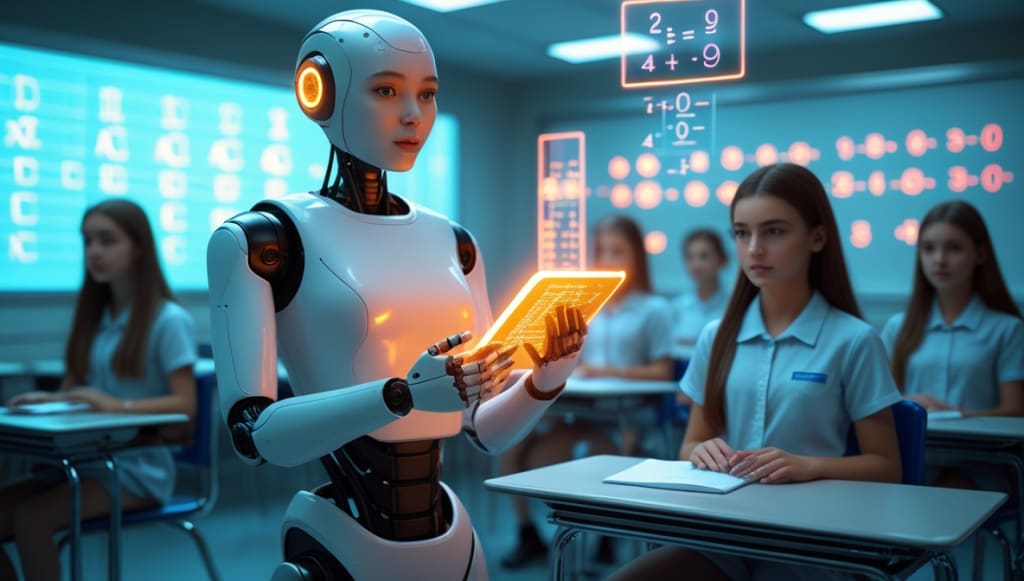
Walk into a classroom today, and you might already see artificial intelligence quietly at work. A grading algorithm checking essays. A chatbot answering student questions. An adaptive learning platform tailoring quizzes to each child’s pace. Education — once the sacred territory of human teachers — is now being reshaped by machines. But the question looms: will AI remain a helpful assistant, or is it quietly preparing to replace teachers altogether?
The Rise of AI in Schools
AI has slipped into classrooms almost unnoticed. Tools like plagiarism detectors, grammar checkers, and online tutors are already standard. In wealthier school districts, robots have even been introduced to help children with special needs or language barriers. During the pandemic, when classrooms went digital almost overnight, AI tools became lifelines for overwhelmed teachers trying to manage dozens of students through a screen.
Parents, too, have embraced AI tutors for after-school learning. Why hire a human for $40 an hour when a chatbot can teach algebra at any time, day or night? With rising costs of education, AI tutoring feels like a bargain. The efficiency is undeniable: no scheduling conflicts, no sick days, and instant access to practice problems. For many families, AI has become the silent second teacher at home.
Benefits That Cannot Be Ignored
AI brings real advantages to education. It never tires, never gets impatient, and can handle hundreds of students at once without losing focus. Personalized learning is where AI shines brightest. No two students learn at the same speed, but AI platforms can instantly adjust lessons to match each child’s ability — something even the most skilled teacher struggles to do in a crowded classroom of thirty.
And then there’s grading. Teachers often spend evenings buried under stacks of essays, tests, and assignments. AI, on the other hand, can provide immediate feedback on grammar, structure, and even argument strength. This doesn’t just save time; it gives students quicker feedback to learn from mistakes in real time. For educators, it means less paperwork and more opportunities to connect directly with students.
AI also levels the playing field for certain learners. Speech-recognition tools can help students with dyslexia. Translation features can support children from immigrant families who are still learning the local language. Adaptive platforms can identify exactly where a student is struggling — fractions, reading comprehension, or essay coherence — and tailor lessons accordingly.
But What Happens to the Human Side?
For all its efficiency, AI lacks something essential: humanity. Teachers do far more than deliver knowledge. They inspire, motivate, and adapt to subtle emotional cues that no machine can replicate. A teacher may notice when a child is unusually quiet, when a smile hides frustration, or when a struggling teenager just needs encouragement rather than another math problem.
A machine can tell you that your essay lacks coherence, but can it notice the fear in your eyes before a big exam? Can it inspire you with a story about its own failures and resilience? Education is not just about filling young minds with information — it’s about shaping character, nurturing creativity, and guiding students through the complexities of life.
The real danger lies in schools and governments seeing AI as a “cost-cutting replacement.” With teacher shortages already plaguing many countries, the temptation to let robots take over is strong. But if that happens, we risk reducing education to a sterile transaction, not a transformative experience.
A Hybrid Future?
Perhaps the real answer isn’t AI versus teachers, but AI with teachers. Imagine classrooms where AI handles the repetitive, mechanical tasks — grading, scheduling, test prep — while human teachers focus on creativity, empathy, and mentorship. In this model, AI doesn’t replace, but enhances.
Teachers could finally do what they entered the profession to do: teach, inspire, and connect. Freed from administrative burdens, they could invest more time in fostering curiosity, encouraging critical thinking, and guiding students through life challenges. AI, in this sense, would become the assistant rather than the master.
But this balance will not happen automatically. If profit-driven systems dominate education policy, AI could become less of a partner and more of a usurper. Instead of empowering teachers, it might replace them — leaving students in classrooms run by algorithms.
What’s at Stake
Education shapes societies. It builds not only workers but citizens, dreamers, and leaders. If we hand it entirely to algorithms, we risk raising generations who are taught by logic but starved of humanity. Schools might produce efficient test-takers but fail to cultivate empathy, resilience, or creativity — the very traits that machines cannot replicate.
On the other hand, if we balance carefully, AI could help teachers reach their fullest potential. The future of classrooms isn’t about technology versus humanity. It’s about whether we’re wise enough to use machines without losing our own soul in the process.
The classroom of tomorrow could be the best of both worlds — but only if we decide that humans, not machines, should remain at the heart of learning.
About the Creator
Keep reading
More stories from Shahjahan Kabir Khan and writers in Journal and other communities.
The Red Sea Mystery: Could Ancient Waters Reveal a Future Catastrophe?
Historically a meeting ground for spirituality, myths, and stamina, the Red Sea has also served as such. Its waters have captivated mankind over millennia, from the old narrative of Moses parting the waves to modern warnings about climate change that could touch countless lives. What though the Red Sea is more than just a river? What if it, in a sense, serves as a mirror reflecting our past as well as our future possibility?
By Shahjahan Kabir Khan4 months ago in Journal
The goals I did not achieve
Every writing goal I made for the year is a wash. It has been this way for a while, but I think it's important to be open about my failures and the reality of how life can get in the way. This is especially true considering the several times I have posted on Vocal about my writing goals, how I was changing my approach, and where I was hoping to be for the upcoming year. I will probably do that again in a couple months, but for now, it is time to acknowledge where I am today.
By Kay Husnick22 days ago in Journal
Business Valuation Services in Los Angeles: A Guide to Accurate Appraisals in Southern California
In the competitive landscape of Southern California, a generic appraisal simply isn’t enough to secure a deal or satisfy a regulator. Whether you are navigating a high-stakes merger in Hollywood or a tech exit in Silicon Beach, understanding the true worth of your enterprise requires a localized, sector-specific lens.
By CEO A&S Developers4 days ago in Journal



Comments
There are no comments for this story
Be the first to respond and start the conversation.