
The Lonesome Death of Hunter S. Thompson
Seventeen years ago this week, the greatest writer of a generation blew his brains out.

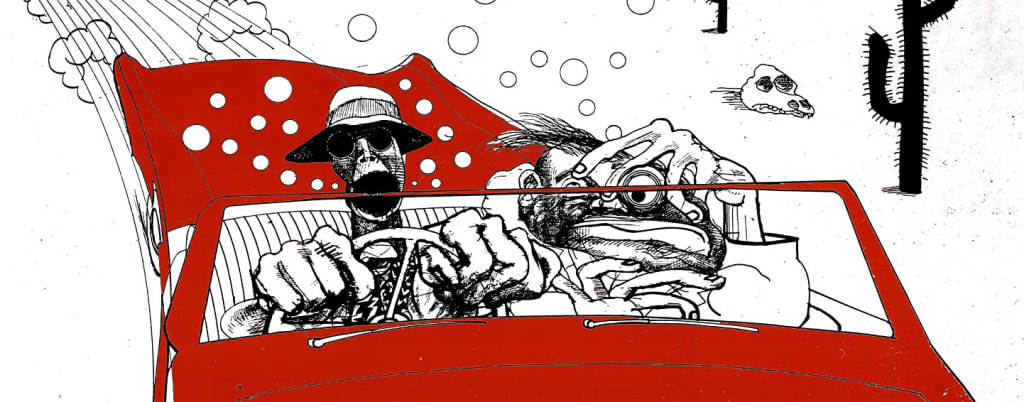
I was pulling my shitty car into the parking lot at my shitty job when the news filtered through.
Hunter S Thompson died today, the man on the shitty radio said.
It was February 20, 2005.
For years, I’d been a freelance journalist but never really made much of it. Mostly, I worked in the street press, and mostly for one magazine. My city had a giveaway music magazine called Beat. Yours probably did, too. Every big city I’ve been to has, for no connected reason. I guess it was just a generically good name for one.
Beat paid, but not well enough. Newspaper internships paid enough, but didn’t want someone who’d dropped out of university before their final year.
To make ends meet, I took the shitty job. It was in a lifeless industrial park, working for a company that hacked out low-quality personal computers to underfunded public schools. I won’t bore you with the details.
I hated that fucking place.
I hated wearing a cheap suit and I hated the petty dictatorship of my passive-aggressive supervisor. I hated that the pay sucked, but was still better than what I was earning on my own.
I hated that only the sales reps git to park out front and the rest of us had to trudge from the car park at the far end across concrete in the middle of summer. It was a steep downward slope and the only thing worse than the walk was the destination. The afternoon walk was uphill, but at least it was away.
The afternoon walk at least gave me the time and solitude to take in the fact that Thompson was dead and what that meant.
With every drink that night, I grew more frustrated that I didn’t have an outlet to say how I felt about that.
Beat was the kind of giveaway magazine that was huge in the nineties but were dying out by the 2000s and the internet age. It paid terribly, but the editors pretty much gave their writers free reign, stylistically.
I said they were a music magazine — and technically they were — but they would really publish just about anything on pop culture because the more content they had, the more ad space they could sell next to it. I called up an editor to still worked there. If I got in first, I knew I could get to say something about Thompson there.
Okay, he said, if you can get it to me in the morning. So I had twelve hours.
This is how it turned out.

Savage Journey’s End
Hunter S Thompson died today.
The news comes like a sharp punch in the kidneys, the kind of body blow that you see coming a mile away and it shouldn’t be a shock but it is. The real surprise isn’t that the man who became the angriest voice of an angry generation finished his days by putting the barrel of a gun to his head. It’s that it didn’t happen sooner.
The chances of the firearm-obsessed Thompson’s exit from the world happening the way it did were only slightly slimmer than the odds of it being caused by an overdose of all the coke or the acid or the myriad uppers, downers, twisters and benders that he spent the better part of a magnificent thirty-year career rapaciously consuming. Or the chances that he might have drowned in the sea of tequila, rum and Budweiser that he consumed in levels that would be diagnosed, in a man with a lesser constitution, as extreme alcohol abuse.
Thompson’s end at his own hand, intentional or otherwise, was as inevitable as the fact that even watching a quarter-century of deliberate disintegration could never quite prepare us for it and all that’s left is for lesser writers — which, of course, is every last one of us on the low side of Dylan — to scrape together a few measly words in unworthy attempts to sum up the life and work and impact of one of the greatest voices we ever heard.
Predictably, of course, we are already fucking it up. Less than a day after Juan Thompson discovered his father’s lifeless, suicided body, every newshound within a mouse click of Google was solemnly and respectfully regurgitating the same tired facts and applying the same tired labels.
Hunter, the creator of gonzo journalism. Hunter, the voice of the drug-friendly generation. Hunter, the loveable eccentric.
Bullshit. All of it was bullshit.
In the first place, to credit Hunter as the single hand in the creation of New Journalism is to slander Jimmy Breslin, Tom Wolfe, Norman Mailer and nameless others. And journalism itself, for that matter, which showed an ability to grow up and out of the sycophantic objectiveness that dominated the post-war era.
In the New Journalism style, writers injected themselves into their stories, downplaying the bland objectivity of the who, what, when, where and how with the infinitely more complex why. The shift in focus was as simple as it was revolutionary. By placing himself amongst the journalistic scenery, the writer could draw in the reader in ways that the most flowery prose could not. By removing the illusory crutch of objectivity, New Journalism treated its readers — rashly, perhaps — as adults who were mature enough to differentiate between fact and opinion.
If any single writer deserves the title of Father of New Journalism, it would be Wolfe, who experimented with the form to the jeers of his stiffer literary fellows. Thompson was more like the Crazy Uncle of New Journalism. He wasn’t the first or only writer to adopt the new language of reportage. He was just the most fluent in it.
In typically irreverent fashion, he offhandedly labeled it ‘gonzo’ journalism and the moniker stuck, in large part because it reflected Thompson’s own persona. The truth was that his entry into the field was entirely an accident. While on assignment to cover the Kentucky Derby for Scanlan’s magazine, the party-loving young journalist found himself backed up against a deadline and, in a fragile state, panicked.
“I’d blown my mind, couldn’t work,” he later told Playboy. “So finally I just started jerking pages out of my notebook and numbering them and sending them to the printer. I was sure it was the last article I was ever going to do for anybody.”
It didn’t get him fired, but the raw energy of Thompson’s stream-of-consciousness style did get him noticed. The piece was hailed as a breakthrough in journalistic technique rather than a chemical-fuelled cock-up. But then, if there was any pattern to Thompson’s career, it was that letting drugs and booze get in the way of a good story isn’t always a bad thing.
In 1971, Thompson was investigating the death of Mexican-American journalist, Ruben Salazar. A year earlier, five hundred LAPD officers had swarmed upon a Vietnam War protest in heavily Chicano-populated East Los Angeles with billy clubs and tear gas. Sometime during the ensuing riots, hundreds of businesses on Whittier Boulevard were looted and vandalised and three people including Salazar — a frequent critic of LAPD overzealousness — were killed.
Thompson had an excellent source in respected lawyer and activist, Oscar Acosta. The problem for Acosta was that dealing with an Anglo journalist, even one as sympathetic to the cause as Thompson, was causing anxiety in the tension-filled atmosphere of East L.A. To put Acosta at ease and get his subject to open up, Thompson suggested a leisurely road trip to Nevada. If the trunk of the car hadn’t been loaded with three cases of liquor and an assortment of illegal narcotics that Thompson likened to a police medical van, what might have been a fine piece on the murder of a journalist became the drug and adrenaline-fuelled memoir, Fear and Loathing in Las Vegas: A Savage Journey to the Heart of the American Dream.
The second piece of rubbish perpetuated in the wake of Thompson’s death is the mistaken belief that Thompson was some kind of Timothy Leary-style advocate of drugs as a cure-all for societal ills. The mythology of this fails on two levels. On the first, Thompson, while open about his own drug use and misuse, had little interest in recommending them to others, preferring that the rest of his generation make up their own minds.
“Take your chances, you know,” he told Rolling Stone foreign affairs editor, P. J. O’Rourke, “I never felt that, aside for a few close friends, it was my business to advocate things.”
The other factor preventing Thompson from becoming a messiah for his generation was the utter contempt in which he held most of it.
Thompson’s involvement in the counterculture was rooted in the pre-acid, pre-hippie days of the Free Speech Movement. By the time the flower power movement had taken root, Thompson was already seeing in his contemporaries a need to conform that was not so different to that of the establishment they were railing against.
Not that any of this is being mentioned in the endlessly identical eulogies. Thompson is too beloved by the anti-establishment — the hippies, the druggers, the protesters, the activists, the academics — for them to be able to bear the horrible possibility that he might not have loved them back.
Instead, we talk about his ‘well-known’ eccentricities. More lies. Beyond his autobiographical writings that centred around a passion for sports, guns, booze and drugs, we know almost nothing about him. He is regularly explained to be painfully shy. Which is true enough if the definition of ‘shy’ can be expanded to include a chronic fear of human contact. We can call him an eccentric, too, because the word is polite and pretty enough to describe a man who was very likely clinically insane.
Let’s call him those things — shy, eccentric, private. Let’s drag this legend down to our own petty levels of adequacy. Let’s do it not just because we love him but we are angry with him, too.
Some are angry for making drugs and booze okay or for his abrupt honesty or for shattering the image of a perfect world by showing it for what it was or for a brilliance and radiance that leaves us impotent by comparison.
Me, I’m angry because he’s gone and I don’t know why and I don’t like feeling like this.
I don’t know where, either. Mostly, I like to think he’s in paradise with Kerouac and Strummer and Mitchum and every last one of those magnificent bastards who looked convention in the eye and convention blinked.
But a tiny part of me, the part that feels sad and abandoned, hopes that Hunter, proud sinner to the end, has gone to Hell. Because that’s where Nixon is and Hunter has earned the right to have Nixon to kick around forevermore. Nixon, to Thompson, was the enemy epitomised — the “dark, venal and incurably violent side of the American character that almost every country in the world has learned to fear and despise,” — and Thompson attacked him every chance he had, hounding him to the grave and beyond.
When Nixon died, every newsagency in America crawled over each other in a stomach-churning race to deify the Great Statesman whom they had helped to bring down.
Thompson alone remained unaffected by the mysterious wave of amnesia that swept the worlds of politics and media that made us forget why we hated Nixon in the first place.
“I have written worse things about Nixon, many times,” he wrote, “and the record will show that I kicked him repeatedly long before he went down. I beat him like a mad dog with mange every time I got a chance and I am proud of it.”
Thompson’s final word on Nixon was one of his finest moments. It was angry and succinct and honest and bold and it was barely heard amidst the weepy bleating of mass media sheep.
It was a bloody and brutal eulogy and Nixon got exactly what he deserved. If we were better writers, if we had the words to describe sheer bloody-minded magnificence, Hunter would too. Not that Thompson would have expected any differently, of course. His dark soul was convinced that the cost of free speech was to be damned if you do, damned if you don’t.
“There is something to remember, if you work in politics or journalism — or both, like I do,” he once warned.
“You will be flogged for being right and flogged for being wrong, and it hurts both ways.
“But it doesn’t hurt as much when you’re right.”
About the Creator
Keep reading
More stories from Jack Faulkner and writers in Journal and other communities.
The Quiet Link Between Evening Light and Restless Sleep
For a long time, I believed my restless sleep was caused by what happened in my head. Too much thinking. Too much stress. Too many unfinished thoughts that followed me into the night. I tried calming routines, earlier bedtimes, and stricter boundaries around work. Some nights improved. Many did not.
By illumipure3 days ago in Journal



Comments
There are no comments for this story
Be the first to respond and start the conversation.