
The Last Human Artist? Can Creativity Survive the AI Boom?
Great follow-up to “End of Work” but focused on arts + culture.
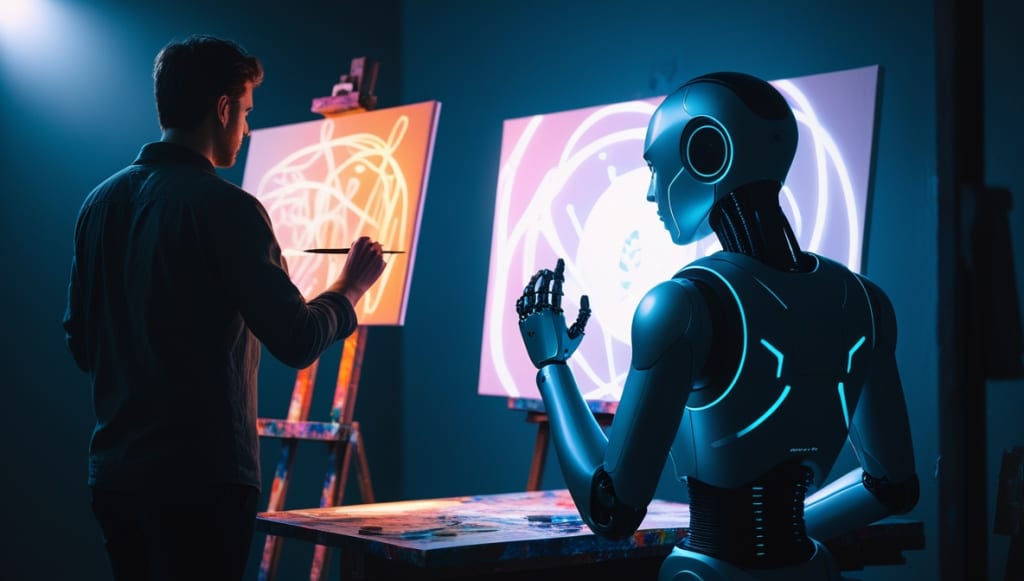
For millennia, the human imagination has been considered as holy—a special burst of genius that computers cannot duplicate. Artists, authors, composers, and filmmakers have all worked under the belief that their works were very human. This faith is starting to crumble apart, though, in the year 2025.
Artificial intelligence is becoming more than just jobs in industry and commerce; it is invading the sphere of culture itself. We have art generated by artificial intelligence selling at auctions, music made by artificial intelligence dominating streaming platforms, and novels written by artificial intelligence filling digital channels. are entering a period when the line between human and machine generated creativity is blurring.
Still disturbing, the question remains: are we nearing the final epoch for the human creator?
The Rise of AI Creativity
It seemed preposterous not long ago that a computer could paint a picture or write a symphony. But AI tools like MidJourney, DALL·E, and ChatGPT have turned this fantasy into daily life in ten years or less. Anybody can create digital art in just a few seconds, write a screenplay in only a few minutes, or compose music with a straightforward click.
This opening up of creativity marks a revolutionary change. Suddenly, generating anything visually remarkable doesn't need a lot of preparation. To release a song, you need not rely on a music label. Artificial intelligence lowers barriers to let more people participate in creative activities.
But the paradox here is that while artificial intelligence expands the accessibility of creativity, it also reduces its exclusiveness. And what meaning does art have without its uniqueness?
The Devaluation of the Artist
Artificial intelligence presents a major challenge for writers who have spent years perfecting their skills. Why would an artist need to be compensated a large sum of money when an artificial image generator can produce a nearly perfect design in a matter of seconds? Why use a ghostwriter given that artificial intelligence can create a completed draft at no expense?
This anxiety goes beyond theoretical. Already winning top honors in art competitions are works made by artificial intelligence. Movie production companies are experimenting with AI-written scripts to save money. Publishers are being flooded by manuscripts produced by artificial intelligence.
The dread strikes at the fundamental issues of life and goes beyond mere financial concerns. If robots are able to generate art almost equal to that created by humans, does the core of human inventiveness still hold significance?
The Human Touch
This study, however, could miss what art actually stands for. Not just the end product, true creativity also comprises the process, the feelings engaged, and the narrative attached therewith.
When we value Van Gogh's Starry Night, we perceive more than just brilliant swirls. As he fights to reconcile his thoughts and surroundings, we observe a guy in agony, suffering, and intensity. When we listen to Nina Simone, we hear not only music but also We hear the voice of a generation seeking for freedom.
While artificial intelligence is able to reproduce techniques, is it truly capable of capturing real-world encounters? Can it communicate intense yearning, sorrow, or injustice? Or will it only be a flawless reproduction of human suffering, a mirror image without the crucial components of imperfection?
Collaboration, Not Competition
Rather than the end, the future could denote the transformation of human inventiveness. Artists are increasingly seeing artificial intelligence as a tool instead of a rival. Just as cameras initially jeopardized painters but eventually improved visual storytelling, artificial intelligence could turn into a companion, like a digital brush or co-author.
One of the most intriguing future inventions will be a fusion of human and machine creation. Artists who embrace change may discover new avenues of creativity that would be impossible without the help of artificial intelligence.
The Cultural Reckoning
Still, society has to deal with urgent problems. Who owns the rights to art produced by artificial intelligence? Is a model stealing or borrowing if trained on many human inventions? Should artificial intelligence creations be distinguished from those generated by people by markers?
Furthermore, are we ready for a world in which technology firms' algorithms influence human culture rather than by painters?
Far from being hypothetical, these questions define the cultural tension of the 2020s.
Conclusion: The Last Human Artist?
Though it will change human inventiveness, AI will not obliterate it. The next artist could rather be the first example of a distinct kind: an individual that combines artificial intelligence with human emotions, not necessarily the ultimate human creator.
It seems finally that the role of the artist has always been the same: to help us to remember the core of human nature. Whatever AI progresses, that duty might still belong just to humans.
About the Creator
Keep reading
More stories from Shahjahan Kabir Khan and writers in Journal and other communities.
Prophets vs. Programmers: Who Do We Trust in the Age of AI?
People claiming to forecast future occurrences have emerged during every age of human history. These people were known as prophets in olden times, perceptive people who predicted famines, wars, and future salvations among other events. For many centuries, their messages—written on scrolls or said in holy sites—highly shaped civilizations.
By Shahjahan Kabir Khan4 months ago in Journal
How do I Become a Mobile App Developer in 2026
The path to becoming a mobile app developer has changed. It has shifted from mastery of syntax to Entity Accountability. It now focuses on high-level architecture stewardship. The shift occurred within a post-generative development economy. In 2026, the barrier to entry is no longer writing code. The new barrier is validating the integrity of systems. You must also validate the security of AI-mediated discovery systems.
By Del Rosario5 days ago in Journal


Comments
There are no comments for this story
Be the first to respond and start the conversation.