
Prophets vs. Programmers: Who Do We Trust in the Age of AI?
A creative comparison of prophecy and coding as “languages of the future."
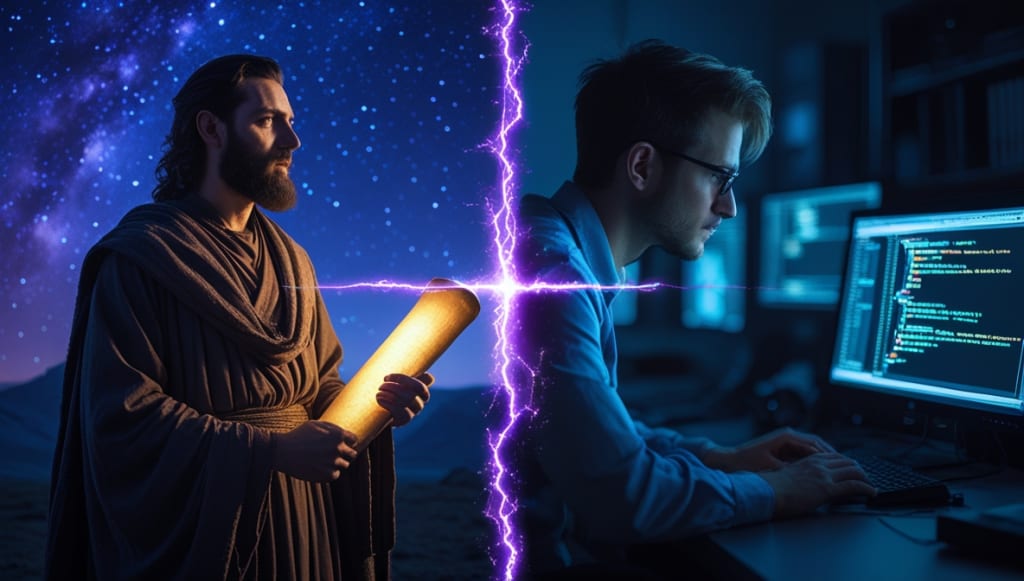
People claiming to forecast future occurrences have emerged during every age of human history. These people were known as prophets in olden times, perceptive people who predicted famines, wars, and future salvations among other events. For many centuries, their messages—written on scrolls or said in holy sites—highly shaped civilizations.
Emergent in our day is a new kind of prophet—not decked out in conventional attire but rather in casual clothing. These are the programmers, software developers, and engineers. Through coding scripts, algorithms, and artificial intelligence models, their visions are expressed rather than in melodic language. Their projections are becoming more highly valued as the ancient texts, whatever their level of self-awareness.
This leads to a crucial question: Whom should we trust in 2025—the spiritual prophets or the artificial intelligence developers?
Prophecy: The Language of Vision
Humanity has used prophecy as a guiding structure for millennia. Ancient seers forecast calamities, sickness, and the rise and fall of civilizations among other events. For those who believe, prophecy serves as either a heavenly warning or a source of solace. Even doubters admit its great cultural influence: predictions have influenced kings' decisions, inspired revolutions, and provided relevance during turbulent times.
Prophecy goes beyond simple foreknowledge. It centers around faith. The audience listens intently when a prophet relays a message since they believe the message is connected to a greater power—whether that be God, chance, or fate. The power comes from its legitimacy as much as from its exactness.
Prophecy still matters as we head for 2025. It is actually once again gaining attention. Discussions on social media about biblical predictions about the end times together with a renewed interest in Nostradamus and the Mayan calendar show that people still seek directions amid ambiguity. Amid a turbulent world defined by epidemics, armed clashes, and natural disasters, prophecy provides comfort: the belief that occurrences belong to an all-encompassing pattern.
Programming: The Language of Code
Although prophets wrote sacred scriptures, modern developers use programming languages such Python, Java, and C++. Code is a contemporary type of scripture: clear, logical, and practical. Though prophecy often uses metaphors, codes convey via functions. Still, both claim to affect future events.
Think about it: when a developer builds an algorithm meant to forecast stock market trends, monitor health issues, or examine electoral results, they are in a sense: forecast future trends. Machine learning algorithms "predict" what is most likely to happen next by means of processing enormous volumes of data.
Unlike prophecy, programming does not call for belief in a deity. It instead trusts numbers, facts, and reasoning. The outcomes let the code self-validate itself. Programmers' "predictions" often direct the course of society in a society becoming more and more driven by technology.
Prophets vs. Programmers: Same Questions, Different Tools
One then sees clearly many parallels between prophets and programmers as one looks at them next to each other.
Prophets wonder: How does God's vision enlighten us regarding the future?
Programmers ask: What revelations regarding the future may we learn from the information?
Prophets employ visions, holy texts, and allegorical language.
Programmers apply algorithms, programming languages, and methods in machine learning.
Prophets draw forth: faith, trepidation, or ethical responsibility.
Programmers elicit: confidence in technology, fear about automation, or hope for developments.
In both cases, humankind is yet asking the fundamental question: what comes after?
The Battle for Trust
The conflict is this: often prophets and programmers differ.
A prophet may advise against a moral collapse or a predicted judgment. On the other hand, a programmer might recommend automation causing massive unemployment or that artificial intelligence would finally surpass human ability. Although each prediction comes from different sources of authority, both generate urgency.
Many people find data-based forecasts more comforting. At the end of the day, numbers may be measured. For others, however, spiritual forecasts have a significance that statistics fall short of: they suggest that events have a more profound significance beyond just probability.
Perhaps this is the conflict: programmers can inform us about what is probable, but prophets elucidate why it is important.
Prophecy in the Age of AI
What results when these two domains meet? Imagine an artificial intelligence taught on all religious scriptures across time— Dead Sea Scrolls, Bible, Qur'an, Torah, and Vedas. Could it bring fresh insight? Could an algorithm claim it is divinely inspired?
This event is actually already occurring in small incidents. At the moment, artificial intelligence chatbots are answering questions about spirituality. Customized daily interpretations of scripture are provided by applications. Some religious organizations, like churches and mosques, use artificial intelligence tools to interact with their membership virtually. We are moving toward a period when the act of prophecy might be, to some degree, mechanized.
Still, there is a great risk associated: traditionally, prophecy has relied on human morality. A prophet was also a moral compass, not only a predictor. Can a machine provide genuine ethical counsel? Or will it simply feed the biases of those who created it?
If algorithms start to behave like prophets, humanity might start to mistake actual purpose for foresight.
Programmers as Modern Prophets
Those who code are increasingly seen as visionaries. Think about Elon Musk warning against artificial intelligence "calling forth the demon" or Sam Altman seeing the rise of artificial general intelligence. These declarations go beyond simple technical forecasts; they strangely mirror modern prophecies.
Though programmers might not speak from altars, their words affect the ideas of many people. Investors, governments, and regular people react to their "prophecies." Silicon Valley has become a singular kind of temple in this regard, where code is sacred text and data reflects its driving ideas.
Who Do We Trust?
Will we believe prophets or programmers in 2025?
Not both alone could provide the best reply.
According to prophets, people have to find significance, morals, and direction. Programmers, on the other hand, stress that people need precise data, effective systems. One is insufficient without the other. A prediction may be nothing more than a superstition without supporting evidence. A code that disregards moral issues might lead to oppression.
Our current issue is not picking between prophets and coders; it's rather finding ways to reconcile religion with reason. For the future of mankind, a collaboration between spiritual and technological means of communication—rather than a dispute—may be required.
Conclusion: The New Oracle
Greeks visited Delphi to look for the oracle's future perspective. People now question ChatGPT, Google, or Siri on their phones. Not much has changed in a strange way; we still want someone or something to tell us what's coming.
The variation is that the solutions by 2025 might come from a mix of human prophets and digital algorithms. The main issue is whose viewpoint we decide to embrace, not about who has better foresight.
Moreover, though prophets gave us meaning, programmers provide us the tools—but Humanity has yet to decide what sort of future we will create.
About the Creator
Keep reading
More stories from Shahjahan Kabir Khan and writers in Journal and other communities.
Digital Babel Tower: How AI Could Unite — or Scatter — Humanity
In the Book of Genesis, humanity came together for its first great project: the Tower of Babel. They dreamed of building a monument so tall it would reach the heavens, a symbol of unity and limitless ambition. But their unity proved dangerous. To stop them, God scattered their languages, ensuring that humanity could no longer speak with one voice.
By Shahjahan Kabir Khan4 months ago in Journal
The goals I did not achieve
Every writing goal I made for the year is a wash. It has been this way for a while, but I think it's important to be open about my failures and the reality of how life can get in the way. This is especially true considering the several times I have posted on Vocal about my writing goals, how I was changing my approach, and where I was hoping to be for the upcoming year. I will probably do that again in a couple months, but for now, it is time to acknowledge where I am today.
By Kay Husnick23 days ago in Journal
Why Catholics Believe Faith and Works Go Together
Why Catholics Believe Faith and Works Go Together A question often asked by non-Catholics is how faith and works relate in the Catholic understanding of salvation. Some believe that Catholics rely on “good works” to earn salvation, while others think faith alone is sufficient. The truth in Catholic teaching is that faith and works are inseparably connected, and both are essential for a living, authentic Christian life. Understanding this balance begins with Scripture, is explained through Church teaching, and is supported by centuries of theological reflection.
By Sound and Spirit5 days ago in Journal



Comments (1)
Interesting way of looking at things, but don't you think the Versus part is the real problem? Divisive thinking seems to be the cause of the confusion or hatred or discord. How do you know Jesus isn't sitting at a desk doing some computer programming? Or maybe Buddha? What if the reincarnated Gandhi is some woman who gets paid to do data entry now? I don't like versus thinking. It makes people take a side, and once there's sides, the only truth is the middle or the ones who didn't choose a side.