

When I set out to visit Runnymede I had two very clear objectives. They were to visit both the JFK and Magna Carta memorials. From the main road from Staines to Windsor I saw very briefly what looked like a set of chairs in the middle of the meadow arranged as if in readiness for picknickers. I had acquired a third objective. A sort of Runnymede bonus.
The damp wooden gate that had marked my entrance to the Magna Carta Rotunda and on to American land became my exit from there and back on to English land which was green and very soggy. The sound of my feet making foot sucking slurpy squelches resumed. As I trudged across the open land towards the chairs in the thickening gloom of the afternoon I kept asking myself ‘Why?’ and ‘What?’. I was also asking myself if I had enough time left before the gates of the car park would be locked? A glance at my phone told me I still had half an hour but as I walked I kept a wary watch on the car park. Just in case the keeper of the keys had decided to carry out their duties early.
Ever closer I could see the chairs were bigger than any standard dining chair in a home or a restaurant and they were cast in bronze. They were a standard shape and as I walked around them and between them I saw that each one was unique. On both sides of their backs were friezes capturing critical moments in the perpetual pursuit of universal freedoms. Freedom of speech, freedom from discrimination, freedom from slavery and freedom of access to information about decisions taken that affect our lives. Underlying all of those freedoms is the need for education systems around the world to transparently teach, without hinderance or censorship, those freedoms, their aspirational universality and their importance. One chair, with a clearly defined historical link to the Magna Carta, represents the right to trial by a jury of twelve of one’s peers. Not lords, barons, dukes or monarchs but one’s peers who are equals.
That is why this installation is called ‘The Jurors’.
Hew Lock, the artist, is asking anyone who has walked this far already to walk a little further in their minds. He wants visitors to act as a member of a jury passing their own judgement on each of the scenes on the backs of the chairs in relation to the continuing influence of the Magna Carta.
To slow down as they walk around the chairs. To even stop and ponder. To sit and imagine they are a member of a jury passing judgement on a fellow citizen that could set them free or send them to prison. Fortunately, here in Britain that is the worst that can happen as the death penalty was abolished for murder in 1965 and for treason and piracy in 1998.
One frieze that did make me stop was on chair twelve. It was of the house in Myanmar where Aung San Suu Kyi was held for 15 years under house arrest from which she became a symbol of peaceful political protest and awarded the Nobel Peace Prize. While I was standing looking at The Jurors our news services released more stories of how the regime in Myanmar was treating the Rohingya minority by brutally forcing them from their homes where they were non-citizens to neighbouring Bangladesh where they became, still are refugees and most likely will be; refugees without citizenship, roots and a place to call ‘home’.
Aung San Suu Kyi was a member of the Myanmar Government that was perpetrating these crimes against humanity and faced a lawsuit at the International Court of Justice in The Hague. During her appearance there she defended her Government’s actions against the charges of genocide which has tarnished her reputation and made it as lacklustre as the weathered bronze of The Jurors.
What we may never know is ‘why’ she did this making her an accomplice to genocide after she had earned so much respect around the world for the way she coped with her interminable house arrest? None of us are walking in her shoes.
I wonder if Aung San Suu Kyi can remember these words:
‘Democracy is a journey of continuous improvement, always striving for a more inclusive and just society.’
The gloom across the meadow became deeper. The cars speeding along the road were just dark shapes. All that marked their progress was their seemingly disembodied headlights. I started my squelchy walk back towards the car park hoping that the council van bringing the official who was going to lock the gate did not turn up. Otherwise, I would have had to have broken into a run which is my least favourite form of physical activity driven by a pathological hate of cross country running at secondary school. I reached the car park just as the van arrived. A man got out jangling a set of keys. There were other cars still parked and no owners in sight. I thought of the problems they might face when they phoned home or work to say their cars had been locked in.
‘I’m just going’ I called out.
‘No rush sir’ the man replied.
As I drove out I realised why he said, ‘No rush sir’. The side of the road in the exit, I was on had a set of metal flaps set in it that faced outwards preventing cars coming in. All he had come to do was lock the gate on the entrance side to prevent people coming in. I was free to leave.
Dec 20
About the Creator
Alan Russell
When you read my words they may not be perfect but I hope they:
1. Engage you
2. Entertain you
3. At least make you smile (Omar's Diaries) or
4. Think about this crazy world we live in and
5. Never accept anything at face value
Keep reading
More stories from Alan Russell and writers in Journal and other communities.
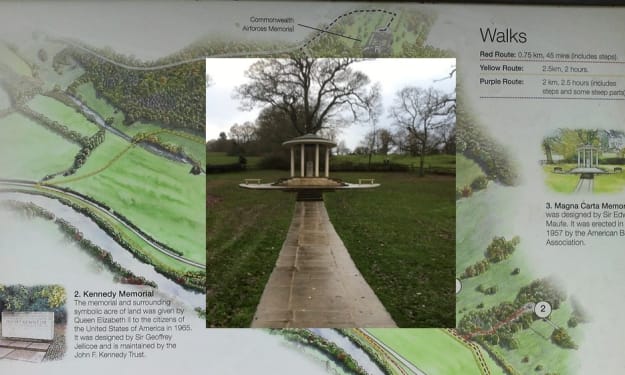
The Magna Carta Memorial @ Runnymede
I had closed the gate on the acre of land that used to be part of England but was now forever part of America, the John F Kennedy Memorial. I felt flat and empty. Not because of the lack of excitement or anticipation that or an inherent part of the border control experience or the mid-winter gloom around me. No, it was because of seeing the memorial stone in such a weathered condition.
By Alan Russellabout a year ago in Journal
Review of 'Man on the Run'
My wife and I saw Man on the Run, a nearly 2-hour documentary on Amazon Prime, about Wings, Paul McCartney's group that flew around the world from shortly after The Beatles broke up in early 1970 to shortly after John Lennon was murdered at the end of 1980, making a Beatles reunion forever impossible.
By Paul Levinson4 days ago in Beat



Comments
There are no comments for this story
Be the first to respond and start the conversation.