
The Role of High-Strength Steel in Ensuring Safe 50-Ton Overhead Crane Construction
How Advanced Materials Enhance Structural Integrity, Load Capacity, and Operational Safety
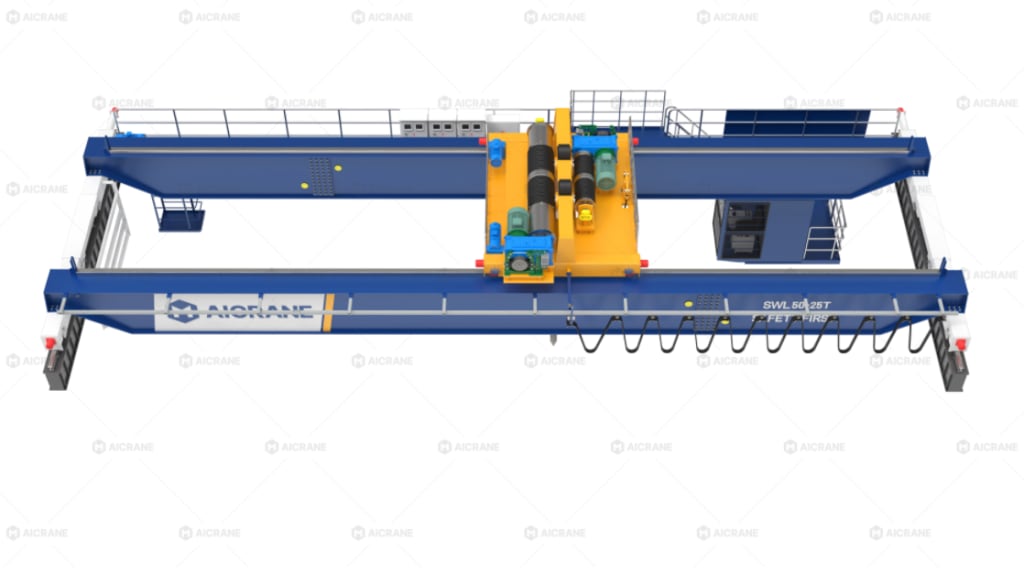
Overhead cranes are indispensable in industries ranging from steel production to heavy machinery handling, providing the capacity to lift, move, and position loads with precision and efficiency. Among these, a 50-ton overhead crane represents a significant engineering feat, capable of handling extremely heavy materials safely. The safety and reliability of such cranes depend heavily on the materials used in their construction. One of the most critical materials in modern overhead crane design is high-strength steel (HSS). This article explores the role of high-strength steel in ensuring safe 50-ton overhead crane construction, emphasizing structural integrity, performance under load, and long-term operational safety.
Understanding High-Strength Steel
High-strength steel is a type of steel alloy designed to deliver superior mechanical properties, including high yield strength, tensile strength, and toughness, without significantly increasing weight. Its unique composition often includes controlled levels of carbon, manganese, silicon, and other alloying elements that improve strength while maintaining ductility.
For a 50 ton overhead crane, the components subjected to the greatest stress, such as the bridge girders, end carriages, trolley beams, and hook assemblies, benefit significantly from high-strength steel. Unlike conventional structural steel, HSS allows designers to reduce material thickness while maintaining or improving load-bearing capacity, reducing overall crane weight without compromising safety.
High-Strength Steel and Load-Bearing Capacity
The primary safety concern for any overhead crane is the ability to safely carry its rated load without structural failure. In a 50-ton crane, every component must withstand not only the static load of the lifted material but also dynamic forces such as acceleration, deceleration, and lateral sway. High-strength steel provides the following advantages:
Increased Yield Strength: HSS can withstand higher stress levels before permanent deformation occurs, ensuring that beams and girders retain their structural integrity under heavy loads. This is particularly critical during sudden load changes or emergency stops.
Enhanced Fatigue Resistance: Cranes are subjected to repeated lifting cycles daily. HSS exhibits better fatigue properties than conventional steel, reducing the likelihood of cracks or fractures over time.
Optimized Weight-to-Strength Ratio: Using HSS allows for thinner, lighter components without reducing load capacity. A lighter crane reduces stress on wheels, rails, and supporting structures, indirectly improving overall safety.
Resistance to Buckling: Under compressive forces, such as those experienced by crane girders or columns during lifting, HSS provides higher resistance to buckling, preventing catastrophic failure.
Structural Safety Through HSS Design
Safety in crane construction is not solely about the steel grade; it also involves how the steel is used in structural design. High-strength steel enables several design improvements:
1. Thinner yet Stronger Girders
The main bridge girders of a 50-ton overhead crane bear the weight of the load and trolley assembly. Using HSS allows for slimmer girder sections that reduce dead weight while maintaining required bending and shear strength. Reduced weight minimizes dynamic forces transmitted to supporting structures and rails, enhancing operational safety.
2. Robust End Carriages
End carriages connect the bridge to the wheels that run along the runway rails. With HSS, end carriages can be designed to withstand higher wheel loads and shock forces, ensuring that the crane remains stable during movement, even under full load conditions.
3. Reinforced Trolley and Hook Assemblies
The trolley, hoist, and hook experience concentrated stresses during lifting. High-strength steel ensures that these components resist wear, bending, and elongation, providing long-term operational reliability. A strong trolley frame also reduces the risk of derailment or misalignment on the crane bridge.
4. Reduced Risk of Fracture and Deformation
Overhead cranes operate in environments where sudden impacts, vibrations, or overloading can occur. HSS exhibits excellent toughness, which is crucial for resisting crack propagation and preventing sudden, brittle fracture. This characteristic directly enhances safety for both personnel and material.
Dynamic Load Safety and High-Strength Steel
A 50-ton overhead crane experiences not only static loads but also dynamic forces, including acceleration, deceleration, load swing, and lifting over uneven surfaces. High-strength steel contributes to safety in the following ways:
Improved Shock Absorption: HSS can better tolerate stress spikes caused by sudden load acceleration, reducing structural damage.
Minimized Vibrations: The stiffness of HSS girders and beams helps maintain smooth crane operation, preventing excessive vibrations that could destabilize the load.
Enhanced Resistance to Impact Loads: When a crane hook engages a load, high-strength steel reduces the risk of local yielding or component failure, keeping the lifting operation safe.
Longevity and Maintenance Benefits
Safety is not just a function of initial construction quality—it also depends on how the crane performs over time. High-strength steel provides long-term benefits that directly relate to operational safety:
Corrosion Resistance: While not inherently stainless, many HSS alloys are treated or coated to resist corrosion, maintaining structural strength in humid or industrial environments.
Reduced Wear and Tear: Components made from HSS are less prone to deformation and fatigue, lowering the frequency of repairs and reducing the risk of unsafe conditions caused by degraded parts.
Predictable Performance: Engineers can design cranes with more accurate load-bearing and safety calculations when using HSS, ensuring that safety factors remain reliable over years of service.
Safety Compliance and High-Strength Steel Standards
Using high-strength steel in crane construction also helps manufacturers meet international safety standards, such as:
ISO 4301-1 – Cranes and lifting appliances classification and safety guidelines.
EN 13001 – European standard for the design of cranes, including structural and safety requirements.
ASME B30.2 – Safety standards for overhead and gantry cranes in the United States.
Compliance ensures that all critical components made of HSS meet rigorous strength, durability, and testing criteria, providing verified safety assurances for operators and maintenance personnel.
Conclusion
The role of high-strength steel in ensuring safe 50-ton overhead crane construction cannot be overstated. By combining high yield strength, fatigue resistance, toughness, and an excellent weight-to-strength ratio, HSS enables engineers to design cranes that are both powerful and safe. Its use enhances structural integrity, resists dynamic and impact forces, and provides long-term operational reliability, reducing the risk of accidents and failures.
As industries continue to demand higher lifting capacities and more efficient crane operations, high-strength steel remains a cornerstone of safe, modern overhead crane design. For a 50-ton crane, every girder, trolley, and hook component benefits from HSS, ensuring that both materials and personnel are protected in the most demanding industrial environments.
Investing in high-strength steel for overhead crane construction is not just an engineering choice—it is a commitment to safety, efficiency, and long-term operational reliability.
About the Creator
Aicrane01
Welcome to the Aicrane Blog, your practical guide to lifting solutions. Discover articles covering overhead cranes, gantry cranes, winches, steel structures, boat lifts, and more.
Website: https://steelmillcranes.com/
~ Fired ~
— Ai Intrusion ~ Are you Next ~ Is Ai Evolution after your job? — Few workplaces haven't been affected. Ai is in supermarkets, at doctors' offices, and even monitoring farms. I just can't think of anything this machine is not getting into, can you? For instance: Education ~ Law and Tech jobs will one day have a major influence or be taken over by these inanimate machines, with accuracy and vigor. From mechanics' diagnoses to a wide variety of everyday jobs, including fast food workers, with this input having the ability to cut their unnecessary work hours. I'm certain all of us have been touched by this with our short stories and colorful headings, have you? Even comments are very questionable 'Non-Robot' insertions.
By Jay Kantor24 days ago in Journal
The Role of Drones in Fire Safety: How Technology Is Revolutionizing Firefighting
Technology is transforming many industries, and firefighting is no exception. One of the most revolutionary innovations in fire safety is the use of drones. Drones provide firefighters with critical information that helps them make faster, more informed decisions, saving lives, property, and resources. From improving situational awareness to enhancing safety protocols, drones are proving to be invaluable tools in the fight against fire. In this article, we’ll explore how drones are changing the way fires are fought and the role they play in fire safety.
By Ruthie Valdez6 days ago in Journal
A Gathering of Evil Bosses
“I’m the queen of chin jutting while I smooth my hair, attacking, insulting, and deflecting to protect my appointer.” “Oh, please, Blondi, my hair is curled, highlighted, and longer than yours. I feature television commercials telling immigrants that we will give them a free plane ride home, and if they voluntarily turn themselves in, they will be allowed to legally apply for re-entry. It runs everywhere, and I look good in it! You can’t compete because of your blond hair. Mine is nicer, and my lips are prettier than yours.”
By Andrea Corwin 7 days ago in The Swamp



Comments
There are no comments for this story
Be the first to respond and start the conversation.