
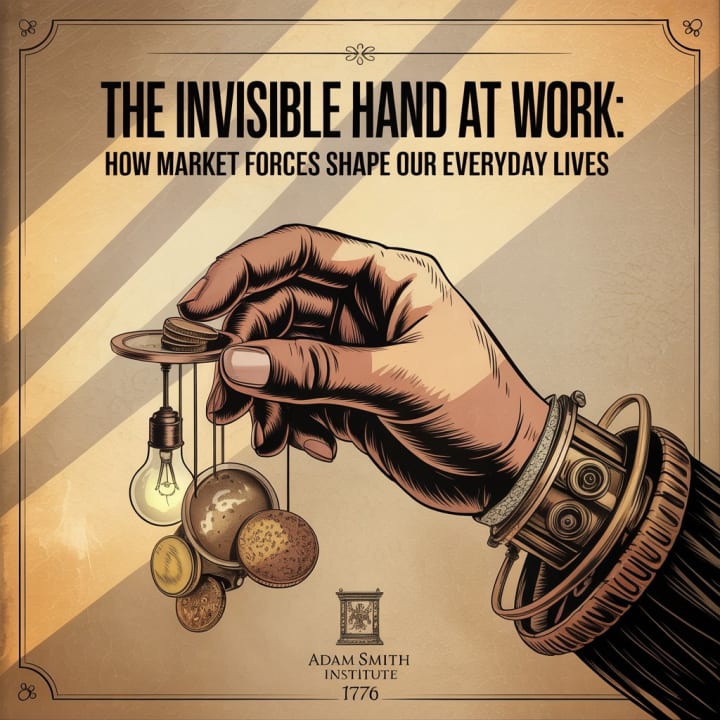
The Invisible Hand at Work
How Market Forces Shape Our Everyday Lives


Have you ever wondered how your local grocery store always seems to have fresh bread, seasonal fruits, and your favorite cereal in stock? Or how ride-sharing apps match drivers and passengers within seconds? It’s easy to assume there's some central planner orchestrating all this. In reality, it’s the work of something far more subtle — the invisible hand of the market.
The term “invisible hand” was coined by Scottish economist Adam Smith in the 18th century. It describes the self-regulating nature of a free market economy, where individuals pursuing their own interests inadvertently contribute to the overall good of society. While no one tells a farmer to grow wheat or a truck driver to deliver it to a city bakery, the needs and behaviors of consumers and producers coordinate these activities almost seamlessly.
This invisible hand is not a mystical force. It’s simply the result of supply, demand, competition, and incentives interacting in a decentralized system. And its effects are all around us — shaping prices, determining what products succeed or fail, and even influencing innovation and labor markets.
From Self-Interest to Social Benefit
Adam Smith’s insight was that when individuals act in their own self-interest — say, a baker trying to make a living — they also end up serving others. The baker wants to sell bread to make money, but to do that, he must provide a product people want, at a price they’re willing to pay. The end result is that the community gets fresh, affordable bread, even though the baker wasn’t trying to feed the town out of generosity.
Multiply this simple transaction across millions of consumers and businesses, and you begin to understand how a modern economy functions. No single entity coordinates it, but each participant, through their own decisions, contributes to a system that — ideally — benefits everyone.
The Price System: A Language of Its Own
Prices are one of the invisible hand’s most powerful tools. They act as signals to both buyers and sellers. If the price of coffee rises, consumers might buy less or switch to tea, while suppliers might plant more coffee to profit from higher prices. Over time, these adjustments bring the market back toward equilibrium — a state where supply meets demand.
For example, during a natural disaster, the price of bottled water may spike. Critics often call this price gouging, but from an economic perspective, higher prices signal scarcity and encourage conservation. They also attract more suppliers who want to take advantage of the high price, ultimately increasing availability and driving prices back down.
Of course, this assumes a competitive and fair market. Without regulation, the invisible hand can sometimes lead to exploitation or inequality — something Smith himself acknowledged.

Innovation and Competition
Another effect of the invisible hand is its role in driving innovation. In a competitive market, businesses must constantly improve to attract and retain customers. That’s why smartphones keep getting better, streaming services offer more content, and restaurants experiment with new flavors.
Companies that ignore consumer preferences risk going out of business. In this sense, the market rewards efficiency, creativity, and responsiveness — all without the need for central oversight.
Take the example of food delivery apps. No government agency ordered their creation. Instead, entrepreneurs identified a demand for convenience and used technology to meet it. As a result, consumers enjoy faster service, restaurants reach more customers, and couriers earn income — a win for all participants.
Labor Markets and Career Choices
The invisible hand also shapes our career paths. When there’s a growing demand for tech skills, wages in that field tend to rise. This attracts more students and workers to tech-related jobs, increasing the supply of skilled labor. Over time, this can help balance shortages and surpluses in the job market.
This doesn’t mean every decision is perfectly efficient or fair — systemic issues, barriers to education, and market failures can distort outcomes. But in a flexible economy, these signals help millions of people make informed decisions without centralized planning.
Limitations and the Need for Guardrails
While the invisible hand works wonders in many areas, it’s not flawless. Market failures can occur — such as pollution (a negative externality), public goods that aren’t profitable to produce, or monopolies that stifle competition. In these cases, government intervention may be needed to correct imbalances and protect public interest.
Even Adam Smith recognized the role of the state in areas like education, infrastructure, and legal systems. The invisible hand guides us most effectively when it operates within a framework of rules, transparency, and accountability.
Everyday Decisions, Global Impact
From choosing which brand of coffee to buy to deciding whether to work remotely or in an office, we’re all part of the marketplace. Our individual decisions, when added together, send powerful signals that ripple through supply chains, labor markets, and even international trade.
Consider how consumer interest in sustainability has pushed companies to reduce plastic packaging, source ethically, and cut carbon emissions. These changes didn’t come from top-down mandates — they were largely driven by market demand and social pressure.
Conclusion
The invisible hand isn’t a magical force — it’s a reflection of human behavior in a system of exchange. When it works well, it aligns personal ambition with collective benefit, creating order without command.
Understanding how this force operates empowers us to make smarter decisions — as consumers, workers, investors, and citizens. And while the market can’t solve every problem, its unseen guidance helps keep our world running, often without us even noticing.
Next time you order your favorite coffee or catch a ride through an app, remember — you’re not just using a service. You’re part of a vast, invisible dance of supply and demand, orchestrated not by a conductor, but by the quiet logic of the market.
About the Creator
Essa Safi
Economics graduate turning complex ideas into simple, impactful stories. Passionate about financial literacy, real-world economics, and content that educates and inspires.
Australia Makes £4.5 Trillion Find That Could Change the World’s Economy
Australia is already one of the world’s leading mineral producers, but a new discovery of iron ore valued at roughly £4.5 trillion (about US $6 trillion) could elevate the country’s role in the global economy even further. Hidden deep under Western Australia’s Hamersley region, one of the richest iron ore deposits ever identified is drawing attention across markets and governments alike due to its sheer scale and quality.
By Salaar Jamali3 days ago in Journal




Comments
There are no comments for this story
Be the first to respond and start the conversation.