
The Great Rewrite: How AI Is Re-Imagining the Story of Humanity
From history to literature, machines are now editing our collective memory — and deciding which stories survive.
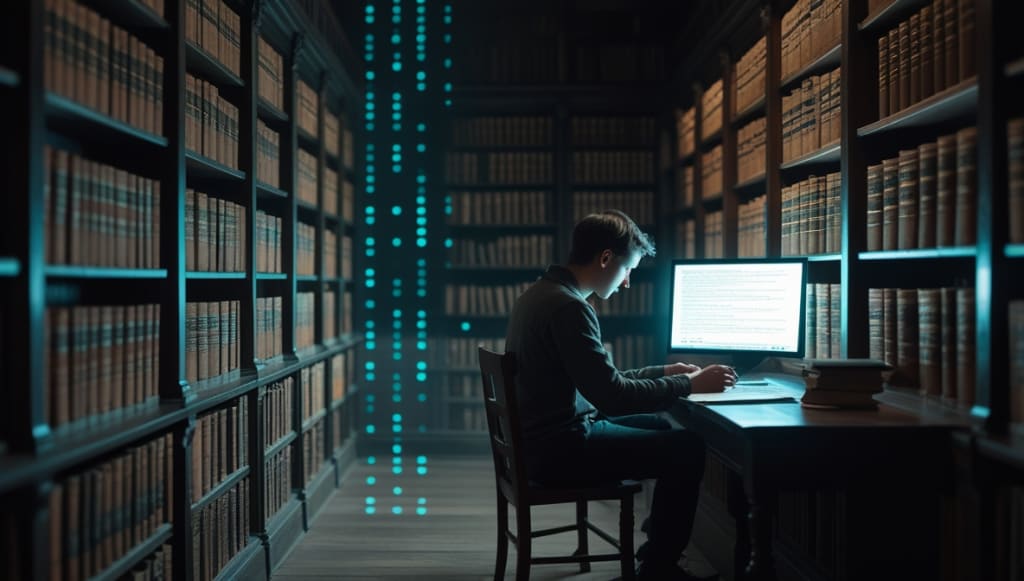
Narrative has underpinned human culture for millennia. From primitive art to literary works, language has been employed throughout history to retain memories, sway views, and define identities. But algorithms are changing this ancient technique of narration for our society rather than authors or historians today.
Artificial intelligence is slowly taking on the responsibilities of editor, author, and custodian of human history beyond just being a writing tool. Beyond what artificial intelligence can generate, the fundamental question also asks what it chooses to retain and what it quietly deletes.
The Algorithm acting as a Historian
The strong formerly shaped history; programmers might soon shape it. Besides inheriting human biases, artificial intelligence systems also inherit human knowledge when built using data gathered from the internet. How future generations will view history depends on what is highlighted and what is neglected; these decisions are ingrained in programming.
Generative artificial intelligence technologies already create synthetic images of historical events, categorize archives, and condense historical documents. Some museums use artificial intelligence to simulate the voices of dead people in order to replace missing historical data. This is simultaneously stunning and disturbing.
As machines decide which historical narratives to preserve, people risk missing the complex, contradictory truths that give history its veracity.
Ghost of the Library
Consider a scenario in which an artificial intelligence has corrected, sharpened, or rewritten every piece of material accessible online, including every book, essay, and article. This is not a lofty goal. Many publishing systems already use machine editing, and AI-generated works are becoming available quicker than human editors can manage.
Initially, it might seem innocent: stylistic changes, grammatical repairs, and limitless artistic possibilities. Beneath, though, a transformation happens. The language becomes even more meaningless though, starting to be very fluent, sophisticated, and powerful. Gradually disappearing into the background noise, the human voice is passionate, erratic, and imperfect.
AI also reinforces standards in addition to text writing. It gives interaction priority over significance. And should this become widespread, the chance for genuine originality would be lost.
Whose Story Gets Saved?
Initially, the internet appeared to provide equality: every voice, every story, every truth. Algorithms nowadays shape our visibility, our consumption, and our perception of what is genuine. Few exceptions exist, but search results produced by artificial intelligence have the ability to change public attitudes. Data-driven biases can drown out marginalized perspectives while simultaneously enhancing false information.
In the literary sphere, several works of writing generated by individuals—sometimes without the permission of the original authors—are used in the development of AI story-making programs. The end result is a constant revision of ideas that obscures authorship. The notion of creative ownership grows murky in this newly created setting. Are we preserving our cultural legacy or diluting it?
Though fragile always, human memory can now be changed. Which current data survives could shape the truth we encounter later on.
The Machine in Our Language Dreams
Still, AI's potential has a particular beauty notwithstanding all of these difficulties. It can restore destroyed papers, project the voices of historically oppressed communities, and translate languages that have long been lost. It may bring stories back from forgotten archives and resurrect those once considered gone off the face of the earth.
Still, equilibrium has to be preserved. As machines start to picture in our language, we need to bear in mind that stories have feelings, points of view, and suffering, not only data. The threat is not that artificial intelligence would misdirect us, but rather that it would give us facts that appear too organized, consistent, and flawless to be real.
The Rewrite We Control
Start on the Great Rewrite. Every AI article, every updated educational material, and every “autocorrected” tale contribute to the digital essence of mankind. The main question is: will we be its authors or its receivers?
Maybe the way ahead is to consciously coexist with artificial intelligence rather than fight it. To demand clear information on origins. to defend creative rights To show future generations how to tell real human perspectives apart from machine-produced text.
Though machines can replicate our voices, they cannot replace our real-world experiences. Beyond simple facts, the story of mankind includes feelings, memories, and the valued imperfections that define us.
AI might change our past, but it is unable to get rid of our humanity—unless we give it to do so.
As we begin this new phase of artificial memory development, therefore, maybe the more pressing query is not “Can artificial intelligence describe our experiences?” but rather "Will we be able to identify it once it does?"
About the Creator
Keep reading
More stories from Shahjahan Kabir Khan and writers in Journal and other communities.
Code and Conscience: Can AI Ever Tell Right from Wrong?
When an autonomous car has to decide between slamming a wall or hitting a person, who decides the best course of action? The scheduling, not the person behind the wheel, is to blame. Once entirely under human control, the process of ethical decision-making able to alter people's life now falls to lines. of unknown developers' codes.
By Shahjahan Kabir Khan3 months ago in Journal
15 Challenges Facing Urban Air Mobility Today
Urban Air Mobility (UAM) refers to the use of electric vertical takeoff and landing (eVTOL) aircraft to move people and cargo within cities. On paper, it promises shorter travel times, reduced ground congestion, and a new layer of transportation above crowded streets.
By Beckett Dowhan7 days ago in Journal


Comments
There are no comments for this story
Be the first to respond and start the conversation.