
Code and Conscience: Can AI Ever Tell Right from Wrong?
As algorithms begin making moral choices — from policing to warfare — humanity faces a mirror it can’t control.
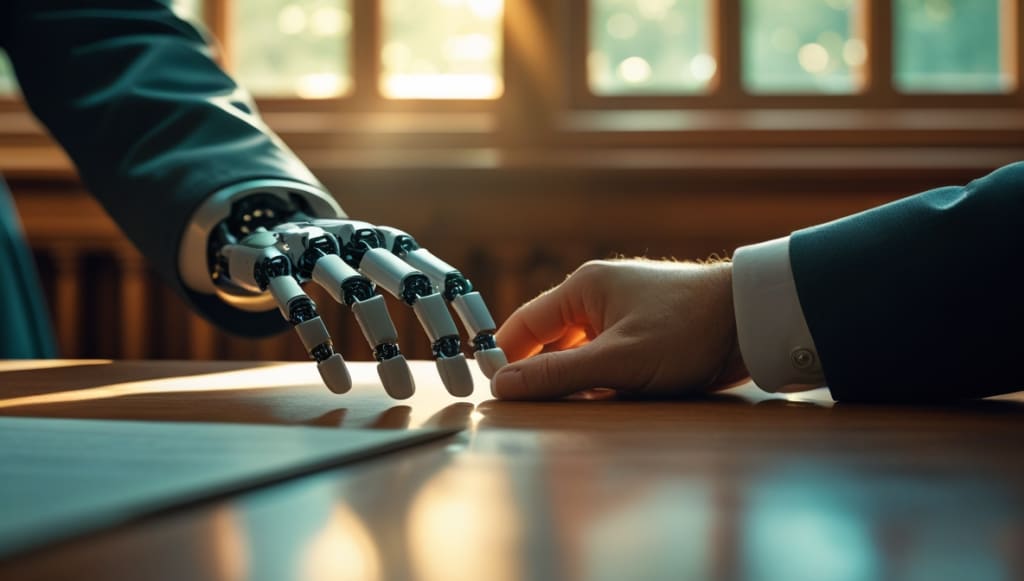
When an autonomous car has to decide between slamming a wall or hitting a person, who decides the best course of action? The scheduling, not the person behind the wheel, is to blame. Once entirely under human control, the process of ethical decision-making able to alter people's life now falls to lines. of unknown developers' codes.
Artificial intelligence has infiltrated a field formerly reserved only for moral thinking. In a range of activities, from evaluating outcomes to assessing human behavior to respond—sometimes faster and more effectively than people—machines have been given capabilities. From piloting unmanned aircraft to foretelling criminal activity, more precisely than we have been able to. This development, however, is accompanied by an increasing feeling of uneasiness: how can we trust institutions that make ethical decisions without guilt, empathy, or compassion?
Ethics becomes quantitative
For humans, morality has always been complex and subtle. The shades of gray arising from emotions, context, and emotional intelligence define our humanity. On the other hand, artificial intelligence regards events in absolutes and analyzes data as knowledge. It simplifies moral complexity to trends, probabilities, and results.
Consider predictive policing. Computational algorithms examine massive volumes of past crime statistics to find high-risk areas or people. Though it appears effective at first, data is by its nature skewed. If it is biased, the algorithm passes on prejudices from past information. Under the veil of fairness, this could lead to the unequal targeting of particular groups or people, thereby reinforcing stereotypes.
Under conditions of war, the stakes rise dramatically. Military drones are under development to independently identify and neutralize hazards. Advocates say that AI will make quicker, more precise decisions on the battlefield than humans, devoid of weariness or fear. Is it ethical for machines to fight, though, if there are no people left to bear accountability for such decisions?
Mathematical formulations of ethical concepts take precedence above human empathy. The most crucial issue is whether artificial intelligence understands the need of the decision rather than if it can make the correct one.
The Illusion of Neutrality
Though tech firms often claim their inventions are impartial, ethical concerns prevent genuine neutrality. Every algorithm mirrors the ideas of its authors, the people who decide what information to emphasize, what to include, and what to ignore.
Think about how an artificial intelligence might assess fairness. Is its primary concern justice rather than safety? Or would efficiency conquer over empathy? If it studies legal documents, it can duplicate the strongly entrenched errors found in those systems. Social media, though, could make it think rage is real.
One little risk arises from artificial intelligence's adoption of moral norms rather than their creation. Because of their intricacy, the ethical justification of algorithms is also often unclear even to the people who developed them. One cannot interrogate a neural network. Why cannot we inquire?
A judge or warrior is held responsible for committing an error. But who is accountable for an artificial intelligence's errors: the company, the software, or the developer? In our haste toward automation, we have created systems at a speed quicker than that of legislation to control them.
Mirror Test
AI somewhat reflects our moral judgment instead of replacing it. When we question if a machine can differentiate right from wrong, we are essentially asking: Can a machine tell right from wrong?
The truth is disconcerting. We have fed enormous volumes of human behavior to algorithms; a significant portion of this behavior is detrimental. The information reveals our biases, avarice, and moral inconsistencies. Consequently, when artificial intelligence depicts something bad, the machine is not to blame. The mirror shows reality raw.
The goal of artificial intelligence ethics might be to highlight the vulnerability of our own moral instinct rather than to build moral robots. Every algorithm that falls reminds us of who we still are.
A Future That Still Needs Us
Though intelligent, artificial intelligence lacks compassion and guilt sense. Though it might resemble compassion, it does not grasp it. Although it follows the standards, it cannot handle the results. Conscience is founded on living experiences, not on logic. It involves admitting to mistakes, remembering difficulties, and appreciating the character of mankind.
This clarifies the cause of the likely endless inability of the idea of moral AI. Although systems may be taught to identify ethical patterns, they will never possess the moral weight of decision-making. They will analyze the results but will not grasp the fundamental meaning.
The issue is therefore one of stopping people from becoming more robot-like rather than of creating more human-like robots. In our search for perfection, we cannot let ourselves delegate the essence of our humanity: the capacity to give kindness over calculation of top importance, even at the expense of efficiency.
As technology advances, how we choose to use artificial intelligence will determine the future, not the decisions made by AI. Though the computer could lead us, we nevertheless have to be responsible for our moral compass.
About the Creator
Keep reading
More stories from Shahjahan Kabir Khan and writers in Journal and other communities.
The Digital Messiah: What Happens When Faith Meets Artificial Intelligence
When a Texas preacher recently revealed his church's newest assistant, an artificial intelligence chatbot created to aid with biblical interpretation, the throng was speechless. Some were interested; others appeared uncomfortable. The pastor told the congregation, it's really helping me with sermon preparation. Still, it was clear everyone was secretly concerned about if the bot in a quiet, nearly human voice was really saying a Bible verse. Is it a matter of programming now or does it depend on faith?
By Shahjahan Kabir Khan3 months ago in Journal
The 5 AM Myth: Why I Trashed My Alarm Clock to Finally Find My Edge
The blue light of the smartphone screen felt like a laser beam hitting my retinas at 4:58 AM. Outside my window, the world was a bruised purple—silent, freezing, and utterly indifferent to my "ambition."
By George Evan7 days ago in Journal



Comments
There are no comments for this story
Be the first to respond and start the conversation.