
The Forbidden Chip: How Huawei Defied Sanctions and Sparked China’s Tech Revolution
Born under sanctions and built in silence, Huawei’s “Forbidden Chip” isn’t just silicon — it’s a symbol of defiance, ambition, and a shift in global power.
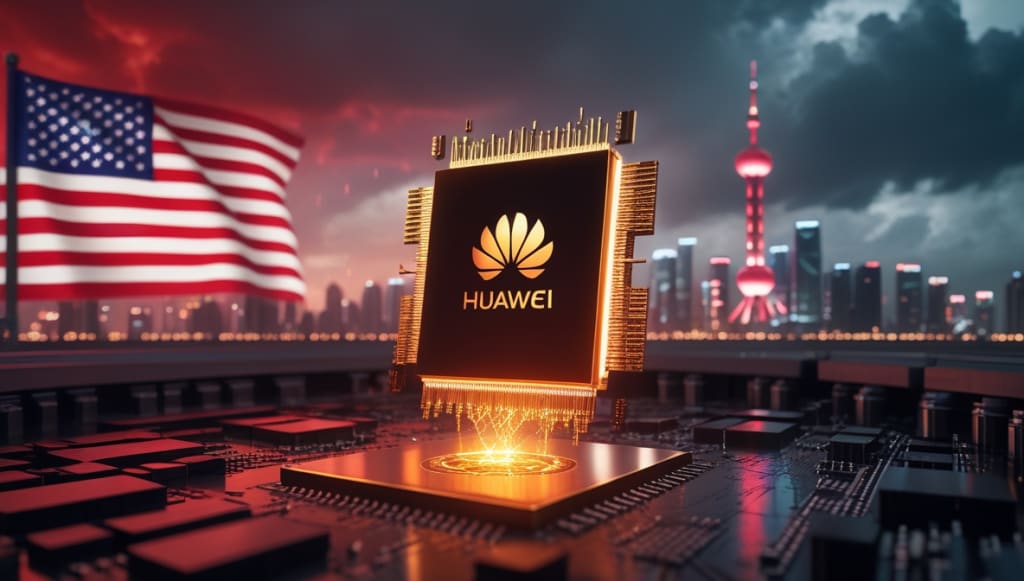
When a Reuters report revealed that Huawei was preparing to start large-scale supply of its newly developed chip—possibly as soon as next month—the global tech world went still.
For years, Huawei was a pariah, crushed beneath one of the harshest sanction regimes in modern history. Yet here it was, rising again with a chip that, by Washington’s own rules, should not exist.
Imagine it: the decade’s most talked-about semiconductor, built not in Silicon Valley or Taiwan, but deep inside China—under embargo, without access to Western machinery.
The company that America tried to erase has built a forbidden chip that could reshape the balance of global technology and power.
The Fall of a Giant
In the late 2010s, Huawei wasn’t just another smartphone brand. It was China’s pride—a world leader in 5G networks and, briefly, the second-largest smartphone manufacturer on Earth, even surpassing Apple.
That success triggered alarm in Washington.
The U.S. government, first under Donald Trump and later Joe Biden, unleashed a wave of sanctions designed to cut Huawei off from the lifeblood of modern technology: semiconductors.
The plan was surgical. Huawei couldn’t work with TSMC, the world’s top chipmaker. Any company using American software or machinery was forbidden from supplying it. Its entire supply chain collapsed overnight.
By 2020, Huawei’s smartphone sales had cratered. Western analysts wrote obituaries. For the U.S., it was proof that sanctions could choke not just a company—but an entire nation’s ambition.
But they underestimated one thing: Huawei’s endurance, and China’s determination.
The Counterattack
When the walls closed in, Huawei didn’t quit. It turned inward.
The company poured billions into research, joined forces with SMIC (Semiconductor Manufacturing International Corporation), and quietly began developing chips without Western tools.
Beijing transformed its “Made in China 2025” initiative from a long-term vision into a survival plan. Billions in subsidies flowed in. Universities, startups, and state-backed firms collaborated. For the first time, China’s entire tech sector moved as one.
While the world believed Huawei had disappeared, it was rebuilding in silence.
And then, in a moment no one expected—it returned.
The Birth of the Forbidden Chip
The new chip—quickly dubbed “The Forbidden Chip”—was a marvel of defiance.
Under sanctions, Huawei had no access to EUV lithography machines from ASML or advanced chip-design tools from the U.S. Yet it produced a 7-nanometer processor, something experts said was impossible.
It isn’t the most advanced—Apple and Nvidia are already at 3 nanometers—but reaching 7 nm under those constraints is like building a skyscraper without steel or elevators.
So how did Huawei do it? Through multi-patterning, a method that stretches older DUV lithography beyond its intended limits. By layering the same process repeatedly, engineers achieved EUV-level precision. It’s slow, costly, and less efficient—but it works.
And in geopolitics, working is victory enough.
A Symbol of Defiance
This chip is forbidden not just because it defied sanctions, but because it defied expectations. It proved that technological dominance is not eternal.
Huawei’s processor doesn’t yet outperform Nvidia’s or Apple’s, but it proves that China can now compete independently. Huawei no longer needs TSMC or Western-approved suppliers. It can design and manufacture within its borders—a priceless breakthrough for Beijing.
Some analysts dismiss it as unsustainable. Others warn production is too limited. But history shows that once a country grasps a technology, progress accelerates.
Japan in the 1980s. South Korea in the 1990s. Taiwan in the 2000s. Now, it’s China’s turn.
As Sanctions Tried to Isolate, They United
Ironically, sanctions that sought to isolate Huawei instead unified China’s tech sector.
Rival companies found common cause: survive, innovate, and become self-reliant. The government provided billions in subsidies, shielding domestic firms from short-term losses and giving them freedom to experiment.
Meanwhile, China reshaped its global partnerships. Nations across Africa, the Middle East, and Latin America—many of whom already relied on Huawei for affordable telecom infrastructure—now view China as a rising chip supplier.
Washington has one global pipeline.
Beijing is quietly building another.
This doesn’t mean China has overtaken the West overnight. The U.S. and its allies still dominate cutting-edge chip manufacturing. But the balance of power is no longer one-sided.
By producing advanced chips despite sanctions, China broke the psychological barrier of dependence. The game is no longer about who has the best chip today—but who controls the supply tomorrow.
Shockwaves in Silicon Valley
Huawei’s chip launch didn’t just shake engineers—it rattled boardrooms and parliaments across the world.
For Nvidia, it’s a direct threat. Its AI chips have powered Wall Street’s faith in Silicon Valley’s dominance. But if Huawei and SMIC can produce 7-nm AI processors—perhaps slower, but far cheaper—entire nations could switch.
Countries in the Middle East, Africa, and Latin America would no longer need Washington’s approval to access advanced AI hardware.
For Apple, the danger is different but no less real. Huawei’s resurgence comes with patriotic fervor. In China, buying a Huawei phone has become a statement of national pride. That sentiment could erode Apple’s market share in its most lucrative foreign market.
And for Washington, Huawei’s comeback is a policy nightmare. The sanctions strategy, meant to halt China’s progress, instead accelerated its self-reliance.
Now policymakers face a dilemma: too much pressure risks backfiring; too little risks losing ground in the global tech race.
Markets in Motion
Wall Street is watching nervously.
For years, investors poured billions into Nvidia, TSMC, and ASML, betting that China could never catch up. Huawei’s chip shattered that confidence.
It doesn’t mean Nvidia’s profits vanish overnight—but uncertainty has entered the market. And uncertainty is the enemy of confidence.
Now, capital is flowing eastward, toward Chinese semiconductor firms. The winds of innovation are shifting.
The Final Word
Huawei’s “Forbidden Chip” has transformed what was once a technological death sentence into a geopolitical earthquake.
The sanctions meant to cripple China may have instead triggered its awakening.
For the first time in decades, the global tech race feels genuinely open—no longer dictated by one side, but contested by two.
This chip isn’t just hardware. It’s a message:
Innovation can’t be banned.
Progress doesn’t need permission.
And in the new age of artificial intelligence, that message may define the century.
About the Creator
Reader insights
Nice work
Very well written. Keep up the good work!
Top insights
Easy to read and follow
Well-structured & engaging content
On-point and relevant
Writing reflected the title & theme
Keep reading
More stories from Shahjahan Kabir Khan and writers in Journal and other communities.
Earthquake Warnings: Can Science and Scripture Both Be Right?
For millennia, earthquakes have upset not only the ground we stand on but also our knowledge of how the cosmos works. Some see them only through the lens of geology: the ongoing movement of tectonic plates with stress building up and then discharging below the Earth's surface. Conversely, some people look more deeply—or lift their perspective—wondering if these occurrences might be telling us, alerting us, or even signaling forces outside human understanding. A fascinating problem arises in 2025 as our planet is increasingly wracked by earthquakes and technology is moving at breakneck pace: Can both religious scriptures and scientific reasoning be genuine?
By Shahjahan Kabir Khan4 months ago in Journal
The goals I did not achieve
Every writing goal I made for the year is a wash. It has been this way for a while, but I think it's important to be open about my failures and the reality of how life can get in the way. This is especially true considering the several times I have posted on Vocal about my writing goals, how I was changing my approach, and where I was hoping to be for the upcoming year. I will probably do that again in a couple months, but for now, it is time to acknowledge where I am today.
By Kay Husnick23 days ago in Journal
The ChatGPT Tell-All: I Fixed The 5 Mistakes That Made My Content Sound Fake
How I Stopped Sounding Like a Robot and Saved My Blog (And The 5 Mistakes That Gave Me Away) Let me be brutally honest with you for a second. There was a time last year when I was pretty proud of myself. My content calendar was packed, posts were going up like clockwork, and I felt like I’d finally cracked the code. I had this new, incredible tool—you know the one—and it was like a superpower. Suddenly, the blank page wasn’t scary anymore. I’d hit a button, and poof, a perfectly competent, grammatically pristine article would appear.
By John Arthor2 days ago in Journal



Comments
There are no comments for this story
Be the first to respond and start the conversation.