
The Democratic Governor of Maine vetoed an offshore wind bill due to labor requirements
Offshore Wind Permitting


Maine Gov. Janet Mills rejected a bill aimed at boosting the state's offshore wind industry on Monday, claiming that the proposal would exclude the bulk of the state's construction employees due to labor rules.
The decision pitted the Democratic governor against the Biden administration, which has frequently stated that new clean-energy employment will be unionized and well-paying.
"We would expect this kind of opposition from a Republican governor." But having a Democratic governor obstructing the president's plan was unexpected," said Francis Eanes, executive director of the Maine Labor Climate Council, a coalition of a dozen unions from around the state.
According to the state's Offshore Wind Roadmap, an elaborate plan prepared by the governor's office in cooperation with outside experts, offshore wind generation is poised to play a critical role in helping Maine fulfill its climate goals.
According to the plan, "it is highly improbable that Maine will be able to meet its future energy requirements solely through onshore renewable energy sources." Instead, it anticipates that Maine would require 2.1 to 2.8 gigatonnes of offshore wind by 2050.
"When it comes to meeting climate targets, offshore wind is the biggest lever we can pull," said Kathleen Meil, senior director of policy and partnerships for the environmental group Maine Conservation Voters.
The specifics
The bill, L.D. 1847, originated in Mills' office. Its original purpose was to establish environmental criteria for ports that enable the development, building, and operation of offshore wind projects.
However, Democratic lawmakers changed the bill to force corporations working on port developments to employ project labor agreements, or PLAs. PLAs often require businesses to pay the prevailing wage and engage registered apprentices. Nothing, according to labor advocates, would prevent non-unionized enterprises from competing for a PLA.
In a letter to lawmakers, Mills stated that this provision may harm Maine-based construction workers because more than 90% of them are not unionized. According to her, the PLA requirement would have a "chilling effect" on non-unionized businesses.
"I do not believe any of us want to see out-of-state workers being bussed up to coastal Maine to build our offshore wind port while Maine workers are sidelined, sitting at home," she wrote.
Mills has also threatened to veto another bill that includes PLAs. L.D. 1895 would commit Maine to achieving 3,000 megawatts of offshore wind power by 2040.
Maine is impatient.'
Since entering office in January 2019, Mills has pushed an aggressive climate agenda under the slogan "Maine can't wait."
- Mills signed a law in June 2019 mandating the state to cut greenhouse gas emissions by 45 percent by 2030 and 80 percent by 2050 compared to 1990 levels.
- In February, the governor declared a goal of 100 percent clean electricity by 2040.
Mills has also been a prominent supporter of building floating wind turbines in the deep seas of the Gulf of Maine, to the point where many lobstermen believe the governor "isn't doing enough to defend their livelihood," according to the Bangor Daily News.
"The Gulf of Maine has some of the strongest wind speeds in the world, representing a large source of potential energy for Maine and New England," Mills said during a Biden administration-hosted summit in February.
'Maine will be patient.'
Mills, though, has disagreed with the Biden administration on the inclusion of robust labor standards in hallmark climate programs.
- The Inflation Reduction Act of last year included billions of dollars in clean-energy tax credits that grow exponentially if businesses meet prevailing wage and apprenticeship criteria.
- The bipartisan infrastructure law of 2021 also established grant programs for port redevelopment that prioritize applicants who adhere to strict labor requirements.
However, Jack Parker, chairman and CEO of Reed & Reed, a Woolwich, Maine-based contractor, hailed the governor's veto.
"All of our employees voluntarily chose to work in a non-union environment," Parker explained in an email. "Why should politicians decide to exclude our employees, as well as the remaining 90% of Maine construction workers, from Offshore Wind?"
The next step
Last week, the Maine Legislature was scheduled to adjourn. However, lawmakers are continuing to meet in order to conclude outstanding work before the Fourth of July vacation weekend.
Maine state Sen. Chip Curry, a Democrat who introduced L.D. 1847, said he is in discussions with the governor's office about changing the measure to gain her approval, but he declined to provide specifics.
"In the governor's letter, she indicated an openness to continuing negotiations," Curry explained. "So we're still completely immersed in it." We're looking for areas where we can all agree."
About the Creator
Erik Roelans
I am founder and CEO of ER-MARINE and write about the green energy transition, renewable energy challenges, climate change, offshore wind permitting, policy dialogue, marine biodiversity, renewables and floating offshore wind development.
Keep reading
More stories from Erik Roelans and writers in Journal and other communities.
Addressing the Triple Planetary Crisis: Collaborating with Multiple Stakeholders for a Sustainable Future
Introduction The globe is being confronted with an extraordinary issue known as the triple planetary crisis, which includes climate change, biodiversity loss, and pollution. Because these challenges are linked, concerted effort from numerous stakeholders is required to effect significant change. Governments, corporations, youth, civil society organizations, academic and research institutions, and the media all play important roles in resolving these serious concerns. In this essay, we will look at how these various stakeholders might work together to support and participate in a common endeavor to create a more sustainable future.
By Erik Roelans3 years ago in Journal
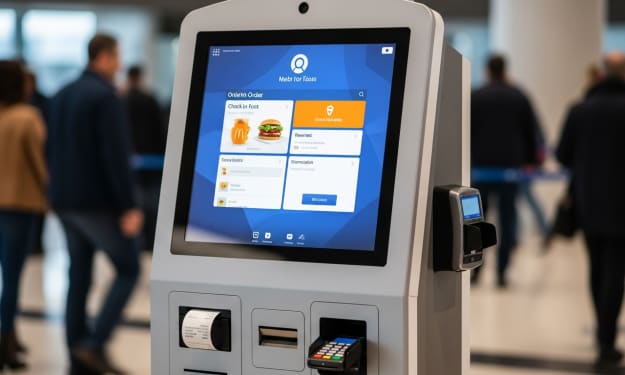
From Voice to Touch: Evolution of Ordering with the McDonald’s Drive Thru Kiosk
For decades, the McDonald’s drive-thru has been a symbol of speed and convenience, allowing customers to place orders through a speaker system without leaving their vehicles. While this voice-based model served millions efficiently, changing consumer expectations and rapid advancements in technology demanded a smarter, more accurate solution. This shift has led to the evolution of the McDonald’s Drive Thru kiosk, marking a major milestone in how quick-service restaurants use the kiosk machine to enhance customer experience.
By Athulya Ns7 days ago in Journal



Comments
There are no comments for this story
Be the first to respond and start the conversation.