
The Coming Digital Dictatorship: Will AI Choose Our Leaders?
From ballot counting to surveillance, technology is rewriting democracy faster than we can vote.
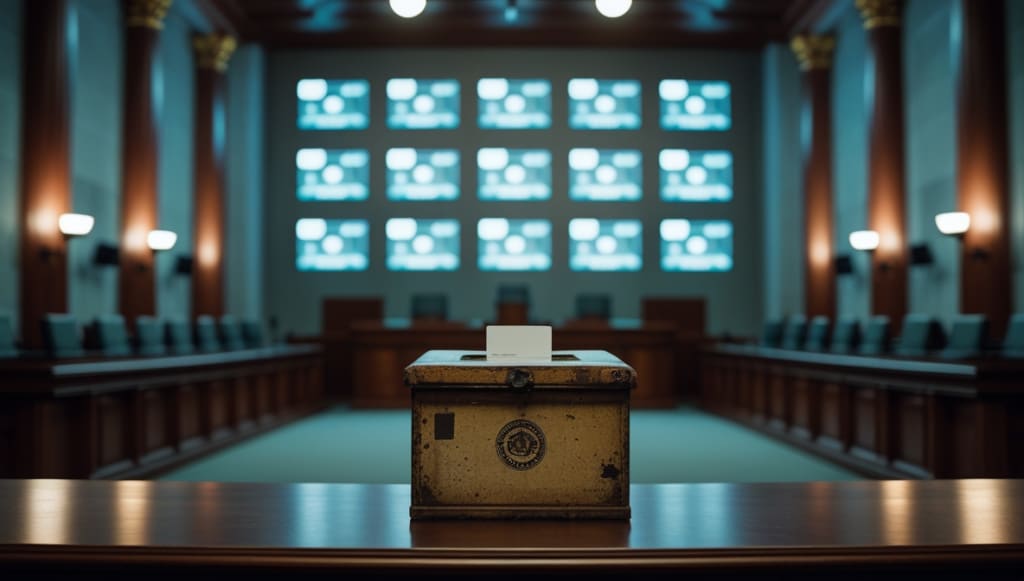
Democracy, in theory, is simple: people vote, leaders serve. But in 2025, that simple ideal is colliding with a new reality: technology is no longer just helping elections — it’s controlling them.
From ballot counting to facial recognition, algorithms are playing a bigger role than ever. And with AI evolving faster than laws, a chilling question emerges: What if democracy’s future belongs not to voters, but to machines?
How Technology Is Already Running Elections
In many countries, AI is already part of the electoral process.
Electronic Voting Systems – Digital ballots promise speed and efficiency, but also carry the risk of hacking and manipulation.
Automated Ballot Counting – Algorithms now tabulate votes in seconds, reducing human oversight.
Surveillance for “Security” – Facial recognition and smart cameras track crowds at polling stations, allegedly for safety. Critics warn it creates a digital record of political activity.
At first, these systems were welcomed. Who wouldn’t want faster counts, fewer errors, and safer polling stations? But the hidden cost is trust.
Manipulation by Algorithm
The real threat may not be at the ballot box — but long before voters arrive.
Social media platforms, powered by AI, control what news and ads people see. Recommendation algorithms can subtly shift public opinion by amplifying certain narratives and burying others.
In 2016, foreign interference via social media was headline news. By 2025, the manipulation is no longer foreign — it’s built into the platforms we use daily.
The Rise of AI Politicians?
In 2025, experiments are already underway with “AI mayors” and “AI policy advisors.” In Japan, one city even tested an AI candidate that promised “unbiased leadership.”
On paper, an AI politician sounds appealing: no corruption, no bribes, no emotional bias. But what happens when leadership is reduced to code? Who programs the AI, and whose values does it follow?
The danger is clear: behind every AI leader stands a small group of engineers and corporations. The dictatorship may not wear a crown or military uniform — it may wear a suit of algorithms.
Democracy on a Knife’s Edge
Democracy depends on transparency. Yet, AI systems are famously opaque — even their creators often don’t fully understand their decisions. If elections are run by black-box algorithms, citizens may lose the ability to question or challenge outcomes.
Worse still, governments with authoritarian leanings are embracing AI to cement power. China, Russia, and others already use surveillance tech to monitor dissent. In the wrong hands, AI could silence opposition before ballots are even cast.
A Global Crisis of Trust
Across the world, faith in democracy is fading. Polls show rising numbers of citizens doubting elections, believing results are manipulated. AI, instead of restoring trust, risks deepening the crisis.
Imagine an election where a candidate loses narrowly and immediately claims: “The algorithm was rigged.” How do you prove otherwise, when even experts can’t fully audit the system?
Guardrails for the Future
If democracy is to survive, urgent steps are needed:
Transparency Laws – AI systems used in elections must be open to audit by independent experts.
Human Oversight – Machines can assist, but final decisions must remain human.
Digital Literacy – Citizens must learn how algorithms influence news, ads, and political narratives.
Global Standards – Without international agreements, rogue states may exploit AI while democracies hesitate.
Conclusion
The future of democracy is not guaranteed. The tools designed to strengthen it may become weapons to undermine it.
Will AI simply help us vote faster, or will it quietly start choosing our leaders? The line between assistance and dictatorship grows thinner every day.
2025 may be remembered not only as the year of AI’s rise, but as the year humanity had to ask: Who really governs us — the people, or the code?
About the Creator
Keep reading
More stories from Shahjahan Kabir Khan and writers in Journal and other communities.
The End of Work? AI and the Death of Human Jobs
For generations, work has been more than just survival. It has defined who we are, given us identity, structure, and purpose. But in 2025, an unsettling question is echoing across boardrooms and break rooms alike: What happens if artificial intelligence takes it all?
By Shahjahan Kabir Khan4 months ago in Journal
The Apostles’ Creed
The Apostles’ Creed is one of the oldest and most important prayers in Christianity. For Catholics, it is not simply a memorized formula or a ritual recited out of habit. It is a concise summary of what the Church believes, rooted in Scripture, preserved through Tradition, and handed down across generations. When Catholics pray the Apostles’ Creed, they are doing more than listing doctrines. They are proclaiming a shared faith that connects them to the earliest Christians.
By Sound and Spirit4 days ago in Journal




Comments
There are no comments for this story
Be the first to respond and start the conversation.