
The End of Work? AI and the Death of Human Jobs
Factories, offices, even creative industries — if machines take it all, what happens to us?
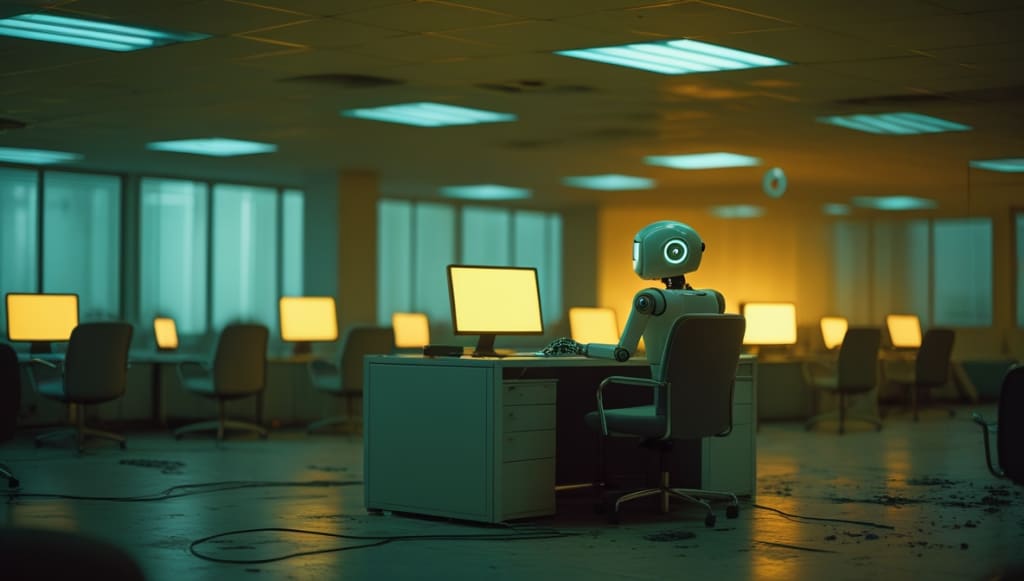
For generations, work has been more than just survival. It has defined who we are, given us identity, structure, and purpose. But in 2025, an unsettling question is echoing across boardrooms and break rooms alike: What happens if artificial intelligence takes it all?
The promise of AI was efficiency. The reality may be obsolescence. Factories, offices, even creative industries are being reshaped by machines that don’t sleep, don’t unionize, and don’t demand health insurance. For millions of workers worldwide, the end of work no longer feels like a distant sci-fi scenario. It feels like tomorrow morning.
From Assembly Lines to Algorithms
The first jobs to feel the pressure were in factories. Robots replaced workers on assembly lines decades ago, welding car doors and packaging goods with precision. Then came retail self-checkouts, which quietly eliminated thousands of cashier jobs.
But 2025 has shown us something new: it’s not just manual labor at risk — it’s intellectual labor too. White-collar professionals, once thought immune, are watching AI do their jobs faster and cheaper.
Lawyers face AI systems that can scan case law and draft briefs in seconds.
Doctors compete with AI that analyzes symptoms and delivers near-instant diagnoses.
Writers, designers, and musicians are seeing algorithms create stories, art, and music at scale.
It is not just low-wage jobs disappearing — it’s entire industries transforming before our eyes.
The Numbers Don’t Lie
A recent World Economic Forum report predicts that by 2030, over 800 million jobs could be displaced by automation and AI. That’s roughly one in five workers worldwide. Already, companies in finance, marketing, and media are experimenting with AI-driven departments where human supervision is minimal.
In the U.S. alone, 2025 has seen mass layoffs across major industries, with tech firms citing “AI efficiency upgrades” as justification. For every role cut, a new AI subscription quietly takes its place.
If Work Ends, What Remains?
The heart of the issue is not only economic but existential. Work gives structure to life. Without it, who are we?
Identity Crisis – For centuries, professions defined people: “I’m a teacher,” “I’m a carpenter,” “I’m a nurse.” If AI erases these roles, will people lose part of their identity?
Economic Inequality – AI often benefits the rich first. Those who own AI tools profit, while displaced workers scramble to survive.
Mental Health Impact – Studies already show unemployment links to depression and anxiety. If “the end of work” becomes reality for millions, societies may face a silent mental health pandemic.
Could AI Create New Jobs?
Optimists argue that every industrial revolution destroys some jobs but creates new ones. The steam engine replaced horses, but created rail engineers. The internet disrupted retail, but created entire digital industries.
Could AI do the same? Possibly. New jobs in AI ethics, programming, and machine oversight are growing. But the question is scale: can these new jobs match the millions lost? And will displaced workers be able to transition into them?
After all, not every laid-off truck driver can become an AI ethicist.
Universal Basic Income: A Solution or a Dream?
As fears of mass unemployment grow, Universal Basic Income (UBI) has returned to the spotlight. The idea is simple: if machines do the work, governments should tax profits and provide every citizen with a living wage.
Proponents argue it could solve poverty and give people freedom to pursue creative, family, or community-driven lives. Critics warn it may breed dependency, weaken ambition, and strain economies.
In 2025, a handful of countries are already running UBI pilot programs. Finland, Canada, and parts of the U.S. have experimented with it. The results show improved well-being — but scaling it worldwide is another challenge entirely.
The Spiritual Question
Beyond economics, the death of work forces us to confront deeper questions. Humanity has always found meaning in creation. If machines now write poetry, paint canvases, and compose symphonies, what role remains for us?
Some religious voices argue this is a wake-up call. If work no longer defines us, maybe relationships, faith, and purpose should. Perhaps the “end of work” is not the end of humanity — but the beginning of rediscovering what it means to be human.
Conclusion
The end of work may not come all at once. It may arrive gradually — a layoff here, an automation upgrade there — until one day we realize the world looks entirely different.
But whether work truly ends or simply evolves, one thing is clear: 2025 is forcing us to face the future head-on. The machines are here. The question is not whether they’ll take jobs, but what we’ll do when they do.
Will we cling to the past, or reimagine the meaning of life beyond labor? The answer may define the century.
About the Creator
Keep reading
More stories from Shahjahan Kabir Khan and writers in Journal and other communities.
Clouds Over Jerusalem: Why Every Prophecy Seems to Point to 2025
The world has always looked toward Jerusalem with a strange mix of fascination and fear. It is a city older than empires, claimed by prophets, and fought over by kings. Today, it remains as contested as ever, and for millions of people across faiths, it represents not just history, but destiny. As 2025 unfolds, more voices—religious, political, and even scientific—are pointing toward this year as a prophetic turning point.
By Shahjahan Kabir Khan4 months ago in Journal
The goals I did not achieve
Every writing goal I made for the year is a wash. It has been this way for a while, but I think it's important to be open about my failures and the reality of how life can get in the way. This is especially true considering the several times I have posted on Vocal about my writing goals, how I was changing my approach, and where I was hoping to be for the upcoming year. I will probably do that again in a couple months, but for now, it is time to acknowledge where I am today.
By Kay Husnick24 days ago in Journal
The Early Church Fathers and Why Their Writings Matter Today
The Early Church Fathers are some of the most important figures in the history of Christianity. Their writings, letters, sermons, and theological reflections helped define the beliefs, practices, and structure of the Church in the centuries following Christ. Understanding who the Church Fathers were and why their works matter today is essential for anyone seeking to understand Catholic teaching, tradition, and the roots of Christian faith.
By Sound and Spirit6 days ago in Journal
The Devil's Cut
“Comrade, finally you’re awake.” The voice was smooth, sensual. A flickering incandescent bar was all that lit the white, sterile room. All Vladimir remembered was everything going black. He tried to move his arms and found them strapped to the gurney.
By Matthew J. Fromm5 days ago in Fiction


Comments
There are no comments for this story
Be the first to respond and start the conversation.