
The Art of Automation: How AI Is Quietly Replacing Creativity with Code
As machines learn to write, paint, and compose, humanity faces a new question: what happens when inspiration goes digital?

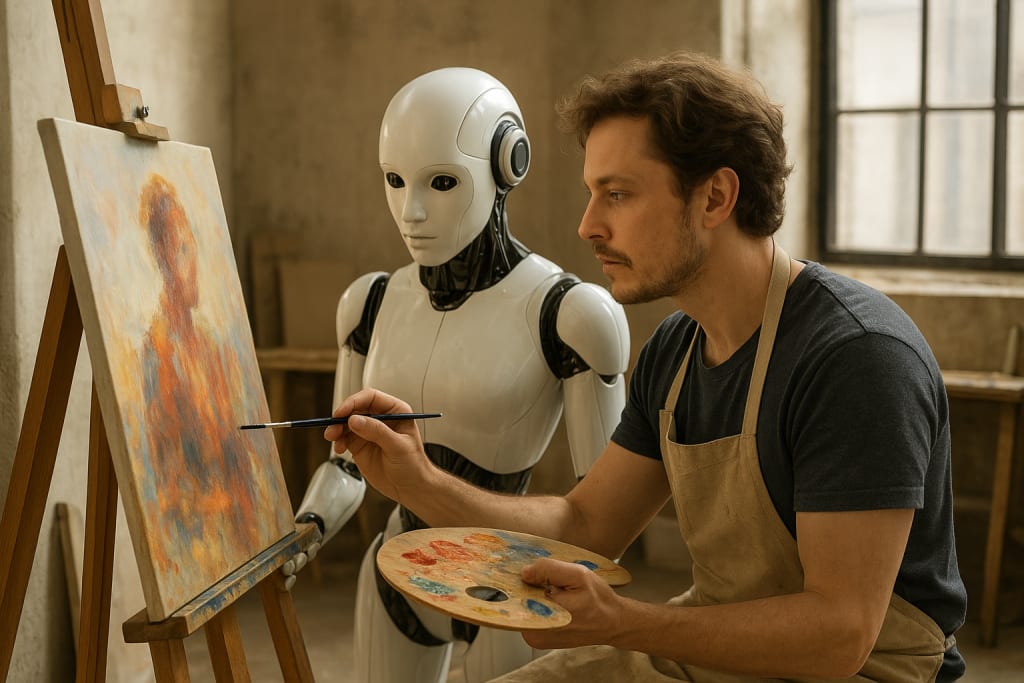
When machines start making art, what happens to the artists who taught them?
A few years ago, “artificial intelligence” was a buzzword — something futuristic, fascinating, but distant. Today, it’s everywhere. It edits our photos, writes our headlines, paints our portraits, and even suggests how we should feel about the world. For many of us, that shift happened so smoothly we didn’t even notice it.
It’s not that AI arrived with fanfare or flashing lights; it simply slipped in through the apps and tools we already used. Photoshop added generative fill. Google Docs learned to finish our sentences. Chatbots became writing partners. Spotify started crafting personalized playlists so accurate they felt emotional.
Suddenly, what used to be called “creative work” — designing, writing, illustrating, composing — began to look more like creative collaboration with an algorithm.
When Creativity Becomes Code
Creativity used to be the final frontier — the one domain we believed was purely human. You could automate factories and logistics, but not poetry, melody, or imagination. Yet here we are.
Text-to-image models like Midjourney, DALL·E, and Stable Diffusion now produce museum-quality art in seconds. Language models draft essays, product descriptions, and love letters with eerie precision. Video tools can turn scripts into cinematic scenes in minutes.
What’s fascinating (and slightly terrifying) is how fast this transition happened. The gap between human-made and AI-generated content is shrinking by the month. In some corners of the internet, people no longer ask, “Who made this?” but rather, “Was this even made by a person?”
The boundaries of creativity — what it means, who owns it, and how it’s valued — are dissolving in real time.
The Disappearing Artist Behind the Prompt
The irony is painful. AI systems only exist because human beings created them — we trained them with our art, our writing, our music, our data. Yet those same models now threaten to replace the people who made them possible.
A freelance illustrator once described it like this:
“It’s like I spent my life building a gallery, and now I can’t afford the ticket to get in.”
That quote stuck with me. Because she’s right — the tools that once helped artists are now competing with them.
Writers face the same paradox. What used to take hours of creative energy — the rhythm of sentences, the subtlety of tone — can now be produced by a text model in seconds. And while the results aren’t always perfect, they’re often good enough for clients who value speed over soul.
This quiet displacement doesn’t look like a revolution. It looks like a gentle fade. One day, your freelance client decides to use “AI-assisted” writing. Your art director starts generating concept sketches instead of commissioning them. The work still exists — but the human behind it doesn’t.
The New Creative Class: Curators, Not Creators
So where does that leave us?
In the emerging creative economy, the most valuable skill might no longer be making — it might be prompting. The artists of tomorrow may be those who know how to speak to machines in the right way, crafting prompts that translate emotion into algorithms.
We’re witnessing the rise of a new kind of creative professional: the AI whisperer.
They may not draw or compose in the traditional sense, but they understand how to shape AI’s output — how to mix the human spark with machine precision. Some call this democratization; others call it displacement. Either way, it’s changing what we mean when we say “artist,” “writer,” or “designer.”
The creative act is no longer confined to the artist’s hand. It lives somewhere between thought and code — in that thin space where human intention meets algorithmic interpretation.
The Emotional Cost of Convenience
Here’s what we rarely admit: AI’s biggest selling point isn’t creativity — it’s convenience.
It’s easier to let a chatbot draft your email, easier to let a tool generate your cover art, easier to let an algorithm remix your voice. And every time we hand off another task, we get a little more comfortable letting go.
But something subtle happens in that process. We lose the friction — the beautiful struggle that comes with trying to express something original. Creativity was never just about results; it was about the journey. The wrong turns, the revisions, the emotional mess that made the final version ours.
Now, with one click, we can skip all of that. And the danger isn’t that AI will destroy creativity — it’s that it will make us forget why we ever cared to create in the first place.
What AI Still Can’t Do
Despite the headlines, AI still doesn’t understand. It doesn’t dream, it doesn’t desire, and it doesn’t experience meaning. It can mimic, remix, and reassemble — but it doesn’t feel.
When you read a poem written by a person, there’s an invisible thread of shared humanity connecting you to the author. When you read one written by a machine, that thread doesn’t exist. The illusion of empathy can’t replace the real thing.
Maybe that’s the hope we need to hold onto: that creativity isn’t just output — it’s intent. It’s the pulse behind the words, the breath behind the brushstrokes, the courage behind the idea.
Machines can produce beauty, but only humans can give it purpose.
A Quiet Coexistence
Perhaps the future won’t be a battle between humans and AI, but a partnership. The best artists may not reject AI but redefine it — using it as an extension of imagination, not a replacement for it.
We might see a new renaissance, one where the lines between artist and engineer blur, where art becomes collaboration, not competition.
But for that to happen, we need awareness. We need to remember that automation isn’t neutral. Every shortcut changes the shape of the journey. Every prompt redefines the meaning of creation.
So maybe the question isn’t “Will AI take over creativity?”
Maybe it’s “Will we still care enough to stay creative when it does?”
Final Thoughts
Artificial intelligence didn’t steal creativity overnight — it joined it quietly.
It didn’t break the system; it rewired it.
And in doing so, it asked us the most human question of all:
What does it mean to create when machines can do it too?
Maybe the answer isn’t to compete with AI, but to rediscover the parts of creativity that code can’t capture — empathy, intuition, imperfection, and meaning.
Because as powerful as machines become, art will always begin with a heartbeat.
About the Creator
Shakil Sorkar
Welcome to my Vocal Media journal💖
If my content inspires, educates, or helps you in any way —
💖 Please consider leaving a tip to support my writing.
Every tip motivates me to keep researching, writing, sharing, valuable insights with you.
Keep reading
More stories from Shakil Sorkar and writers in Journal and other communities.
“Trade, Power, and Rare Earths: What Trump and Xi’s Busan Meeting Really Means”
When two of the world’s most powerful leaders sit down together in a near-secret meeting, the headlines tend to shout. But in the case of the October 30, 2025 meeting in Busan, South Korea, the change was more subtle than sensational. What emerged was less a loud victory and more a quiet shift.
By Shakil Sorkar5 months ago in Journal
Author’s Advice
If you would’ve asked me 20 years ago did I know I’d become a writer and an author, I would’ve said “nope, ain’t happening”. As fate would have it I did become an author and I can honestly say I’m loving it so far. It really does feel good to be a writer. I’ve learned a lot on this journey and I feel like with even me being as new to this world as I am, there’s some wisdom I need to share with every other aspiring author.
By Joe Patterson4 days ago in Journal
A Beginner’s Guide to Trading NASDAQ and Dow Jones
Trading NASDAQ and Dow Jones requires a clear understanding of what these indices represent and how they function in global financial markets. Both indices track groups of large companies listed in the United States, but they differ in composition, sector focus, and market behavior.
By Agast Mishraa day ago in Journal




Comments
There are no comments for this story
Be the first to respond and start the conversation.