
The AI Shift
How Artificial Intelligence Is Quietly Transforming Our Lives

The Invisible Revolution
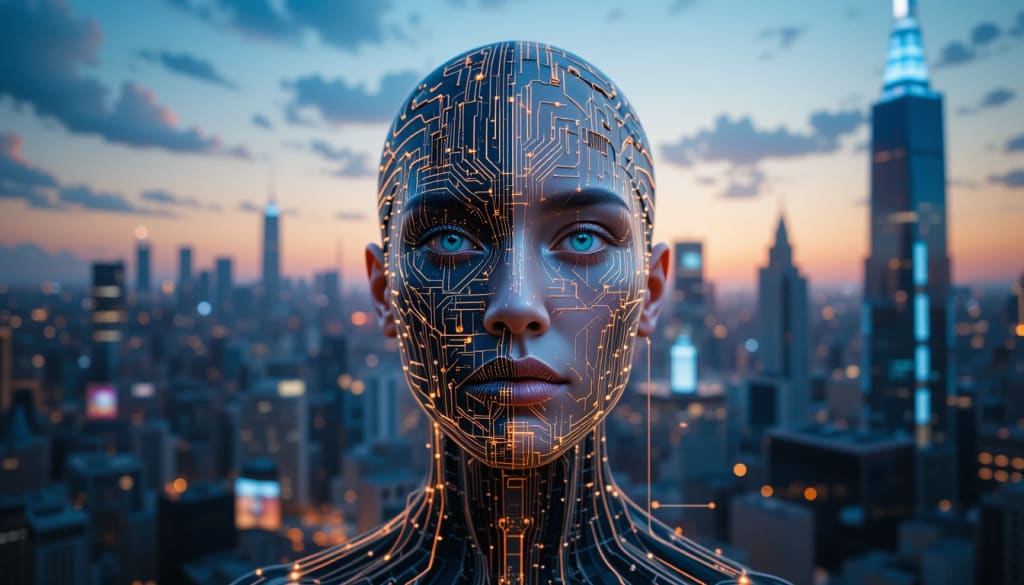
You may not see it, but it’s happening. Right now, while you scroll, shop, work, or rest, artificial intelligence is weaving itself into the fabric of daily life. It doesn’t shout. It doesn’t need to. From the ads you see to the music you hear, AI is quietly shaping your world—algorithm by algorithm.
This isn’t science fiction. It’s today.
But how did AI get here, why is it everywhere, and what does that mean for your future? In this article, we break down the AI shift—what it is, why it matters, and how to navigate it.
Chapter 1: The Origins of Smart Code
AI wasn’t born overnight. The seeds were planted in the mid-20th century, when visionaries like Alan Turing and John McCarthy imagined machines that could think. Early AI systems were basic—math-based problem solvers that could play simple games or crunch data.
The big leap came with the explosion of data and computational power. Suddenly, machines could learn from patterns. This gave birth to modern machine learning and deep learning—algorithms that improve with experience, much like humans.
Today, AI doesn’t just follow commands. It adapts, predicts, and sometimes surprises even its creators.
Chapter 2: Where AI Is Hiding in Plain Sight
AI isn’t just in robots or research labs. It’s everywhere, often unnoticed. Here’s where it’s quietly working in your world:
1. On Your Screen
Social media platforms use AI to filter your feed. TikTok’s algorithm studies your watch time; YouTube suggests what you’ll click next. Netflix decides what to recommend based on your mood, even time of day.
2. In Your Pocket
Virtual assistants like Siri and Google Assistant aren’t just voice search tools. They manage your calendar, understand commands, and learn your habits.
3. At the Store
Amazon uses AI to predict your purchases, set prices, and even manage inventory. Walk into an Amazon Go store—there are no cashiers. Cameras and AI track what you take and charge you automatically.
4. In Your Car
Modern vehicles come with AI-powered safety features: lane detection, automatic braking, adaptive cruise control. Tesla’s Autopilot takes it further, navigating highways and changing lanes autonomously.
5. At Work
Recruiters use AI to scan resumes. Teams use tools like Grammarly, ChatGPT, and Notion AI to write, summarize, and brainstorm. Even your Zoom meetings may be transcribed and analyzed by AI.
Chapter 3: The Good, the Bad, and the Uncertain
AI brings opportunity—but also risk. Let’s look at both sides.
The Good: Promise and Potential
Medicine: AI reads X-rays, predicts disease outbreaks, and designs drugs in days instead of years.
Climate: AI helps scientists model climate change, track pollution, and suggest efficient energy use.
Education: Adaptive learning platforms tailor lessons to each student’s pace and style.
Accessibility: AI-powered apps give vision to the blind, voice to the mute, and mobility to those with disabilities.
The Bad: Bias and Breakdown
Algorithmic Bias: AI learns from real-world data—which includes human bias. Facial recognition, for example, has shown errors when identifying people of color.
Job Loss: Automation is replacing workers in transportation, manufacturing, and even journalism.
Surveillance: Governments and corporations use AI to track people, often without consent or transparency.
Deepfakes and Misinformation: AI can create fake videos and voices, making it harder to trust what we see and hear.
The Uncertain: Where We’re Heading
Will AI achieve human-level thinking—so-called AGI (Artificial General Intelligence)? Some experts say yes, others warn it may never happen. But if it does, the implications will be enormous—for freedom, power, and identity.
Chapter 4: Jobs and the Future of Work
One of the biggest fears about AI is job displacement. And it’s not unfounded.
Automation has already changed factories. Self-checkout machines have replaced cashiers. AI bots write news summaries and answer customer service calls.
But it’s not all doom. AI also creates jobs: AI ethicists, data labelers, prompt engineers, and algorithm auditors are roles that didn’t exist a decade ago.
The key will be retraining and adaptation. Skills like creativity, empathy, and critical thinking will become more valuable—because machines can’t easily replicate them.
Chapter 5: AI in Everyday Decisions
AI doesn’t just handle big tasks. It also influences small, personal ones:
Dating apps use AI to find your match.
Fitness apps build custom routines based on your data.
Banking apps detect fraud and suggest savings tips.
The upside? Convenience. The downside? Invisible influence. When AI becomes the middleman for so many choices, it subtly shapes our lives—even our values.
Chapter 6: Can We Trust the Machines?
Trust is the backbone of human-AI interaction. But how do you trust something you don’t understand?
AI often operates in a "black box." We don’t fully know how it makes decisions—only that it works. This opacity creates challenges in fields like law, finance, and healthcare, where transparency is essential.
We need AI that’s explainable, accountable, and fair. This requires a shift not just in design, but in philosophy: AI should be made for people—not just profit.
Chapter 7: Creativity and the Human Touch
AI is now writing books, generating art, composing music, and designing buildings. But is it truly creative?
Critics argue that AI mimics but doesn’t originate. It recombines what it’s seen but doesn’t feel joy, pain, or purpose. Others say creativity is not about feeling—it’s about output.
Whatever your stance, one thing is clear: AI is pushing artists to redefine creativity. Collaborations between humans and machines may become the next great artistic movement.
Chapter 8: Regulating the AI Wild West
The pace of AI advancement has outstripped regulation. Right now, companies race to release tools—sometimes without understanding the consequences.
What’s needed?
- Transparency: Knowing how AI makes decisions.
- Fairness: Preventing discrimination and bias.
- Consent: Giving users control over how their data is used.
- Accountability: Ensuring companies are responsible for AI failures.
Governments are waking up. The EU is pushing forward with the AI Act. The U.S. is exploring executive orders and task forces. But regulation must move faster, or we risk letting AI outgrow oversight.
Chapter 9: AI, Ethics, and Humanity
The deeper AI goes, the more it raises ethical questions:
Should AI systems be allowed to make life-or-death decisions?
Do sentient machines (if they ever exist) deserve rights?
Who gets to decide how AI evolves—corporations, governments, or the people?
These aren’t tech questions. They’re human ones. And we must ask them now, before it's too late.
Conclusion: Living with AI
AI is not a distant technology. It’s a present reality. It’s in your home, your work, your pocket—and your future.
It can help us solve big problems, unlock creativity, and improve life for billions. But it can also divide, deceive, and destroy—if left unchecked.
The AI shift isn’t about the technology. It’s about us.
How we build it.
How we use it.
How we make sure it serves everyone—not just the powerful.
The future with AI is not something we enter. It’s something we shape.
And the time to shape it is now.
About the Creator
Shohel Rana
As a professional article writer for Vocal Media, I craft engaging, high-quality content tailored to diverse audiences. My expertise ensures well-researched, compelling articles that inform, inspire, and captivate readers effectively.
Keep reading
More stories from Shohel Rana and writers in Journal and other communities.
AI: Friend or Foe?
Introduction: The Rise of the Intelligent Machine Not long ago, artificial intelligence was a distant fantasy—something from the pages of science fiction or the imagination of Hollywood. Today, AI is very real. It’s in your phone, your car, your bank, your doctor’s office, and even the apps you use to write, shop, or find love. AI is no longer coming. It’s here—and it’s changing everything.
By Shohel Rana8 months ago in Journal
The goals I did not achieve
Every writing goal I made for the year is a wash. It has been this way for a while, but I think it's important to be open about my failures and the reality of how life can get in the way. This is especially true considering the several times I have posted on Vocal about my writing goals, how I was changing my approach, and where I was hoping to be for the upcoming year. I will probably do that again in a couple months, but for now, it is time to acknowledge where I am today.
By Kay Husnick24 days ago in Journal
How to Power an RV Using a Portable Solar Panel
Traveling in an RV is all about freedom freedom to explore remote places, stay off-grid, and enjoy nature without giving up basic comforts. One of the easiest and most eco‑friendly ways to achieve this independence is by using a portable solar panel for RV power needs. Whether you are a weekend camper or a full‑time RVer, portable solar can keep your lights on, devices charged, and appliances running without relying on noisy generators.
By Lyra Winslow5 days ago in Journal
How, Too
Many people wonder how, too. You are not alone, and I am an expert. I will teach you how, too! First, you need to remit a small application fee and fill out an application describing the nature of your financial situation and how often payments will be made, as this will have great bearing on how well I teach you how, too.
By Harper Lewis3 days ago in Fiction



Comments (1)
AI is truly everywhere these days. It's crazy how it's in our social media feeds, virtual assistants, and even at the store. I remember when Amazon started using it to predict purchases. It made shopping so much more convenient. But it also makes you wonder what else it's doing behind the scenes that we don't know about. How much more will our lives change as AI keeps evolving?