
AI: Friend or Foe?
How Artificial Intelligence Is Reshaping Our World, One Algorithm at a Time

Introduction: The Rise of the Intelligent Machine
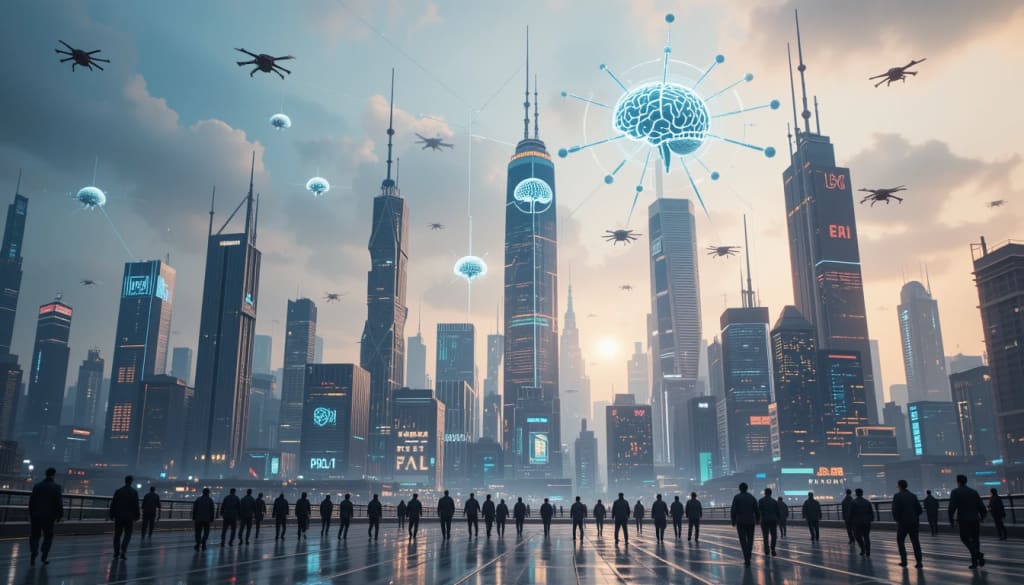
Not long ago, artificial intelligence was a distant fantasy—something from the pages of science fiction or the imagination of Hollywood. Today, AI is very real. It’s in your phone, your car, your bank, your doctor’s office, and even the apps you use to write, shop, or find love. AI is no longer coming. It’s here—and it’s changing everything.
But how exactly did we get here? And what does this radical transformation mean for our future?
This article explores the evolution of AI, its current applications, ethical challenges, and what it might mean for the world we’re building together—whether we're aware of it or not.
Chapter 1: From Chessboards to Chatbots
The journey of AI began humbly. In 1950, British mathematician Alan Turing asked, “Can machines think?” That question laid the foundation for what we now call artificial intelligence. By 1997, IBM’s Deep Blue beat world chess champion Garry Kasparov, proving machines could match—if not outwit—human intellect in specific tasks.
The next big leap came with machine learning, especially deep learning. These systems learn from data the way we learn from experience. Feeding millions of images into a neural network taught it to recognize cats, faces, emotions—even sarcasm.
Enter the age of chatbots, image generators, and predictive models. Siri, Alexa, and ChatGPT aren't magic—they’re the fruits of decades of training algorithms on oceans of data. The more they learn, the better they get.
Chapter 2: Where AI Lives Today
AI is no longer a lab experiment. It lives in the real world:
1. Healthcare
AI helps detect diseases earlier than ever. Tools like IBM Watson assist doctors in diagnosing cancer, while AI-powered apps monitor your heart rate and mental health.
2. Finance
Banks use AI to detect fraud in real-time. Robo-advisors manage your investments. Even your credit score might be shaped by AI algorithms.
3. Transportation
Self-driving cars aren’t perfect yet, but AI controls traffic flow, ride-sharing apps, and GPS systems. Tesla’s Autopilot is just the beginning.
4. Entertainment
Netflix recommends your next binge-watch. Spotify curates your music. AI writes scripts, composes music, and even paints.
5. Retail
From virtual try-ons to personalized shopping suggestions, AI transforms how we buy everything from sneakers to furniture.
Chapter 3: The Ethics of Intelligence
The more powerful AI becomes, the more questions we must ask:
1. Bias in Algorithms
AI learns from data—but what if that data is biased? Facial recognition systems have shown racial bias. Hiring algorithms sometimes favor certain demographics over others. AI reflects society’s flaws unless we actively correct them.
2. Job Displacement
From truck drivers to graphic designers, automation threatens millions of jobs. Some roles will vanish, others will evolve, and new careers will emerge—but at what cost?
3. Privacy Concerns
AI feeds on data—often your data. Every click, scroll, and search tells it something. In the wrong hands, this knowledge can become surveillance, manipulation, or exploitation.
4. Autonomous Weapons
AI is being trained for war. Drones that choose their own targets raise ethical alarms. Who’s accountable if a machine makes a lethal mistake?
Chapter 4: The Promise of AI
Despite the fears, AI holds immense promise. Used wisely, it could uplift humanity:
Education: Personalized tutors for every child.
Climate: Predicting disasters, optimizing energy use.
Medicine: Curing diseases once thought incurable.
Accessibility: Helping people with disabilities navigate the world.
The future isn’t set in stone. It depends on how we guide the growth of AI—and whether we build it to serve all, not just a few.
Chapter 5: AI and Human Identity
One of the biggest philosophical questions AI forces us to face is: What does it mean to be human?
When a machine can write poetry, compose music, or hold a convincing conversation, it challenges our sense of uniqueness. But maybe that’s not a threat—maybe it’s a reminder.
We are not just logic and language. We are emotion, intuition, connection. Machines can mimic but not feel. AI may be intelligent, but it lacks consciousness. It does not dream. It does not grieve. It does not love.
That distinction matters.
Chapter 6: The Need for Human-Centered AI
We’re at a crossroads. Will AI serve humanity—or will we serve it?
Researchers and ethicists are calling for human-centered AI: technology designed with empathy, fairness, and inclusivity in mind. That means:
Transparent algorithms
Diverse datasets
Built-in ethical checks
International regulations
And, most importantly, a seat at the table for voices from all walks of life.
Chapter 7: AI in the Creative World
In a surprising twist, AI is now shaping art. Tools like DALL·E, Midjourney, and ChatGPT create images and text that rival human artists. Some welcome this new wave of creativity. Others see it as theft.
When AI trains on human-created work, who owns the result? Can a machine make art if it has no soul? And will human artists be devalued—or empowered?
There’s no easy answer. But this tension might be the heartbeat of the AI age: creation without consciousness.
Chapter 8: The Global Race for AI Supremacy
Nations are racing to dominate AI. The U.S. and China are the main players, investing billions into research and development. AI isn’t just about convenience—it’s about power.
Military strategy, economic leverage, and even diplomatic influence are all shaped by who leads in AI.
If the technology is developed behind closed doors with profit or control as the only motive, the consequences could be severe. Global cooperation—not competition—might be our only way forward.
Chapter 9: What Comes Next?
We stand on the edge of something unprecedented. AI won’t just change industries—it will change civilization. Some experts predict:
- Artificial General Intelligence (AGI): Machines as smart as humans
- AI Rights Debates: Do sentient machines deserve legal status?
- Merging Mind and Machine: Neural implants and brain-computer interfaces
But not all predictions are optimistic. The late Stephen Hawking and Elon Musk have warned of runaway AI. Once machines outthink us, will we still be in control?
The future of AI isn’t written yet. That’s the beauty—and the burden—of this moment.
Conclusion: The Story We Choose to Write
AI is a mirror. It reflects our best and worst impulses. It amplifies our potential—and our peril.
This isn’t just a technological revolution. It’s a human one. We must decide what kind of world we want, then build technology to match that vision.
Because AI isn’t destiny. It’s a tool.
And in the hands of thoughtful, compassionate, and curious people—it just might help us build a better tomorrow.
About the Creator
Shohel Rana
As a professional article writer for Vocal Media, I craft engaging, high-quality content tailored to diverse audiences. My expertise ensures well-researched, compelling articles that inform, inspire, and captivate readers effectively.
Keep reading
More stories from Shohel Rana and writers in Journal and other communities.
Google's AI Era Begins
The tech world holds its breath every year during Google I/O, the company’s annual developer conference. But this year—Google I/O 2025—was different. It wasn’t just about new phones, new updates, or even flashy announcements. It was about one thing:
By Shohel Rana8 months ago in Journal
Spotify Classic Rock/Metal Playlist
Why I Put This Playlist Together This playlist did not begin as a project, a brand, or a plan. It began the way most meaningful things do, quietly and without intention. I was talking about music, one song at a time, and over time those songs began to gather weight.
By Sound and Spirit6 days ago in Journal
Smart phones, Humans and Aliens.
WARNING. I will be tapping into one of your favorite creative tensions: The absurdity of humans worshipping their glowing rectangles as if they were tiny oracles. There’s something deliciously poetic about that contradiction, and it lends itself beautifully to an instructive proviso.
By Novel Allen4 days ago in Poets


Comments (1)
This article really shows how far AI has come. Remember when Deep Blue beat Kasparov? That was huge. Now, it's everywhere. In healthcare, it's amazing how it helps with early disease detection. In finance, fraud detection in real-time is a game-changer. But I wonder, with all this AI around us, how do we ensure it doesn't replace human jobs completely? And what about the ethical side of using it in our daily lives?