
The 7,000-Mile Shockwave: How China’s AI Chip Revolution Is Reshaping the Global Tech War
A real-world story of sanctions, survival, and a silent shift that could rewrite the global chip market.
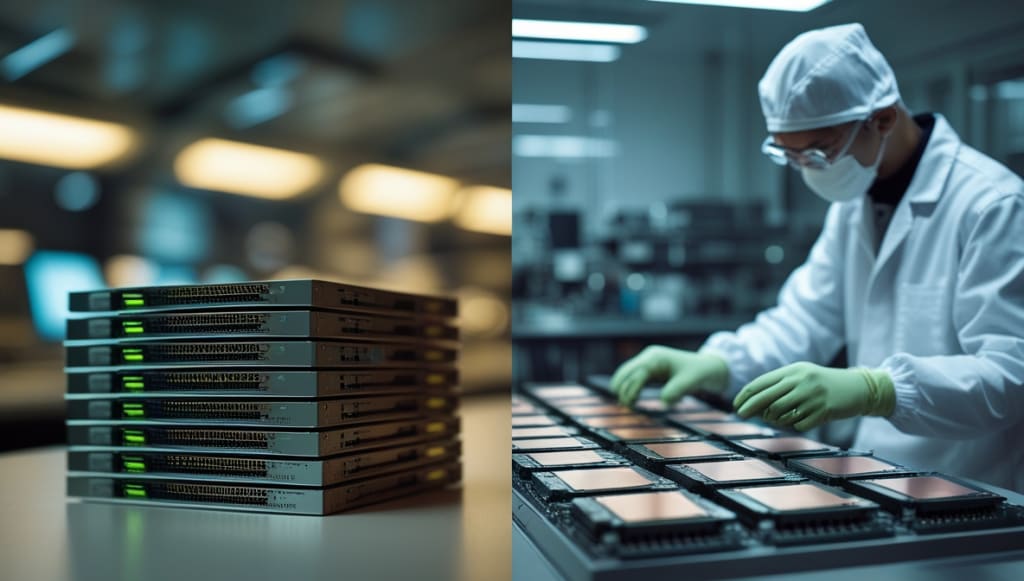
When NVIDIA was celebrating record-shattering profits last year, something unexpected was unfolding nearly 7,000 miles away—a quiet, determined engineering revolt inside China. While Wall Street toasted NVIDIA for powering the global AI boom, Huawei was doubling its AI chip production, hitting an astonishing 600,000 units. At the same time, SMIC, China’s largest chip manufacturer, began constructing not one but three massive semiconductor foundries that will triple the country’s AI chip output by next year.
And the plot twist?
They did all of this without a single piece of American technology.
This isn’t just a business update.
This is a turning point in a $460-billion industry that shapes wars, economies, innovation—and the digital lives of billions.
To understand how China pulled off what many experts once called “impossible,” we need to rewind to 2022.
The Sanction That Sparked a Revolution
In 2022, the U.S. blocked NVIDIA from selling its most powerful AI chips—H100 and A100—to China. The move was meant to stall China’s progress for years, possibly decades. But instead of slowing down, China did what many South Asian audiences will immediately recognize.
They said, “Fine. We’ll build it ourselves.”
It’s the same spirit that led India to create its own GPS system and build one of the world’s cheapest successful lunar missions. It’s the same energy that helped Bangladesh become a garment superpower despite global doubt. It echoes Pakistan’s history of navigating sanctions and still finding ways to innovate.
In other words—China activated its national “we will do it anyway” mode.
The numbers tell the story:
- NVIDIA’s market share in China plunged from 95% to nearly zero
- Huawei’s Ascend 910C chip scaled from 0 to 600,000 units
- SMIC will double its 7nm capacity by 2026
- China’s total AI chip production will triple next year
But this raises a big question:
If the U.S. banned advanced chip-making machines, how is China producing 7nm chips?
The Answer No One Expected
Most of the world believed it was impossible to make 7nm chips without ASML’s EUV (extreme ultraviolet) machines—the crown jewels of semiconductor technology. EUV tools are so advanced and so restricted that not even Japan or South Korea can buy them freely.
But China didn’t wait for permission.
SMIC began using older DUV machines combined with a grueling technique called multi-patterning—running the same chip-printing process four to eight times to mimic EUV-level precision.
Is it slow? Absolutely.
Is it expensive? Very.
But does it work?
Yes—and it’s working better every month.
SMIC is now operating at 95.8% capacity, nearly full throttle. Profits jumped 35.6% in just six months. The company is investing $7.5 billion in new factories—more than Pakistan’s entire two-year IT exports.
China isn’t building just one new foundry.
Three mega-factories are coming online:
- One started production this year
- Two more launch in 2026
- Combined output will exceed SMIC’s current entire capacity
In short, China is building a second SMIC from scratch.
And It’s Not Just Huawei
China’s domestic AI chip ecosystem is exploding:
- Cambricon’s stock doubled in three months
- Baidu has a full five-year Kunlun AI chip roadmap
- Alibaba’s chips are edging closer to NVIDIA’s mid-range H-series
- MetaX secured major contracts with China Unicom
- Moore Threads—founded by NVIDIA’s former China head—is making gaming-tier GPUs
But the world’s biggest question remains:
Can China Actually Beat NVIDIA?
Let’s break the hype and look at the facts:
- Huawei’s 910C = 800 teraflops
- NVIDIA’s H100 = 2,000 teraflops
- Chinese chips use HBM2E memory
- NVIDIA uses HBM3
- Chinese data speeds are 40% slower
- SMIC’s yields (60–70%) trail far behind TSMC’s 90%+
China can make 5nm chips—but in tiny quantities, too unreliable for mass production.
So why is NVIDIA CEO Jensen Huang worried?
Because China doesn’t need to win the chip war chip for chip.
The DeepSeek Lesson
Earlier this year, DeepSeek shocked the world by training a powerful AI model using fewer chips and lower hardware requirements. They proved that smart architecture, efficient training, and software innovation can offset weaker hardware.
Huawei’s strategy follows the same logic:
Instead of one super-powerful chip,
they connect hundreds of cheaper chips into massive clusters.
Huawei’s Atlas 900 SuperCluster uses 384 chips to deliver 300 petaflops.
Not elegant, not efficient—but undeniably effective.
China is betting on scale over perfection.
And scale is something China does better than anyone.
The Big Bottleneck: HBM Memory
There’s still one obstacle China hasn’t solved—HBM (High-Bandwidth Memory). This ultra-fast memory is critical for training massive AI models.
And 70% of the world’s HBM comes from:
- SK Hynix
- Samsung
Both are refusing to sell to China.
Think of China’s AI chip like a Ferrari engine…
with bicycle wheels.
CXMT, China’s leading memory company, is racing to catch up, but in 2025 it produced just 0.42 billion gigabits, compared to America’s 23.7 billion—a massive 56x gap.
But China has a history of closing big gaps quickly.
This year, CXMT shifted aggressively toward DDR5 and DAR-EM. Nearly 60% of its production now targets advanced memory. They are scaling, improving yields, and backed by unlimited government funding.
And then came Jensen Huang’s statement:
“China is nanoseconds behind the U.S.—not years, not decades.”
That’s the closest a CEO has ever come to saying,
“We’re worried.”
What This Means for South Asia
This regional impact will be enormous.
South Asia sits between two AI superpowers:
- Western AI ecosystem: NVIDIA, AMD, Intel
- Chinese AI ecosystem: Huawei, SMIC, Baidu
And each country is already leaning in one direction:
- India → West
- Pakistan, Bangladesh → Belt and Road
- Sri Lanka, Nepal → In-between
This divide will shape:
- tech imports
- AI training costs
- startup ecosystems
- new manufacturing opportunities
- foreign investment patterns
Indian startups may soon access cheaper Chinese clusters.
Bangladesh could become a tech-assembly hub.
Pakistan’s $3.2B IT economy may benefit from low-cost Chinese compute.
We’re heading toward two parallel futures—and navigating both wisely may become South Asia’s biggest advantage.
The Verdict: Will China Overtake NVIDIA?
Short term (2025–2027): No.
NVIDIA still leads in:
- performance
- efficiency
- software ecosystem
- reliability
- supply chain depth
Long term (2028+): Very likely.
If China keeps scaling capacity, fixes HBM bottlenecks, and improves chip efficiency, NVIDIA will face serious competition in the world’s largest AI market.
The chip war is no longer a prediction.
It’s happening—right now.
The only question remaining is:
Which side of this new technological world will you choose?
#China AI #NVIDIA #Huawei #SMIC #Global Chip War #South Asia Tech #AI Chips #Semiconductor Industry #Sanctions #Technology Trends
About the Creator
Keep reading
More stories from Shahjahan Kabir Khan and writers in Journal and other communities.
Hindustan Power Accelerates India’s Clean-Energy Push with New 150 MW Solar and Storage Project Under Ratul Puri’s Leadership
New Delhi — In a significant move that underlines India’s accelerating transition to cleaner power, Hindustan Power has secured a major renewable energy contract to develop a 150 MW solar project integrated with advanced battery storage — a development that Chairman Ratul Puri says reinforces the company’s commitment to future-ready energy infrastructure.
By Chinmaya Singh5 days ago in Journal


Comments
There are no comments for this story
Be the first to respond and start the conversation.