
Space Mining Market: Will Asteroids Fuel Our Future?
How off-Earth resources are reshaping exploration, economics, and survival beyond Earth
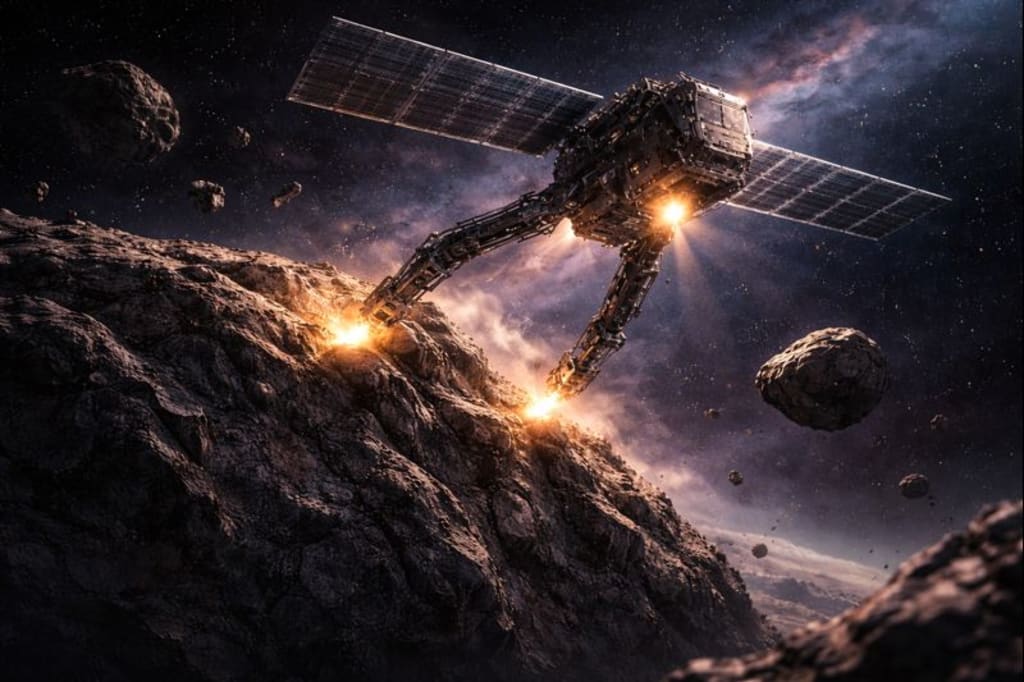
Far beyond Earth’s atmosphere, a silent object drifts through darkness. No flags. No footprints. Just rock that has traveled the solar system for billions of years. Soon, a machine built by humans may reach out and extract what lies beneath its surface.
This moment signals more than a technological milestone. It represents a shift in how humanity sources materials, sustains exploration, and imagines economic growth beyond Earth. At the center of this transformation is the Space Mining Market, where science, industry, and ambition converge to redefine what resources mean in a universe that is no longer out of reach.
Why Space Resources Are Becoming Essential
Earth’s appetite for minerals continues to grow. Technologies powering clean energy, advanced electronics, and aerospace systems depend on materials that are increasingly difficult and costly to extract. At the same time, space missions are pushing farther, demanding sustainable ways to support long-term exploration.
This is where the Space Mining industry enters the picture. Rather than launching every kilogram from Earth, future missions aim to use resources already in space. Water can become fuel. Metals can become infrastructure. What once sounded speculative is now being planned with measurable timelines.
The Space Mining market size reflects this shift. Valued at USD 2.58 billion in 2025, the market is expected to grow from USD 3.07 billion in 2026 to reach USD 7.39 billion by 2031, registering a compound annual growth rate of 19.18 percent. This growth underscores increasing confidence in commercial and institutional space resource programs.
What Exactly Is Being Mined
Early space mining efforts focus on practicality. Water ice found on the Moon and certain asteroids is considered the most valuable near-term resource. When processed, it supports life systems and provides hydrogen and oxygen for propulsion.
Metal-rich asteroids also attract attention. Many contain high concentrations of platinum group metals and rare elements essential for modern manufacturing. These bodies require less energy to reach than deeper planetary surfaces, making them attractive early targets.
The Space Mining market share is currently dominated by asteroid mining concepts, as they offer higher economic potential and fewer operational constraints compared to lunar extraction. This focus aligns with early mission feasibility rather than immediate large-scale production.
How Mining Works in Zero Gravity
Mining in space is fundamentally different from Earth operations. Without gravity, traditional drilling methods must be reimagined. Autonomous probes survey targets using spectroscopy, confirming mineral composition before extraction begins.
Robotic systems anchor to surfaces, collect material, and process it either in orbit or during return missions. These operations rely heavily on artificial intelligence, remote sensing, and autonomous decision making.
This evolution highlights a key finding of the Space Mining market analysis. Growth is driven as much by advancements in robotics and autonomy as by resource demand itself. The ability to operate reliably without human presence defines success in this environment.
Who Is Building the Space Mining Ecosystem
While national space agencies laid the groundwork, private enterprises are accelerating development. Launch providers, robotics firms, and materials specialists are forming partnerships to address mission complexity.
North America leads early development due to established aerospace infrastructure and supportive regulatory environments. Asia Pacific is emerging rapidly as investment increases in space technology and launch capabilities.
This global participation is shaping Space Mining market trends that emphasize collaboration between governments and private entities rather than competition alone.
Risks and Realities Beyond the Dream
Despite optimism, space mining faces formidable challenges. High capital requirements, long development timelines, and uncertain legal frameworks pose real risks. Technologies must withstand radiation, extreme temperatures, and communication delays measured in minutes rather than milliseconds.
There is also debate around environmental responsibility in space. Managing debris and preserving celestial bodies adds ethical dimensions to commercial ambitions.
Yet history shows that infrastructure follows necessity. Railways, aviation, and satellite networks all faced skepticism before becoming indispensable.
Looking Ahead to an Off-Earth Economy
The Space Mining market forecast points toward sustained expansion rather than rapid saturation. As launch costs decline and exploration missions increase, space-derived resources will play a growing role in supporting orbital stations, lunar bases, and deep space travel.
Over time, space mining could reduce reliance on Earth-based extraction while enabling permanent human presence beyond our planet. The Space Mining industry is not just about profit. It is about building the foundation for a multi-planet future.
About the Creator
william jack
i am research analyst
Keep reading
More stories from william jack and writers in Journal and other communities.
Flight Data Monitoring Market: What Black Boxes Reveal About Modern Aviation Safety
The aircraft hums steadily at thirty-five thousand feet. Passengers sip coffee, read, or sleep, unaware that every movement of the plane is being quietly recorded. Every climb, every turn, every fluctuation in speed leaves a trail of data more detailed than most people realize.
By william jacka day ago in Journal
The Difference a Month Makes
Last month, around this time, I was sitting in a homeless shelter typing up an update on the status of my ongoing melodrama with my reflexively abusive husband. Today, I'm curled up in my and my hubby's home and happy to report that the worst of the storm is past us now. No more 2:30am mornings, no more putting ten thousand miles on the car in a month, no more strangers touching my laundry in shared machines or my food in a shared kitchen.
By Maia Gadwall the metAlchemist5 days ago in Journal




Comments
There are no comments for this story
Be the first to respond and start the conversation.