
So You Want to Be a Film Director?
How To Skipper Your Ship and Avert Mutiny
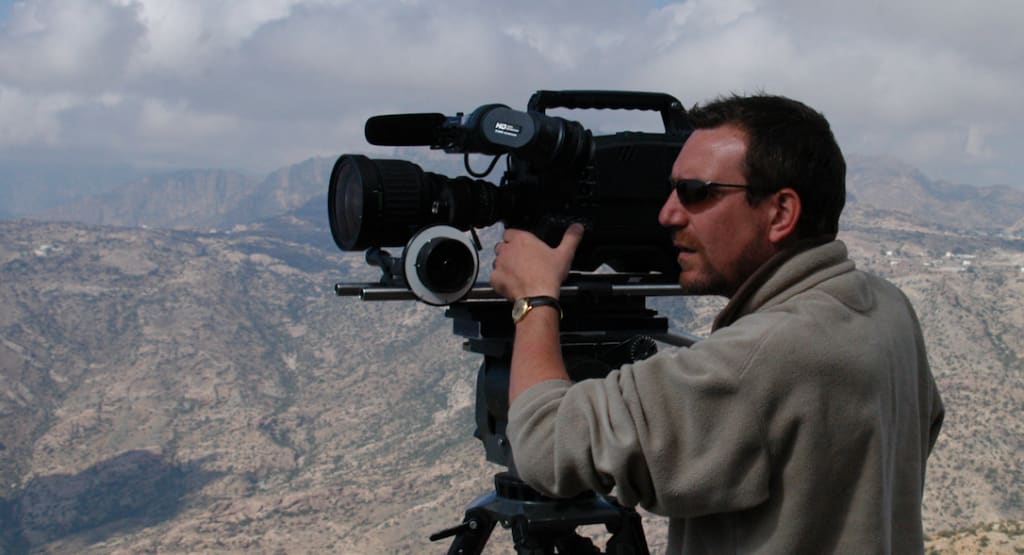
I’ve spent the past 20 years making a living (occasionally lucrative, often precarious, seldom steady, largely rewarding) directing films. In the main, I've enjoyed a career I know I am very fortunate to have and I've travelled the world—from the North Pole to Saudi Arabia, from Kenya to Brazil. It has seldom been plain sailing, and at times I have navigated stormy waters, struggling to remember why I chose this ridiculous life, convinced that I’ll never work again or be able to feed my children. I’ve nearly frozen to death filming an expedition in the Arctic, nearly boiled my blood in the Arabian desert, seen the back seat propelled from a helicopter in which I was filming high above the Nigerian Delta and negotiated with the head-honcho in Rio de Janeiro favela. And throughout, I've worked with some of the most wonderful and some of the most trying people known to man.
Most of the time it’s somewhere in between, riding tides high and low, rough and calm, never the same. In the main, I still love what I do.
I count myself as one of an increasingly lucky (and diminishing) band of jobbing directors who cut their teeth shooting on film: 16mm at film school—first on a wind-up, fixed-lens Bolex, all the way up to shooting commercials and films on Super 35mm with every gizmo you’ve ever heard of and a few you probably haven’t.
Whilst I embrace (and let's face it, we HAVE to embrace) the access, speed, and efficiencies of the digital/DLSR/desktop editing age, I confess a certain nostalgic pang for the aesthetics of celluloid. This early period of my career meant much more than celebrating the extraordinary depth of imagery that celluloid provided and the many hours in the magic netherworld of tele-cine. Most importantly, It taught me the discipline of and necessity for meticulous planning, thorough rehearsals and clear, ongoing communication between all departments.
Working on film usually involved a camera department of at least three, art department, sound department, line producers, production managers, location managers, script supervisors, ADs, and runners; it always meant spending serious money.
I never met a producer with whom I didn’t have to negotiate a shooting ratio—and it was often far less than I was hoping for. (I'd want 10:1 and I'd get 6:1 if I was lucky.) So I learnt to rehearse thoroughly and to plan meticulously; mistakes were expensive and noted; you simply couldn’t afford too many of them if you were to establish and—crucially—maintain credibility as a working film director.
Largely, the prohibitive costs of a high shooting ratio are irrelevant today. Relative to film, the digital world of cards, drives, and storage are all super-cheap, and whilst it’s crucial to get your data-wrangling nailed, there’s no longer anything to develop or process. The requisite "dark-arts" skill-set for the unseen, nimble-fingered loading of negative stock in a black bag is all but lost to our craft. (*Author sighs for the "good-old-days.")
However, the disciplines instilled in those of us who started our careers shooting on film are, in my opinion, as relevant today as they ever were, and just because you can shoot hours and hours of footage inexpensively, it doesn’t mean you should.
Equally, it doesn’t mean you shouldn’t ensure you get all you need in full to give your film a fighting a chance of becoming a coherent and consistent entity.
I started my working life as an editor and that, for me, was perhaps the best twist of film-game-fate that could have befallen me; and it was certainly down to luck more than judgement that I found myself in an edit suite rather than behind a camera—and it very quickly gave me a sense of what one requires to make a scene and a film (of any type or duration) really work structurally. It also taught me—often painfully—what happens when you haven’t got all the footage and most crucially all the time you need in production.
With that in mind, here are my top 3 “hopefully-helpful-hints” for anyone tempted to navigate the uncertain waters of directing for the camera:
1. PLAN EVERYTHING—Time goes faster on a film set.
Of course, scientifically this is nonsense. But it sure feels that way. When (and I guarantee this WILL happen) it feels like 8:00 AM just became 11:30 in the period it took to put those three lamps up and get your talent out of the makeup chair, and when the crew are focusing on what’s for lunch rather than your grand vision, you can be certain that the sun is still going down to its own schedule and is not about to wait for you to be ready for that magic-hour shot.
So you absolutely better PLAN EVERYTHING; maybe you haven’t got the budget for a really experienced 1st AD… and even if you have, I can’t stress the following enough:
Break your scenes down into shots.
- What do you NEED to cover the scene properly and what is expendable when necessary?
Turn these shots into time and schedule them thoroughly.
- How long do you think each of them will take to prep, light, re-light, and argue with your DOP and Gaffer about how much time they think they need/you know you have?
- How long to move, prep and set the camera, try lenses, change lenses, spot the monitor(s), measure the focus, rehearse the camera move, rehearse the scene technically?
- How long to block the scene, rehearse the action, discuss performances with the talent, and re-rehearse?
- How much time should you allow to deal with technical problems, find the background artist who is in the loo and the other one who is on the phone, wait for that noisy plane to disappear, do make-up checks, realise there’s something in shot that shouldn’t be and something that should be but isn’t, check continuity against various stills from previous scenes, (probably change pretty much all of the above again once you realise it isn’t working as you thought it would), and then shoot it at least five times, with various delays for all manner of other issues not listed here?
Now whatever time you’ve estimated this will take, double it.
That’s a pretty good guide for how long it might actually take.
So PLANNING—and PLANNING REALISTICALLY—is absolutely essential to you standing any chance whatsoever of making the film you want to make on schedule and within budget.
2. Kill your darlings.
I can’t recall where I first heard this phrase, but it’s one of the most difficult and most important rules I’ve learnt.
Picture this: You’re in the edit suite and you’re watching the rushes of that precious, elusive and long-planned shot that took forever to devise and half a day (literally) to achieve. Maybe you managed to get that crane or drone or underwater housing you wanted…and it took an absolute age to finally get over all the technicalities and unforeseen problems you encountered on the day to get the damned thing in the can…and you all celebrated on set because you all rolled up your sleeves and laboured together, against the odds, to achieve the seemingly impossible and you did it! All that work and time and money and effort! And there you are in the edit—you and the editor in some small room surrounded by various scribbled notes of A4 and the smell of cold coffee—and you simply can’t understand how it’s not working in the scene—not when it costs so much time, sweat, problem-solving, belligerent co-operation, blagging, patience and hard cash to pull off.
Guess what?
Nobody cares.
Only you.
So get over it. Try for just a moment to see the film from the audience’s perspective and not your own…and get rid of it. Ditch that beautiful, precious, impossibly-hard-to-get-and-I-really-love-it showstopper of a shot.
It’s a painfully hard thing to do, but nobody cares how long you and your crew stood in the rain or how much that lighting-set-up cost…get rid of it when a simple wide-shot on a tripod serves the story and film better.
3. Journeys are as important as destinations—and ships need captains AND crews.
If I’ve learnt anything, this is probably the most valuable lesson to me and one I try to take to each and every project. “How did you get into directing” is a question I’ve been asked a thousand times and the answer is that I stated that I was one. Arrogant? Maybe. Determined? Certainly. Convinced I could do it and do it well? Not at all initially. The more pertinent question is how to keep being a director because nobody respects an idiot and no one likes an ego-maniac.
When I was at film school, I paid my way by making "behind-the-scenes" films of big commercials, and I remember being on set with a very well-known "A-List" American actor and lots of extras and a very frustrated young director screaming out loud, “The problem is I don’t know what I want!”
Now call me an upstart, but I promised myself that would never be me.
Actors and crew, your collaborators and partners—the people upon whom you are utterly reliant for any success you might have as a director—hate indecision. They hate incompetence even more. So directing is finding the right balance of ensuring you are steering the ship and that the crew all know where you are going and how you are going to get there. But it’s also about ensuring they are with you, 100%, for the duration. It’s my firm view that they are and should always be respected and treated as valued, indispensable members of the same team. It’s called a "crew" for good reason.
Of course, there are manifold stories of monsters and screamers who make it as big-name directors, but in my experience these are few and far between.
You aren’t necessarily going to be universally liked all the time or by everyone. But if you are in control but not controlling, willing to listen as well as speak and realise that all the heads of department and specialists around you are far more competent than you at their specific, highly skilled jobs then you might just command the necessary respect you need to make a half-decent film—and the journey might even be a generally pleasant one even if the seas are sometimes rough.
Oh, and just as an aside and as a friendly word-in-your-ear piece of advice, for the love of God, PLEASE don’t try to do anyone else’s job for them, as that’s likely to lead to mutiny and you getting tossed from the boat/fed to the sharks/finding yourself in a galaxy far, far away.
To stay metaphorically nautical, if you can remain at the helm whist respecting the roles and value of all on board, steer the ship to its intended destination AND do all you can to ensure the journey is a pleasant one, then you stand a fighting chance of skippering more than one vessel on more than a maiden voyage. Moreover, you’ll get the best from the crew (especially when you need to ask them to go the extra mile) and the passengers should enjoy the view to boot.
Finally, always remember that this was never going to be easy; if you had the guile/folly to put yourself forward as the captain of this cinematic ship, then the least you can do is your utmost to get safely to your destination without anyone (you included) falling overboard.
Remember, it’s a choice. Not everyone is cut out to be a director.
Famously, the celebrated and brilliant 1st Assistant Director David Tomblin was asked by Sir Richard Attenborough to instruct the crowd of some 300,000 extras assembled for the funeral scene in Ghandi. "I want you to convey to them, David, that Gandhi has died…” explained the exhausted director. “It's an extraordinary event, darling, the most extraordinary event in the whole history of India! Gandhi is gone! Their god, their national hero is gone!"
David Tomblin turned to the crowd and through the numerous loudspeakers assembled around the location, his immortal words echoed: "Right, listen up! Gandhi's dead and you're all fucking sad!"
As I said, not everyone is cut out to be a director.
Have a safe trip and a bon voyage.
About the Creator
Keep reading
More stories from writers in Journal and other communities.
Wild Card Weekend Recap: What Happens Now?
I think I figured out why I love Wild Card Weekend so much. It's because it's the first playoff anything of the calendar year. The NFL season starts in the fall, and once upon a time, the champion was crowned either on or slightly before New Year's. The evolution of the NFL schedule has resulted in the playoffs starting just into the New Year, and currently, the final week of the season falls on the first weekend of the New Year, with Wild Card Weekend coming a week after that. So yes, chronologically, the NFL's Wild Card Weekend serves as the first playoff anything of the calendar year.
By Clyde E. Dawkins5 days ago in Unbalanced




Comments
There are no comments for this story
Be the first to respond and start the conversation.