
Saudi Arabia Abandons the Dream of a 100-Mile Desert Megacity
Visionary Genius or Multibillion-Dollar Delusion? The World Reassesses the Fate of The Line
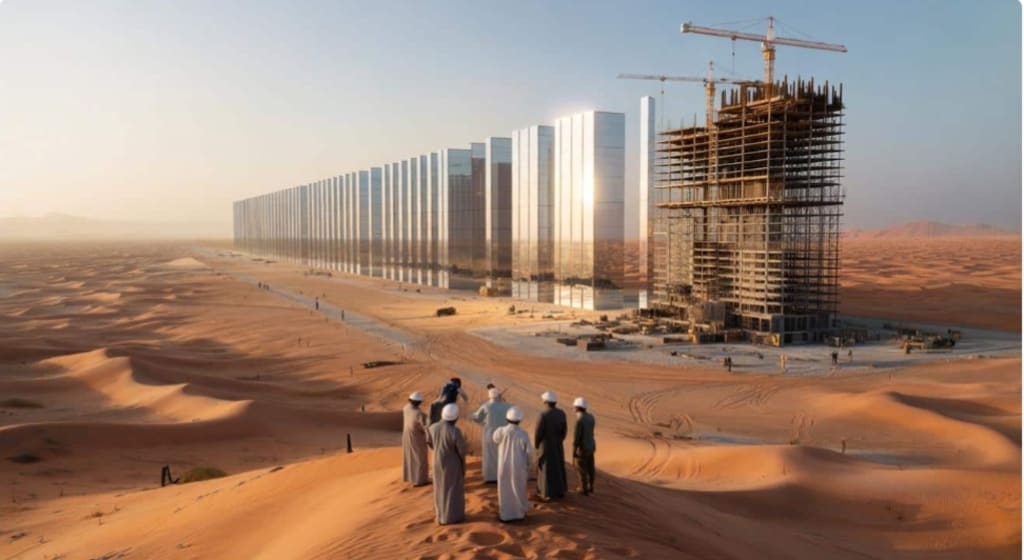
For years, the idea sounded almost unreal: a 100-mile-long city carved into the Saudi desert, with mirrored walls, no cars, zero emissions, and nine million residents living vertically rather than horizontally. It was promoted as the future of urban living — a radical break from congested, polluting cities of the past. Now, reports that Saudi Arabia has effectively scaled back or abandoned the original vision of the project have reignited a global debate: was it visionary genius, or a multibillion-dollar delusion?
The project, known as The Line, was the centerpiece of the kingdom’s flagship development zone, NEOM. Its quiet retreat from initial ambitions marks one of the most significant recalibrations in modern megaproject history.
---
What Was The Line Supposed to Be?
Unveiled in 2021, The Line was promoted as a revolutionary linear city stretching roughly 170 kilometers (about 100 miles) across the desert of northwestern Saudi Arabia. Instead of roads and sprawl, it promised two parallel mirrored skyscrapers, each over 500 meters high, enclosing a narrow urban corridor.
Residents would live within a five-minute walk of daily necessities, while ultra-high-speed transit would move people end-to-end in 20 minutes. Artificial intelligence would manage energy, services, and infrastructure, while nature would be preserved around — and even within — the city.
At the heart of the vision was Crown Prince Mohammed bin Salman, who framed The Line as a bold response to climate change, urban overcrowding, and humanity’s outdated approach to city planning.
---
Why Has Saudi Arabia Pulled Back?
While officials have not formally declared the project “cancelled,” multiple signals suggest the original 100-mile vision is no longer realistic. Construction timelines have been extended, population targets reduced, and early development appears limited to a far shorter section of the city.
Several factors contributed to the retreat:
1. Soaring Costs
Initial estimates placed NEOM’s total cost at over $500 billion, with The Line absorbing a massive share of that budget. Rising global construction costs, inflation, and tighter capital markets made financing increasingly difficult — even for a resource-rich nation.
2. Engineering Complexity
Building the world’s longest mirrored structure in harsh desert conditions posed unprecedented technical challenges. From heat management to structural stability and logistics, the engineering demands were unlike anything attempted before.
3. Economic Reality
Saudi Arabia’s Vision 2030 relies on balancing diversification with fiscal sustainability. As oil revenues fluctuate and global economic uncertainty grows, prioritizing returns on investment has become more urgent than maintaining symbolic megaprojects.
4. Global Skepticism
From architects to urban planners, critics questioned whether a linear city could function socially, psychologically, or economically. Concerns included livability, evacuation safety, and the human cost of forced relocations linked to early construction phases.
---
Visionary Genius: The Case for The Line
Supporters argue that The Line was never meant to be judged by traditional standards. Instead, it functioned as a “moonshot” — a conceptual leap designed to push global thinking forward.
They point out that many once-ridiculed projects, from space exploration to smart cities, initially faced disbelief. In this view, The Line helped reposition Saudi Arabia as a serious player in innovation, sustainability discourse, and futuristic design.
Even if scaled back, the research, planning, and technology developed for the project could influence future urban developments worldwide.
---
Multibillion-Dollar Delusion: The Case Against It
Critics counter that The Line ignored basic human behavior and urban history. Cities evolve organically, they argue, rather than through rigid top-down design. Forcing millions into a narrow corridor — regardless of efficiency — risked creating social alienation rather than harmony.
Environmentalists also questioned the sustainability claims, noting the massive embodied carbon required to construct mirrored megastructures in the desert.
From this perspective, the project became a cautionary tale about what happens when ambition outpaces feasibility.
---
What Happens to NEOM Now?
NEOM itself is not disappearing. Instead, Saudi Arabia appears to be pivoting toward more conventional — and achievable — developments within the zone, including luxury tourism, industrial hubs, and coastal resorts.
Projects like Oxagon, a floating industrial city, and Trojena, a mountain tourism destination, are expected to continue, albeit with closer scrutiny on costs and returns.
The Line may still exist in a reduced form — a symbolic segment rather than a 100-mile reality — serving as a proof of concept rather than a full-scale city.
---
A Broader Lesson for the World
The retreat from The Line resonates far beyond Saudi Arabia. Around the globe, governments are grappling with climate change, urban overcrowding, and technological disruption. The temptation to solve these problems with sweeping megaprojects is strong — but so are the risks.
The Line highlights the tension between bold vision and practical governance. It asks an uncomfortable question: how far should societies go in pursuing radical futures before ensuring they can actually be lived in?
---
End of a Dream — or a Necessary Reset?
Saudi Arabia’s apparent abandonment of the 100-mile desert megacity does not mean the idea failed entirely. Instead, it may represent a strategic reset — a recognition that even visionary nations must adapt to economic, technical, and human realities.
Whether remembered as genius or delusion, The Line has already left a lasting mark on global urban discourse. It challenged assumptions, sparked debate, and forced the world to imagine cities not as they are, but as they might be.
In the end, perhaps that was its most valuable achievement.
About the Creator
Keep reading
More stories from Sadaqat Ali and writers in Journal and other communities.
Voters, Trump and the Fed: The Three Forces Shaping the US Economy
The U.S. economy—home to the world’s largest financial system—doesn’t move on numbers alone. It’s shaped by a powerful trio of influences: the preferences and perceptions of voters, the policy agenda of the White House under Donald Trump, and the monetary decisions of the Federal Reserve. Each force pulls in its own direction, with implications for inflation, interest rates, jobs and everyday financial life. Understanding how they interact is key to decoding what lies ahead for the economy in 2026 and beyond.
By Sadaqat Ali7 days ago in Journal
Jordan Stolz Sets Olympic Record, Wins Gold in 1,000m at Milan Cortina Games
Milan, Italy (AP) — Jordan Stolz has imagined this moment since he was five years old. Back then, he was just a kid in Wisconsin, skating on a frozen backyard pond after watching the 2010 Winter Olympics and falling in love with speedskating. He dreamed of standing atop an Olympic podium one day.
By Omasanjuwa Ogharandukun6 days ago in Journal
Nancy Guthrie: Is a miracle still possible after close to two weeks?
Close to two weeks since Nancy Guthrie's abduction As of February 12, 2026, Nancy Guthrie remains classified as missing for 12 days, but there is no official confirmation that she is deceased. Blood matching Guthrie’s DNA was found on her front porch, indicating she likely suffered an injury during the abduction.
By Cheryl E Preston5 days ago in Geeks


Comments
There are no comments for this story
Be the first to respond and start the conversation.