
Revolutionizing Cell Biology: The Next Generation of Live Cell Imaging Technologies
Why is the Live Cell Imaging Market growing so rapidly, and what does it mean for the future of medicine?

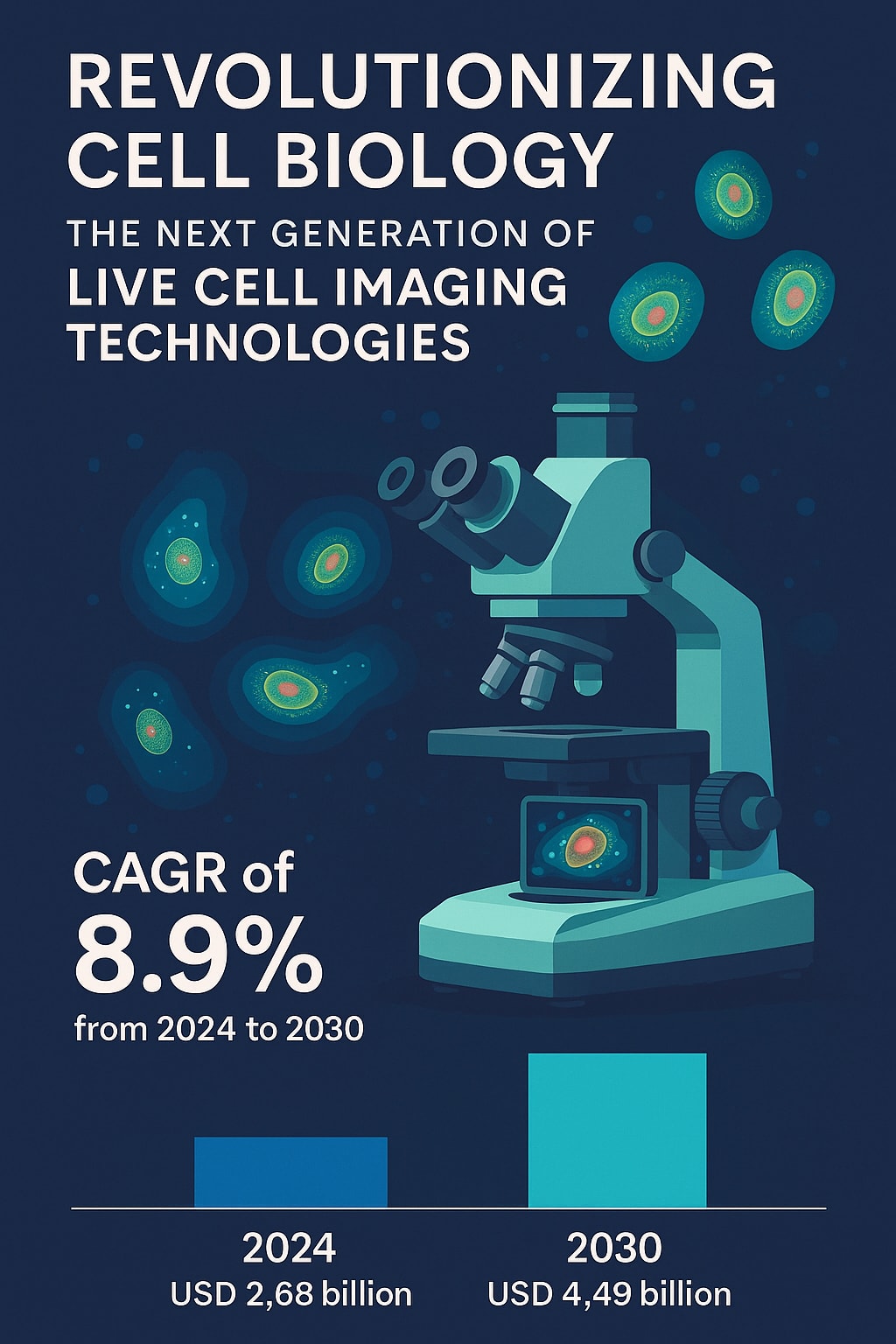
Live cell imaging stands as a fundamental technology within life sciences research that transforms scientists' approaches to examining cell functionality and behavior. Researchers no longer depend exclusively on static images of stained cells to understand cellular functions. High-resolution real-time imaging now provides us with the ability to monitor living cells' internal processes with exceptional precision. The scientific advancement both expanded our cellular process knowledge and created new paths for drug discovery research alongside cancer, immunology, and neuroscience exploration.
Today marks the beginning of a new biological discovery era while the Live Cell Imaging Market witnesses incredible expansion. The combination of improved microscopy techniques together with automated systems and artificial intelligence analytics will push this market into multi-billion-dollar territory soon. What specific factors are driving the revolutionary transformation in cell biology and what future developments should be expected?
The Power of Seeing Cells in Motion
Live cell imaging encompasses various technologies which enable scientists to monitor living cells through time with state-of-the-art microscopy and digital imaging techniques. Live cell imaging delivers dynamic visualizations of biological processes such as mitosis and cell migration which traditional fixed-cell imaging methods cannot provide.
The temporal dimension proves essential for studying diseases characterized by cellular behavioral changes over time including cancer metastasis and neurodegenerative disorders. Researchers gain ability to formulate advanced biological inquiries which yield more detailed and contextual responses when they track cellular changes live.
Technological Innovations Driving the Shift
Live cell imaging experienced its greatest advancement through the combination of multiple essential technologies.
1. Super-Resolution Microscopy: STED (Stimulated Emission Depletion) and SIM (Structured Illumination Microscopy) techniques surpassed the diffraction barrier to deliver unmatched spatial resolution in live cell imaging.
2. Fluorescent Probes and Biosensors: Researchers can now track specific proteins and ions inside living cells in real time because of new genetically encoded fluorescent proteins and biosensors that maintain cellular integrity.
3. Microfluidics and Environmental Control: Current systems integrate both incubators and microfluidic chips to replicate physiological environments through temperature control and gas concentration management enabling extended cell imaging sessions.
4. AI and Machine Learning: The processing of vast datasets from time-lapse imaging has become possible through the use of automated image analysis and AI algorithms. These tools identify patterns and gain insights that manual analysis could not achieve.
5. Multiplexing and 3D Imaging: Light-sheet microscopy and confocal spinning disk technologies enable quick 3D imaging of complete cells or tissues and enhance biological comprehension with additional depth.
The Booming Live Cell Imaging Market
Research forecasts the Live Cell Imaging Market will see substantial expansion throughout the next ten years. The market currently valued USD 2.48 billion is expected to grow at a CAGR of 9% to exceed USD 4.49 billion in the early 2030s.
The key drivers of this growth include:
• Rising demand for personalized medicine
• Expanding cell-based research in oncology and immunology
• Increased investment in biotech and pharmaceutical R&D
• Adoption of AI-powered imaging platforms
The leadership of North America and Europe in market dominance stems from their well-developed research facilities and substantial presence of market-leading companies. The Asia-Pacific area is quickly becoming crucial in global biotechnology because investments in the sector are expanding throughout China, India, and Japan.
Applications in Modern Science
Live cell imaging techniques have become essential tools in numerous scientific fields.
• Cancer Research: Study how therapeutic compounds influence tumor cell proliferation and their movement and invasion patterns.
• Stem Cell Biology: Scientists can observe stem cell development pathways and pluripotency markers simultaneously during real-time analysis.
• Immunology: Scientists use live cell imaging to understand how immune cells detect and eliminate foreign pathogens or cancerous cells.
• Drug Development: Dynamic evaluation of cellular responses to drug candidates enhances both efficacy and toxicity screening accuracy.
Challenges and Future Directions
Despite the promise, several challenges remain. Live cell imaging necessitates high-cost equipment and experienced personnel to operate it. The viability of cells being observed under the microscope can be negatively impacted by phototoxicity and photobleaching throughout extended imaging sessions. Handling data becomes increasingly problematic because high-throughput imaging produces terabytes during individual experiments.
Future live cell imaging systems are expected to integrate advanced features such as omics data combination, remote access capabilities and portable device technology.
• Integration with Omics: Holistic cellular analysis emerges from integrating imaging data with genomic and proteomic information.
• Remote and Cloud-Based Imaging: Real-time remote access and collaboration are enabled through dedicated platforms.
• Miniaturized and Portable Devices: Live imaging technology should become widely available for clinical use and point-of-care diagnostic applications.
Conclusion
Live cell imaging represents a fundamental change in our understanding and study of microscopic life beyond a simple technological improvement. The field maintains its forward momentum through ongoing advancements while the expanding market positions it as essential for biological exploration and therapy development which will enhance human health outcomes.
The development of the Live Cell Imaging Market will provide researchers with precise and fast tools that deliver deep insights which will transform cell biology and shape the future of biomedical science.
About the Creator
Paxton Templeton
I’m a storyteller at heart with a passion for turning data into compelling narratives. With a focus on industry trends, market insights, and growth statistics, I bring clarity to complexity
Keep reading
More stories from Paxton Templeton and writers in Journal and other communities.
Driving Efficiency: How the Automotive Heat Shield Market is Heating Up
As modern vehicles become faster, lighter, and more efficient than ever before, the hidden technologies that enable these advancements are becoming increasingly important. Automotive heat shields now receive increased attention and innovative developments as they join the ranks of unsung heroes. The automotive heat shield market is rapidly accelerating its growth because automakers are pushing for better performance and sustainability under increased global regulatory pressure.
By Paxton Templeton10 months ago in Journal
Author’s Advice
If you would’ve asked me 20 years ago did I know I’d become a writer and an author, I would’ve said “nope, ain’t happening”. As fate would have it I did become an author and I can honestly say I’m loving it so far. It really does feel good to be a writer. I’ve learned a lot on this journey and I feel like with even me being as new to this world as I am, there’s some wisdom I need to share with every other aspiring author.
By Joe Patterson3 days ago in Journal




Comments
There are no comments for this story
Be the first to respond and start the conversation.