
Restoring Balance: Environmental Justice in the Face of Global Crisis.
Exploring the Urgency of Equitable Solutions for Climate Change, Resource Distribution, and Community Resilience
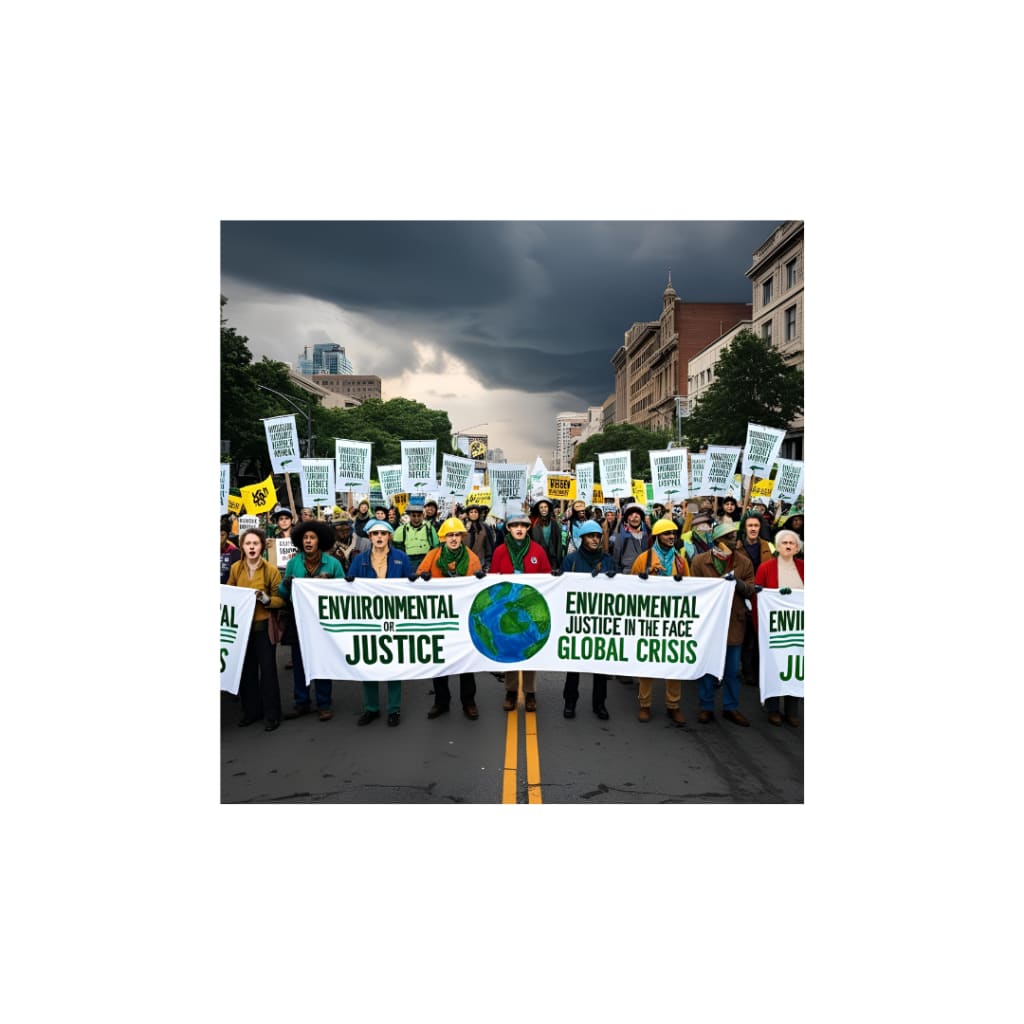
Restoring Balance: Environmental Justice in the Face of Global Crisis
The Importance of Environmental Justice in the Present The environmental crises of the 21st
century have progressed at an alarming rate of nearly 13% per decade, from the Australian
and Amazon rainforest fires to the alarming melting of Arctic ice. Climate change, pollution,
and habitat destruction are no longer distant threats but present-day emergencies affecting
millions globally. According to the World Health Organization (WHO), an estimated 4.2
million deaths annually are linked to outdoor air pollution, disproportionately harming
marginalized communities. These stark facts highlight the urgent need for environmental
justice, a principle that promotes equal treatment and participation in environmental
decision-making for all people, regardless of race, nationality, or income.
Global Perspective on Environmental Justice:
Understanding Beyond conservation, environmental justice encompasses human rights,
equity, and dignity. Globally, vulnerable populations bear the brunt of environmental
degradation. The United Nations refers to these people as "climate refugees" because
thousands of Bangladeshis living along the coast are being displaced by rising sea levels,
which are increasing by approximately 3.3 millimeters annually. Similarly, the World Food
Programme (WFP) reported that extreme weather and prolonged droughts have put over 45
million people in Sub-Saharan Africa at risk of severe food insecurity. These figures show
that social inequalities and environmental issues are deeply intertwined. Communities with
low incomes, indigenous groups, and minorities are frequently relegated to areas with high
pollution levels, limited access to clean water, and inadequate climate shock resilience
infrastructure. This imbalance underscores why environmental justice must be at the heart of
global policy frameworks.
The Historical Roots of Environmental Injustice
The concept of environmental justice emerged prominently in the United States during the
1980s, catalyzed by incidents such as the Warren County protests in North Carolina, where
hazardous waste dumps were disproportionately located in African-American
neighborhoods. A 1987 report by the United Church of Christ revealed that race was the
most significant factor in predicting the location of hazardous waste facilities, even more than
income.
Fast forward to today, and the situation remains dire globally. For instance, in India’s
capital, New Delhi, where air pollution levels frequently exceed safe limits by over 500%, the
urban poor, who live in densely populated slums near industrial zones, suffer the worst
health impacts. These historical patterns of environmental racism and classism have
entrenched inequalities, making environmental justice not merely an ecological necessity but
a moral imperative.
The Impact of Climate Change on Environmental Unfairness
Climate change intensifies pre-existing social disparities. Countries like Tuvalu and Kiribati,
where sea encroachment has already contaminated freshwater sources and submerged
arable land, are threatened by rising sea levels in the Pacific Islands. According to the
Intergovernmental Panel on Climate Change (IPCC), global sea levels could rise by up to
one meter by 2100 if current emissions trends continue.
Furthermore, the economic toll of climate-related disasters disproportionately affects poorer
countries. The World Bank estimates that climate change could push an additional 132
million people into extreme poverty by 2030. In contrast, wealthier nations, while not
immune, possess greater resources for adaptation and recovery, widening the global
inequality gap.
Public Health and Environmental Justice: A Critical Nexus
The intersection of environmental justice and public health is undeniable. According to
research that was published in The Lancet, air pollution is responsible for 9% of all deaths
worldwide. In low-income areas, residents are often exposed to hazardous pollutants from
nearby factories, vehicular emissions, and waste incineration plants. For example, in Lagos,
Nigeria — a city of over 15 million — air quality levels exceed WHO safety thresholds by
nearly five times, contributing to respiratory illnesses and reduced life expectancy.
Water contamination also remains a severe concern. In Flint, Michigan, the infamous water
crisis exposed thousands of residents, predominantly African-American, to
lead-contaminated water. Globally, UNICEF reports that nearly 2.2 billion people lack safely
managed drinking water services, a disparity that exacerbates health inequalities and
undermines human rights.
Corporate Responsibility and Environmental Injustice
Multinational corporations play a significant role in perpetuating environmental injustices.
Industrial giants often relocate hazardous manufacturing processes to countries with lax
environmental regulations, externalizing the costs of pollution onto vulnerable communities.
The 1984 Bhopal disaster in India, caused by a gas leak at a pesticide plant owned by Union
Carbide (now Dow Chemical), resulted in over 15,000 deaths and continues to affect
generations through contaminated groundwater.
Today, similar practices persist under the guise of globalization. Children in Ghana
dismantle toxic electronics with their bare hands in Agbogbloshie, one of the world's largest
electronic waste dumps, exposing themselves to harmful chemicals for minimal financial
gain. Developed nations frequently export electronic waste to countries like Ghana.
The Role of Environmental Activism
Environmental justice movements worldwide have gained momentum, challenging
corporate and governmental negligence. Youth-led initiatives, such as Greta Thunberg’s
Fridays for Future, have mobilized millions across continents, emphasizing that the climate
crisis is also a fight for justice. In the Philippines, environmental defenders like Gina Lopez
championed community rights against destructive mining practices, highlighting the
indispensable role of local activism.
Despite facing significant risks — with Global Witness reporting that 177 environmental
activists were killed in 2022 alone — grassroots movements remain a powerful force for
change. These campaigns amplify the voices of marginalized communities and pressure
policymakers to enact equitable environmental laws.
Policy and International Agreements: Pathways to Justice
Addressing environmental justice requires robust legal frameworks and international
cooperation. With commitments to limit global warming to below 2°C above pre-industrial
levels, the 2015 Paris Agreement marked a historic step in global climate action. However,
mere commitments are insufficient without enforcement and equitable financing.
The Green Climate Fund (GCF), established to support developing countries in climate
adaptation, has mobilized over $10 billion to date. However, developed nations have yet to
fulfill their promise of $100 billion per year, indicating a disconnect between rhetoric and
reality. Effective implementation demands transparency, community involvement, and
prioritization of vulnerable populations.
Technological Innovations and Sustainable Solutions
Technological advancements offer promising solutions to environmental injustice. In
addition to democratizing energy access, renewable energy sources like solar and wind
reduce greenhouse gas emissions. In Kenya, for instance, solar microgrids have electrified
remote villages, improving education and healthcare outcomes while reducing reliance on
polluting kerosene lamps.
Similarly, green infrastructure projects — such as urban forests and green roofs — can
mitigate heat island effects in cities, improve air quality, and enhance community resilience.
In order to guarantee an inclusive transition to a green economy, investments in such
sustainable technologies must give priority to underserved communities.
Conclusion: Towards a Just and Sustainable Future
Environmental justice is not a peripheral concern but a cornerstone of sustainable
development. The interdependence of ecological health, human rights, and social equity
demands an integrated approach. The moral imperative to act has never been greater as
the global population reaches 8 billion and natural disasters become more frequent and
severe. Fulfilling the promise of environmental justice requires collective action — from
policymakers enforcing equitable laws, corporations embracing ethical practices, to
communities demanding accountability. As the proverb wisely states, "We do not inherit the
Earth from our ancestors; we borrow it from our children." The choices we make today will
determine the legacy we leave behind.
By restoring balance through justice, we pave the way for a world where all people,
regardless of background, can thrive in harmony with the planet, can thrive in harmony with the planet. It is not just an
environmental goal — it is a human imperative.
About the Creator
Keep reading
More stories from Farhad khan and writers in Journal and other communities.
The Rise of Multipolarity: End of American Hegemony
Introduction: A Changing World Order Since the end of the Cold War, the United States has enjoyed a position of unrivaled global dominance, shaping international institutions, military strategies, economic policies, and political ideologies. This unipolar moment, as coined by political scientist Charles Krauthammer, positioned America as the sole superpower. However, the geopolitical landscape of the 21st century is rapidly shifting. A new global structure is emerging — one that is multipolar, complex, and resistant to singular control. With the ascent of powers like China, Russia, India, and the resurgence of regional alliances, American hegemony is under threat, prompting a profound transformation in the international order.
By Farhad khan 8 months ago in Journal
Affection and Healing for Yourself
During the night of the last quarter moon, I gathered my ritual supplies. I carefully handled the chunk of black tourmaline that would protect me from your overall negative and narcissistic energy. I carefully walked the house with my stick of selenite in hand, asking the universe to cleanse our working space.
By Alisha Wilkins ✒️🦋🖋️4 days ago in Fiction



Comments (2)
Amazing work
well structured and informative