
Procrastination Isn’t Laziness, It’s a Fear Response (And Creators Experience It More Than Anyone)
Long to-do lists drain motivation. Creative projects feel overwhelming because they’re big, undefined, and emotionally loaded. Tiny actions remove the emotional weight.


There’s a story we tell ourselves when we’re avoiding our work:
“I’m just not disciplined enough.”
“I need more motivation.”
“I’m being lazy.”
But those explanations rarely hold up under honest self-reflection. Most creators are not lazy; in fact, they care deeply about their work. They care so much that finishing, publishing, and sharing it with the world feels emotionally risky.
Procrastination is not a character flaw. It’s a fear response.
- Fear that your work won’t be good enough.
- Fear that no one will buy what you create.
- Fear that the time you invest won’t be worth the outcome.
- Fear that your effort won’t match your expectations.
So instead of finishing the course, launching the template, or publishing the ebook, you stay in the “safe” zone — the world of preparation. You tweak your logo. You reorganize your Notion dashboard. You watch tutorials. You research tools you don’t need. These activities create the *illusion* of progress, while protecting you from the vulnerability of actually shipping the thing.
I know this pattern intimately. Early in my digital product journey, I spent six months revising one offer. Six months of editing, adjusting, refining, and circling back. Not because it wasn’t ready — it was. But launching felt too exposed. What if people didn’t like it? What if no one bought it? What if I failed publicly?
Eventually, I reached a point where waiting felt more painful than releasing. I launched messy, imperfect, and terrified. But that launch taught me something important: growth rarely comes from polishing. It comes from publishing. Once the offer was out in the world, clarity flowed. Feedback came. Sales increased. And I finally understood that procrastination had been protecting me from an imagined threat, not a real one.
After that, I needed a more reliable way to stay consistent and avoid slipping back into the comfort of “productive avoidance.” That’s where a simple 3-step productivity system changed everything.
1. The Power of Tiny Wins
Long to-do lists drain motivation. Creative projects feel overwhelming because they’re big, undefined, and emotionally loaded. Tiny actions remove the emotional weight.
Instead of aiming to “write an ebook,” aim to outline the first section.
Instead of “building a course,” aim to record a two-minute intro.
Instead of “launching an offer,” aim to write one landing page paragraph.
Tiny wins create momentum, and momentum is what dissolves procrastination.
2. Time Blocking: The Antidote to Creative Chaos
Creators are notorious multi-taskers. Switching between writing, editing, responding to messages, researching, and designing breaks focus and slows everything down.
Time blocking reduces friction by assigning each part of your day a purpose.
- A block for content creation.
- A block for admin.
- A block for rest.
Two focused 90-minute sessions often outperform a scattered eight-hour day. When your energy is channeled, your work feels lighter and faster.
3. The Finish Line Habit
Most creators don’t finish because “finished” is vague. Without a clear stopping point, projects stretch longer than they need to.
Before starting anything, define your finish line in one sentence:
“This project is finished when __________.”
Maybe it’s when all five modules are uploaded.
Maybe it’s when the lead magnet has three completed pages.
Maybe it’s when the landing page is written.
Once you reach that point, it’s done. Publish it. Move on.
The Real Secret Behind Consistency
Sustainable productivity isn’t about working harder — it’s about building self-trust. Every time you follow through on a small action, your brain starts believing you’re someone who finishes things. That identity shift makes procrastination lose its power.
Procrastination doesn’t disappear through hacks; it disappears when you see yourself as someone who follows through.
- Choose one small action today. Finish it.
- Celebrate it.
- Then take the next one.
That’s how creative momentum is built, one tiny, completed step at a time.
Join 2000 creators and connect with me to receive my deep dive notes and helpful guides on building profitable digital product businesses with strategy and identity shifting.
About the Creator
Edina Jackson-Yussif
I write about lifestyle, entrepreneurship and other things.
Writer for hire [email protected]
Entrepreneur
Software Developer + Machine Learning Specialist
Founder:
➡️Creator Vibes Club
➡️Article Flow Club
Keep reading
More stories from Edina Jackson-Yussif and writers in Journal and other communities.
You're Broke Because You Refuse to Take Giant Steps
For a long time, I thought I was doing everything right. I was reading the books, watching motivational videos, journaling every morning, setting goals, even scripting the life I wanted. On paper, I was working hard. But deep down, I knew something wasn’t changing.
By Edina Jackson-Yussif 2 months ago in Journal
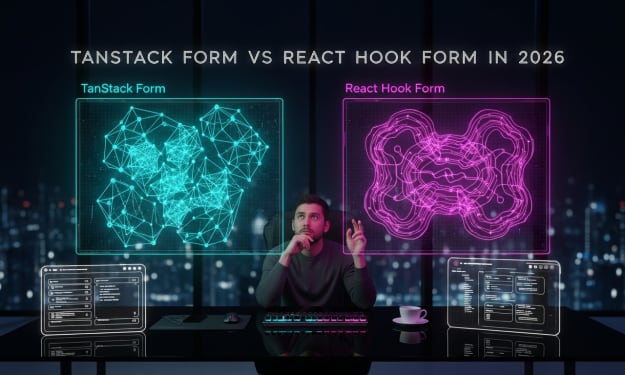
TanStack Form vs React Hook Form in 2026
Choosing a form library in 2026 is a major decision. It is no longer just about reducing re-renders in the browser. We are now deeper into the era of Server Components. We must handle localized state hydration and strict type safety. Your choice defines how your application architecture will scale. TanStack Form and React Hook Form (RHF) have both evolved. They have changed significantly over the last two years. However, they still serve different philosophies of state management. One focuses on uncontrolled speed within the React ecosystem. The other prioritizes type-safe logic that works across different frameworks.
By Del Rosario6 days ago in Journal



Comments
There are no comments for this story
Be the first to respond and start the conversation.