
Plane Accident at 17,000 Feet
British Airways Pilot Sucked Out of Plane Mid-Flight, Cabin Crew Clings to His Legs to Keep Him Alive

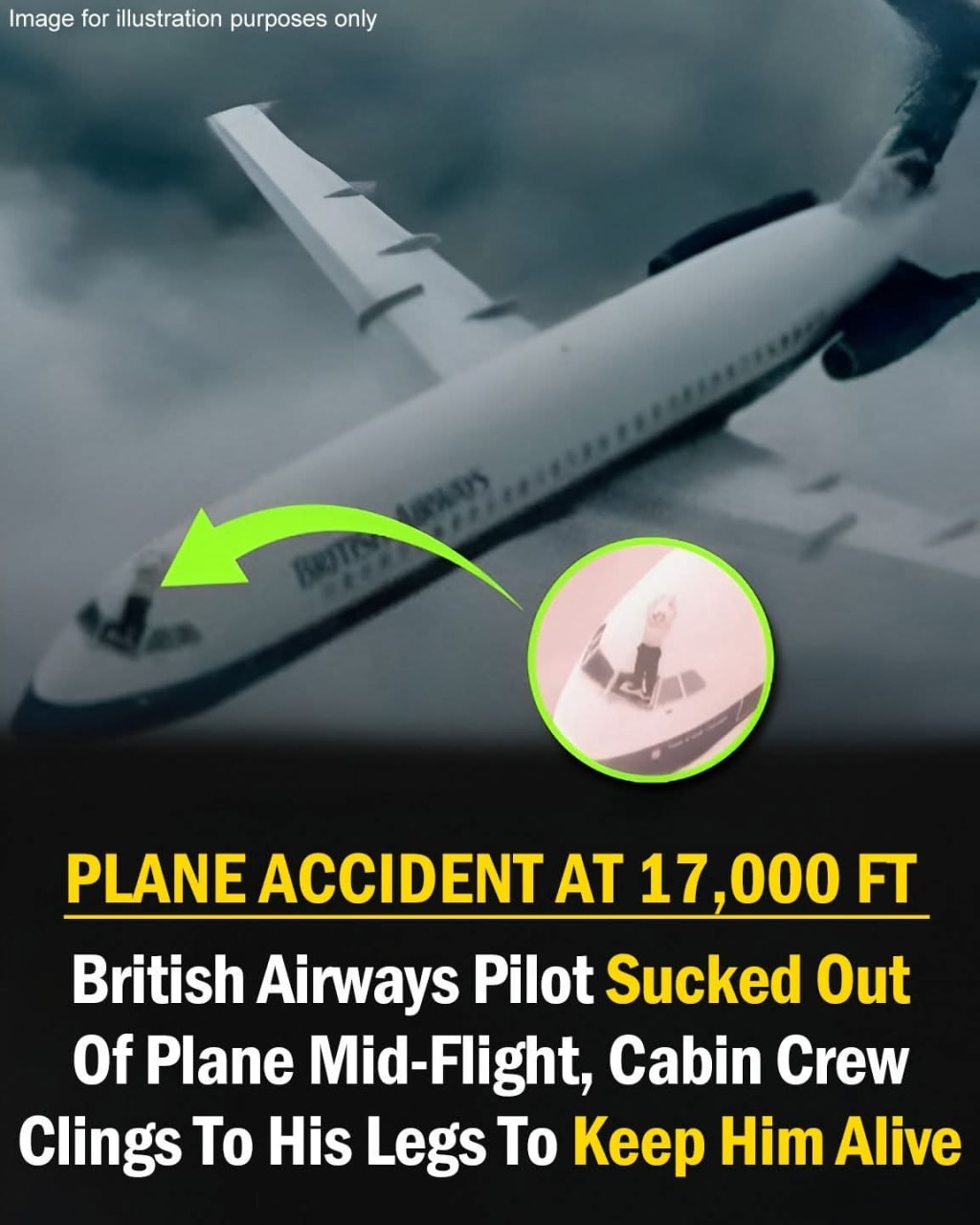
In the world of aviation, few incidents are as terrifying — or as miraculous — as what occurred aboard British Airways Flight 5390. On June 10, 1990, a routine flight from Birmingham, England, to Málaga, Spain, turned into a heart-stopping ordeal when the aircraft’s cockpit window suddenly blew out at 17,300 feet. The resulting decompression violently sucked the pilot halfway out of the aircraft, leaving him clinging to life — quite literally — as a flight attendant held on to his legs for over 20 minutes while the co-pilot fought to land the plane safely.
The aircraft, a BAC One-Eleven, had taken off normally, with Captain Tim Lancaster at the controls and First Officer Alastair Atchison beside him. The weather was clear, the passengers were calm, and there were no indications of trouble ahead. But approximately 13 minutes into the flight, a loud bang shattered the routine. The left windshield panel of the cockpit suddenly separated from the aircraft. In an instant, the cockpit experienced explosive decompression.
Captain Lancaster, who had just removed his shoulder harness, was pulled out of his seat by the force of the rushing air and partially ejected through the hole where the windshield had been. His body slammed against the exterior of the aircraft, pinned by the powerful air pressure. His feet caught on the flight controls, and his torso was bent backward, exposed to the freezing winds at 17,000 feet.
Chaos erupted in the cockpit. Loose papers and objects were flying around, alarms were blaring, and communication was impossible due to the deafening wind. But amidst the panic, First Officer Atchison reacted with incredible composure. He immediately took control of the aircraft, disengaged the autopilot, and began an emergency descent to a lower altitude where the air pressure was higher and the temperature less brutal.
Flight attendant Nigel Ogden, who had just entered the cockpit moments before the incident, saw the captain’s body being sucked out and, without hesitation, lunged forward to grab his legs. Ogden held on with all his strength, even as the freezing air numbed his hands and the captain’s body battered the fuselage. Another crew member helped secure Lancaster’s legs to the cockpit controls using seat belts, desperately trying to keep him from being lost entirely.
Atchison, flying alone under immense pressure, communicated with air traffic control and diverted the flight to Southampton Airport. The situation was critical. The aircraft was descending fast, the captain’s condition was unknown, and there was no guarantee they could keep him from slipping out completely. Yet the cabin crew and co-pilot worked together with astonishing courage and efficiency.
For nearly 20 minutes, Lancaster remained stuck in the cockpit window, unconscious and exposed to violent winds and sub-zero temperatures. The pressure had caused his eyes to bulge and his body to turn blue. Most assumed he was already dead. Still, the crew refused to let go.
Amazingly, when the plane finally landed safely in Southampton, emergency services rushed aboard expecting to retrieve a corpse. Instead, they found Captain Tim Lancaster alive. He had suffered frostbite, multiple fractures to his arms and hands, and severe bruising — but he survived. After a lengthy recovery, he returned to flying commercial aircraft.
The investigation that followed revealed that the accident had been caused by human error during maintenance. The bolts used to secure the windshield had been too short and of the wrong diameter. As a result, the pressure differential at altitude caused the panel to blow out. The incident led to a major review of aircraft maintenance procedures and highlighted the critical importance of attention to detail in aviation engineering.
This incredible survival story is often cited as an example of how professionalism, training, and sheer human determination can overcome even the most horrifying of scenarios. The cabin crew’s refusal to let go of their captain, despite thinking he was already dead, exemplifies the kind of selfless courage that often goes unnoticed in daily life. Atchison’s calm under pressure was instrumental in saving not only the life of the captain but also all 81 people on board.
British Airways Flight 5390 is more than a story of a freak accident. It is a testament to human resilience, quick thinking, and the strength of teamwork in the face of overwhelming odds. The haunting image of a man hanging halfway out of a jet at 17,000 feet, kept alive by the grip of his colleagues, continues to captivate and inspire those who hear it.
More than three decades later, the incident remains one of the most extraordinary and improbable survival stories in the history of flight — a reminder that even when the sky seems to fall apart, bravery can keep us grounded.
About the Creator
Keep reading
More stories from DigitalAddi and writers in Journal and other communities.
Trapped Beneath the Mountain
For many, adventure is a calling. For 25-year-old Isabella Torres, hiking volcanoes was more than a thrill — it was how she felt alive. The Brazilian backpacker had spent months traveling solo across Central America, capturing breathtaking photos, journaling deep thoughts, and connecting with nature in ways most people only dream about.
By DigitalAddi7 months ago in Journal
Russian Gerbera Drone Found on Moldovan Lake Shore, Triggering Security Alert
In a startling development that has heightened regional security concerns, authorities in Moldova reported the discovery of a Russian Gerbera drone washed ashore on a lake near the northern border. The unmanned aerial vehicle (UAV), which has been associated with surveillance and tactical operations in recent conflicts, has prompted a swift response from Moldova’s military and intelligence agencies. Officials emphasized that while no immediate threat was detected on land, the incident underscores the growing complexity of drone operations in Eastern Europe and the potential for spillover from ongoing regional conflicts.
By Fiaz Ahmed Brohia day ago in Journal
Center Stage with Paul Stewart
*** I'm keen to republish the interviews I did for my series with Vocal creators. It's been a few years and I thought it might be nice to revisit these wonderful conversations. I'll be releasing them one at a time for a few weeks/months.
By Heather Hubler4 days ago in Interview



Comments
There are no comments for this story
Be the first to respond and start the conversation.