
Nvidia Beats Apple and Microsoft to Become the World’s First $4 Trillion Public Company
Nvidia $4 trillion, Nvidia vs Apple, Nvidia vs Microsoft, Nvidia stock 2025, AI chip leader, world's most valuable company

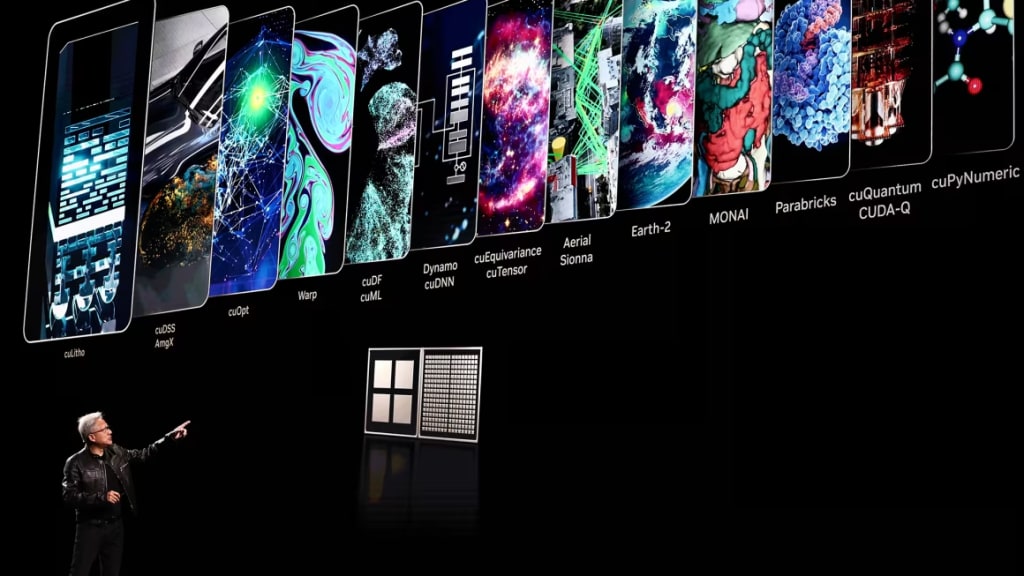
The AI King Takes the Throne
In a world where silicon drives supremacy and data is more valuable than oil, Nvidia has just pulled off what once seemed unthinkable—surpassing Apple and Microsoft to become the world’s first $4 trillion public company.
Yes, you read that right. $4 trillion. That’s trillion with a “T”—twice the GDP of Nigeria, nearly equal to the GDP of Germany, and more than the combined market cap of ExxonMobil, Coca-Cola, and JPMorgan Chase. If money talks, Nvidia just delivered the loudest mic drop in financial history.
But how did a company that once specialized in gaming graphics cards rise to become the undisputed heavyweight champion of the stock market? Let’s unpack it—Vusi Thembekwayo style. With rhythm, revelation, and raw power.
💾 From Gaming Geek to Silicon Sultan
Imagine telling someone in 2005 that a company making graphics cards for Call of Duty would one day dethrone Apple and Microsoft.
They’d laugh.
They’d probably call you a dreamer.
But that’s exactly what happened. Nvidia’s journey is a masterclass in staying ahead of the curve. And more than that, it’s a case study in betting big—before the world catches up.
Founded in 1993 by Jensen Huang, Nvidia cut its teeth making GPUs—chips that rendered beautiful graphics for gamers. But underneath those pixels lay power—raw, parallel computing power. The kind of power that could run AI models, simulate physics, and train self-driving cars.
Huang saw the wave coming long before the surfboard industry was born. While Intel was stuck optimizing for desktop PCs and Apple was selling lifestyle with hardware, Nvidia was building the backbone of AI infrastructure.
In one sentence?
Nvidia was gaming with the world, but coding the future.
🧠 AI: The Billion-Dollar Bet That Paid in Trillions
What really pushed Nvidia over the edge? Two words: Artificial Intelligence.
AI isn’t just hype anymore. It’s the engine of the digital revolution.
It powers everything from ChatGPT to self-driving Teslas, drug discovery to fraud detection, real-time translations to voice assistants.
And guess what powers that engine?
Nvidia’s GPUs.
When ChatGPT launched and the generative AI boom began, everyone from OpenAI to Google DeepMind scrambled for Nvidia H100 chips. The demand was so high, it made Bitcoin mining look like a school science fair.
In fact, in 2024 alone, Nvidia’s data center revenue more than doubled—hitting over $100 billion annually. That’s not revenue from gaming. That’s not revenue from consumer electronics.
That’s AI. Pure, undiluted, enterprise-grade AI.
📈 The Market Moves: How Nvidia Stacked the Billions
Let’s look at the scoreboard in July 2025:
Company Market Cap
Nvidia $4.03 trillion
Microsoft $3.48 trillion
Apple $3.43 trillion
Amazon $2.11 trillion
Alphabet (Google) $2.06 trillion
Source: Nasdaq, July 2025
Nvidia’s stock has grown over 400% in the last two years, riding high on the AI tsunami. While Microsoft leaned into cloud and Apple focused on Vision Pro headsets, Nvidia owned the shovels in the AI gold rush.
Jensen Huang—ever in his signature black leather jacket—became the tech world’s Tony Stark: equal parts engineer, futurist, and showman. When he speaks, Wall Street listens. When he launches, developers build. When he hints, rivals sweat.
🏗️ The Empire Nvidia Is Building
Beyond AI chips, Nvidia is spreading its tentacles wide:
Nvidia Omniverse: Their metaverse platform for industrial simulation and 3D collaboration.
Nvidia CUDA: A dominant software framework used in AI development.
Nvidia DGX Cloud: GPU-as-a-Service platform that’s turning cloud computing into a speed race.
Nvidia Robotics and Automotive AI: Powering autonomous vehicles and industrial automation.
In short, Nvidia doesn’t just sell chips—it sells capabilities. It’s becoming the Intel, AWS, and Tesla of AI—all rolled into one.
🇺🇸 GEO Focus: Why Nvidia's Rise Matters to the USA
In the geopolitical chessboard of tech dominance, Nvidia is America’s queen piece. While China invests heavily in domestic semiconductors and Europe frets over regulation, the U.S. has found a technological warhorse in Nvidia.
With its headquarters in Santa Clara, California, and deep partnerships with American firms like Amazon, Microsoft, Meta, and Google, Nvidia has positioned the U.S. as the undisputed leader of AI hardware globally.
This gives Washington a strategic edge in everything from defense to energy, education to economics.
Forget oil. AI compute is the new national resource.
🏛️ Meanwhile, Apple and Microsoft Watch from the Sidelines
It’s not that Apple and Microsoft are falling—far from it. Apple continues to lead in hardware elegance. Microsoft is still the emperor of enterprise software and cloud services via Azure.
But in the race for the future—the one powered by machine learning, real-time inference, neural networks, and quantum leaps of cognition—Nvidia owns the track, the car, the engine, and the fuel.
Apple makes the devices.
Microsoft runs the platforms.
But Nvidia? Nvidia builds the brains.
🏆 Nvidia’s CEO Jensen Huang: The Man Behind the Trillions
Let’s pause and talk about the man behind the machine.
Jensen Huang, born in Taiwan, moved to the U.S. as a child. He studied electrical engineering and co-founded Nvidia in 1993. Today, he’s one of the richest and most respected tech leaders on the planet.
But what separates Huang isn’t just his brain—it’s his conviction. He bet the company’s future on AI long before anyone believed it was more than science fiction. Where others saw GPU sales, he saw the foundation of machine intelligence.
While the world zigged, he zagged—and turned the zig into a trillion-dollar triumph.
😂 The Joke on Wall Street
Back in 2019, an analyst on CNBC famously quipped:
“Nvidia’s a gaming chip company. Great stock, but not a long-term winner like Apple or Microsoft.”
Fast forward six years.
Now Wall Street memes read:
“God created the world in 7 days. Jensen Huang rendered it in real-time… using 6 GPUs.”
📉 Caution Ahead? A Word of Market Wisdom
Let’s be honest. A $4 trillion valuation brings lofty expectations. Some investors are already whispering “bubble.”
Nvidia’s current P/E ratio is astronomical by historical standards. Regulatory scrutiny is rising. And competition from AMD, Intel, and even custom silicon players like Google’s TPU or Apple’s own M chips is heating up.
But here’s the catch—Nvidia isn’t just trading on profit margins. It’s trading on belief. Belief that the AI wave is just beginning. Belief that the next phase of civilization will be computational.
And belief that Jensen Huang is holding the future’s motherboard.
💡 Final Thoughts: Not Just a Company, But a Signal
This isn’t just a finance story. It’s a cultural moment.
It signals that the world’s most valuable commodity is no longer oil, software, or hardware—it’s compute intelligence.
Nvidia reaching $4 trillion isn’t just about beating Apple or Microsoft. It’s about the ascendancy of AI.
And as the world rushes toward smarter machines, faster decisions, and hyper-automated realities, Nvidia is the gatekeeper of what’s possible.
“Some companies ride waves.
Others make waves.
Nvidia? They built the ocean.”
Words: 1128
0
About the Creator
Omasanjuwa Ogharandukun
I'm a passionate writer & blogger crafting inspiring stories from everyday life. Through vivid words and thoughtful insights, I spark conversations and ignite change—one post at a time.
Keep reading
More stories from Omasanjuwa Ogharandukun and writers in Journal and other communities.
The Alberta Government Strikes Again
At coffee this morning, there was some rather vibrant talk around the table of the Alberta Government and its latest dealings with teachers in the province. This discussion led, of course, to a replay of a conversation held on a previous date around the same coffee table in the same restaurant. If I recollect correctly, I think it all went something like this.
By John Oliver Smith5 days ago in Journal


Comments
There are no comments for this story
Be the first to respond and start the conversation.