
Medical Biomimetics Market Fueled by Tissue Engineering and Organ Regeneration Trends
The rise of regenerative medicine and personalized treatment approaches in contemporary healthcare positions biomimetics as an essential driver for innovative developments.

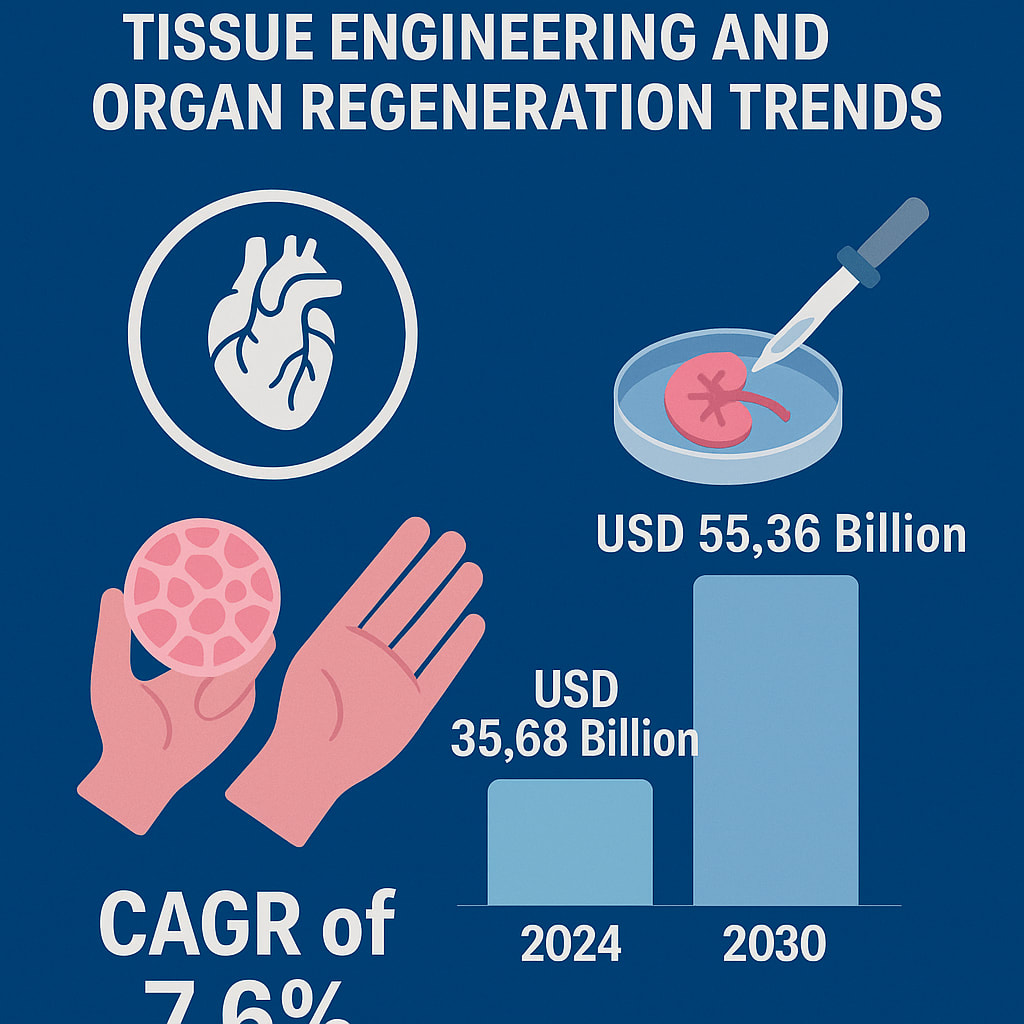
Medical biomimetics stands at the core of the healthcare revolution caused by the fusion of biology and engineering through its use of nature-based solutions to address medical problems. The field of biomimetic technologies which includes synthetic skin and bioengineered organs is rapidly expanding through progress in tissue engineering and bioinspired materials along with organ regeneration developments.
The medical biomimetics market which holds a value of USD 35.68 billion in 2024 is expected to grow to USD 55.36 billion by 2030 with a compound annual growth rate (CAGR) of 7.6%.
What Is Medical Biomimetics?
Medical biomimetics involves the development and use of technology that replicates natural biological systems to address healthcare challenges. The investigation of living organisms' structures and functions enables scientists and engineers to create materials and devices that either replicate or improve human physiological systems.
Core applications include:
- Tissue scaffolds for regenerative therapies
- Bioinspired prosthetics and implants
- Synthetic skin and wound dressings
- Artificial organs and organ-on-chip systems
- Biomimetic drug delivery mechanisms
These innovative technologies focus on enhancing human biological functions with greater natural efficiency compared to conventional methods.
Key Drivers of Market Growth
1. Advances in Tissue Engineering
Biomimetic scaffolds engineered to simulate the extracellular matrix (ECM) serve as essential structures to promote cell growth and differentiation while facilitating tissue regeneration. The utilization of scaffolds for bone, cartilage, skin and cardiovascular tissue repair represents a hopeful substitute for traditional grafts and transplant techniques.
2. Rising Demand for Organ Regeneration
The worldwide increase in organ transplant waitlists has led biomimetics to develop bioengineered tissues for liver, kidney and cardiac repair. Experts are employing 3D bioprinting technology and stem cell research to recreate organ functions which will lead to the development of fully operational lab-grown organs shortly.
3. Aging Population and Chronic Diseases
The aging global population leads to higher occurrences of degenerative diseases alongside osteoporosis cardiovascular problems and wound healing difficulties. Medical professionals commonly choose biomimetic materials like bone graft substitutes and bioresorbable stents because they demonstrate excellent biocompatibility while seamlessly integrating with surrounding tissues.
4. Innovations in Material Science
Through the study of spider silk and gecko feet material science is discovering new types of bioinspired polymers as well as ceramics and nanomaterials. These materials now feature in medical implants, wearable sensors and surgical tools to improve healing outcomes and minimize rejection.
Leading Applications in Medical Biomimetics
Cardiovascular: Biomimetic heart valves and stents achieve natural elasticity while enhancing endothelial cell growth.
Orthopedic: The design of artificial joints and bone scaffolds replicates both the porosity and strength of natural bone to improve osseointegration.
Dental: Dental restorative materials along with enamel coatings boost both resistance and sensitivity reduction.
Ophthalmology: Vision restoration possibilities expand through the use of corneal implants together with retina-like sensors.
Wound Healing: Smart bandages and skin substitutes replicate skin structure to speed up healing processes and minimize infection risks.
Regional Insights
North America dominates the market because of powerful R&D environments combined with substantial investments in regenerative medicine and high healthcare expenditure.
Europe maintains a close position in the market with substantial EU program funding backing research in tissue engineering and biomaterials.
The Asia-Pacific region continues to expand quickly with Japan, South Korea, and China at the forefront of technological development and healthcare demand growth.
Latin America and the Middle East & Africa markets are developing because of enhanced healthcare systems and greater knowledge about advanced treatments.
Challenges to Overcome
The medical biomimetics market holds potential but encounters multiple obstacles.
The medical biomimetics market struggles with high research and development expenses alongside lengthy durations to bring products to market.
The medical biomimetics market faces regulatory challenges which become especially complex when seeking approval for implantable or regenerative therapies.
Bioengineered tissues and organs encounter manufacturing limitations that affect scalability.
The use of stem cells and genetic materials in biomimetic products raises ethical questions.
The cooperation among academic institutions, industry partners and regulatory agencies remains crucial to speed the transition of scientific research findings into clinical applications.
Future Outlook: Toward Living, Responsive Systems
Medical biomimetics will progress from static substances to active systems that adapt to real-time body signals in future developments. Key trends include:
- Biohybrid implants combining synthetic and living cells
- Responsive biomaterials enable drug delivery or structural transformation when exposed to specific stimuli.
- Drug testing and personalized medicine will benefit from organ-on-chip platforms.
- Researchers use AI-driven biomimicry methods to reproduce complicated interactions found in biological systems.
- Biomimetics will become essential in developing regenerative healthcare solutions which will be both personalized and sustainable as these innovations advance.
Conclusion
Medical biomimetics goes beyond nature imitation by working together with natural systems to create advanced medical technologies. The field advances the limits of therapeutic innovation and organ replacement through the integration of biology with engineering and material science for tissue regeneration. The medical biomimetics market stands ready to revolutionize healthcare which is evolving towards precision medicine and regenerative therapies.
About the Creator
Silvie Karson
Passionate storyteller exploring the world of trends. With a background in digital marketing, I craft compelling narratives that inform and inspire. Whether diving into deep-dive features, growth analysis, or trend analysis.
Keep reading
More stories from Silvie Karson and writers in Journal and other communities.
From Check-In to Care: Medical Kiosk Market Booms Amid Digital Health Transformation
Medical kiosks market have become essential components throughout the patient journey as the digital revolution transforms healthcare delivery from self-check-in procedures to diagnostic services and teleconsultations. Medical kiosks empower patients with quick contactless access to healthcare services while streamlining administrative processes and reducing operational burdens. The result? Medical kiosks represent a rapidly expanding global market which analysts predict will increase from USD 1.62 billion in 2024 to USD 3.76 billion by 2030 through a compound annual growth rate (CAGR) of 15.1%.
By Silvie Karson7 months ago in Journal
What Milwaukee Teams Overlook During App Planning Phases?
Most app projects in Milwaukee do not fail because of poor execution. They struggle because early planning feels productive while leaving the hardest questions unanswered. Whiteboards fill up. Features get approved. Timelines look reasonable. Momentum builds. What is missing rarely feels urgent at that stage.
By Samantha Blake7 days ago in Journal
How to Succeed at the Benson Directory®
Congratulations and welcome to the Benson Directory® employee #22391! As our newest call handler, you will have the privilege of speaking with dozens of unique and interesting people on a daily basis as well as the opportunity to earn bonuses for high performance. Contained within this handbook you will find a set of ease to follow instructions designed to help you settle in to your new role and begin paving the way to success.
By S. A. Crawford2 days ago in Fiction



Comments
There are no comments for this story
Be the first to respond and start the conversation.