
Measuring Design
Frameworks to quantify the value of good design.

I have tried to write this article for the designer, agency, and entrepreneur or business. This article will probably be confusing trying to appeal to everyone. However, my experience in the last decade has shown me there is a massive disconnect between designers and businesses. I want to show designers and creatives how to understand and implement processes to evaluate what their designs are worth. I also want to show businesses and entrepreneurs that designers and creatives can and do add value to businesses.
Designers instinctively see the value of “good design” and yet often don't understand how to "prove" it. Finding the numbers, statistics and metrics to measure their designs is not something we've traditionally been taught in school. A typical outcome is that designers become sellers of an à la carte service where the client can pick and choose the designs or services they want without receiving the full benefit of an inclusive package. Another outcome is that designers, especially freelancers, are asked to do too much with very little pay. This affects the outcome for both the designer and the client.
Where the disconnect happens is when a business comes to a designer or agency. Businesses often allocate very little money to the brand and design of their business or their digital or packaged offerings. Many businesses, startups, and entrepreneurs, feel money is better spent on the product or service offering. So there becomes a two-fold issue. The designer, just trying to make a living in the world of Wix, Squarespace, 99Designs, Fiver, Canva, and cheaper offshore labour, reduce their prices forcing their colleagues to follow suit. The consequence is that designers cannot offer a full design service due to budget constraints.
Businesses, on the other hand, often feel design is subjective in nature. Additionally, once a design project is complete, without visible metrics, businesses fail to see the value in their design purchase.
The solution is to quantify good design. Quantifying design is a useful exercise for a few reasons. As a business owner, you want hard numbers that prove value, so you can justify the expense. With solid numbers to show prospective clients, creatives can justify higher prices.
Then I am going to give a working definition of design. I will then explain various ways of measuring design. To start, I will share studies which measure the impact of good design on business. Hopefully these studies will help convince people of both the need for good design and the utility of measuring design. Lastly, I am going to give a working definition of design and explain various ways of measuring design and design projects.
Remember, as a business owner, you can implement these meatrics yourself. These frameworks and formulas will allow for a more realistic design budget and by understanding these, your work with designers and agencies will be rewarding both personally and financially.
As creatives, finding a way to measure your work from the beginning of a project through to the end will allow you to price you services accordingly. Something to note, though, is that value will be seen months or even years after you’ve handed off your project to your client. It is therefore helpful to build a solid relationship with your client so that you can work with them at a later date.
Before I begin I want to differentiate between hard and soft values. An example of a hard value would be the profit made when an order page is redesigned to have less friction. This ease of use means more people will stay on the page to complete the order, which directly translates to increased profit. A soft value would be the customer satisfaction derived from a page that's easier to use, such as when an app is "gamified". That soft-value would translate into another purchase at a later date or a recommendation. Both hard and soft values are relevant for quantifying design.
Thankfully for us, there are an increasing number of studies that measure the success that design has on business. An industry-wide assessment has shown that design positively affects business across national borders, economic systems, and industries. This is good news as these studies prove quantitatively what designers have known all along. Design equals more profit.
Here are some findings:
• Design-driven companies have outperformed the S&P Index by 219% over 10 years.
• Companies that foster creativity enjoy 1.5x greater market share.
• A study in the UK showed that for every £100 spend on design, there was a £225 return and similar study in Denmark showed that companies that increased their design investment outperformed competition by 40%.
• Companies that value design compete less on price, suggesting that design plays an essential role in customer perceptions of value.
• A focus on either functional or experiential design can increase profitability by 9%.
• A focus on both functional and experiential design can increase profitability by 20%.
• Companies that embrace design saw a connection between better business performance and increased employee satisfaction.
Top companies are leading with design. Think Apple, Airbnb, and Square. Looking at the above statistics, it becomes clear that companies that aren’t willing to invest in design because they think it can’t be measured or tied to ROI will fall behind. Design has become a key value differentiator.
Chief product officer of AirBNB, Joe Gebbia say, “To me, design thinking is another way of saying empathize with the customer. It’s consideration for the person you’re designing for. That’s all it is. What it means is you’re going to spend the time and the effort to understand the needs of the person you’re designing for such that you can create something that’s valuable to them.”
Steve Jobs summed it up well in the NY times article, Guts Of A New Machine. "Most people make the mistake of thinking design is the visual aspect, or what it looks like. However, design is also how it works.”
Good design, meaning designing powerful experiences, benefits businesses in the sense that it helps you attain a solid understanding of the many ways that customers engage with your brand—from websites and social media to packaging.
To begin with, let’s define “good design”. There are many definitions, but for the purpose of this article, we are going to define design as a collaboration between a creative and client to solve a problem in business, communication, or society. We could go further and define good design as a positive experience.
The simplest and most obvious way to begin to measure the value of good design is the ROI (Return On Investment) formula. Because it’s easy to calculate and interpret and can apply to a wide variety of investment types, this is a useful metric to start with.
The formula for ROI is: Gain of investment - cost of investment / cost of investment x 100 = % ROI.
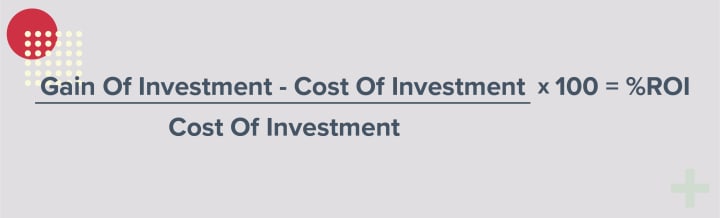
For instance, your company is hired (or you hire a company) to produce high-quality graphics for Facebook ads. Since FB comes with its own native analytics, calculating the ROI is very easy and doable. $2,000 is spend on graphics and paid ads for a specific launch day. That launch day, sales are $20,000. So we minus the cost of the designer and ads (or the cost of investment from the profits) ($20,000 - $2,000 = $18,000) and then divide the profits by the investment cost ($18,000 / $2,000 = 9), which, as a percentage is 90% and a very good ROI. Using this formula, we could further calculate how much the designs themselves directly contributed to the ROI.
While initially, this metric looks easy to do and works quite well in this case, the ROI becomes more difficult to calculate for something such as a website. Within the design scope of a website, the obstacle is that it can be difficult figuring out the role of how a design influenced customer/consumer decision making for a business. (Although a/b testing allows us to refine this knowledge.) For magazine ads or other projects where we can’t plug in analytics, we need to find other methods of understanding the customer/consumer decision making as it relates to your designs.
A good way of tackling this is through an ethnographic review. Use surveys and interviews with sales staff and customers to gain an understanding of the value created through a design. Even a simple survey through email can reveal surprising insights.
Another useful measurement is the Cost/Benefit Analysis (CBA). If ROI is summative, meaning it sums up everything at the end of a project, then CBA is formative, in that it determines feasibility before a project begins.
The formula is simple.
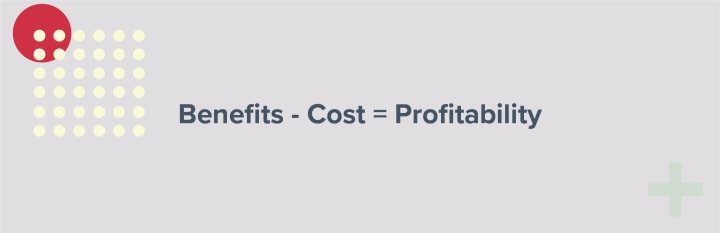
Benefits - costs = profitability or Positive factors - negative factors = project viability.
Or,

Before diving into the intricacies of the Cost/Benefit Analysis, we must make a few assumptions and also explain one of the crazier aspects of business forecasting. Basically we are going to assign a dollar value to something that does not yet have a dollar value.
Businesses do this all the time when forecasting, such as when writing a business plan. It’s basically an educated guess as to how much something costs. Now that we know that and all the creatives have wrapped their head around the idea of made up numbers, let’s get on with the steps of the CBA.
Step 1: Generate a list of hard and soft costs.
A hard cost would be a flat fee for design or development of an app.
A soft cost would be the time it takes for customers to learn how to use the new app.
Step 2: Identify hard and soft project benefits and associated remuneration.
Hard benefit would be the new ease of use of the app.
Soft benefit would be the (good) feeling of using the app.
Here is where you make assumptions or educated guesses about associated costs. So go ahead. Assign a dollar value to these benefits. However, as every business owner knows, be careful about what dollar value your assign. I have rarely ever seen a business plan or CBA that does not widely over-inflate profits.
Step 3: Subtract costs from benefits.
When looking at the Cost/Benefit Analysis formula it is helpful to keep in mind some of these questions for the business owners: What would happen to your business if the project was cancelled. How much would this decision ultimately cost for your business? What if the project failed to meet its objectives? How much would you be willing to pay to ensure this doesn’t happen? How long will it take to earn back the investment in the project?
The are many other ways of measuring the value of design, but I have tried to keep this as simple as possible. Freelancers and small teams don't have the resources available to do any in-depth analysis and each company and business is different as to what is needed. Hopefully though, I have been able to provoke both curiousity and thought about good design, it's value, and how to measure it.
I love hearing from other creatives and entrepreneurs. Reach out and tell me what you thought of this article. I am always looking for ways to improve.
About the Creator
Keep reading
More stories from Amy Pierrson and writers in Journal and other communities.
Building Strong Businesses Through Strategy and Adaptability
In the modern business landscape, adaptability has become one of the most valuable skills an entrepreneur or business leader can possess. Markets evolve quickly, consumer expectations shift constantly, and external pressures—economic, technological, or social—can reshape industries overnight. In this environment, businesses that survive are rarely the fastest-growing ones; they are the most thoughtful and resilient.
By ORM_Specialist3 days ago in Journal



Comments
There are no comments for this story
Be the first to respond and start the conversation.