
Lifting the Future: How Forklift Market Are Powering a New Industrial Era
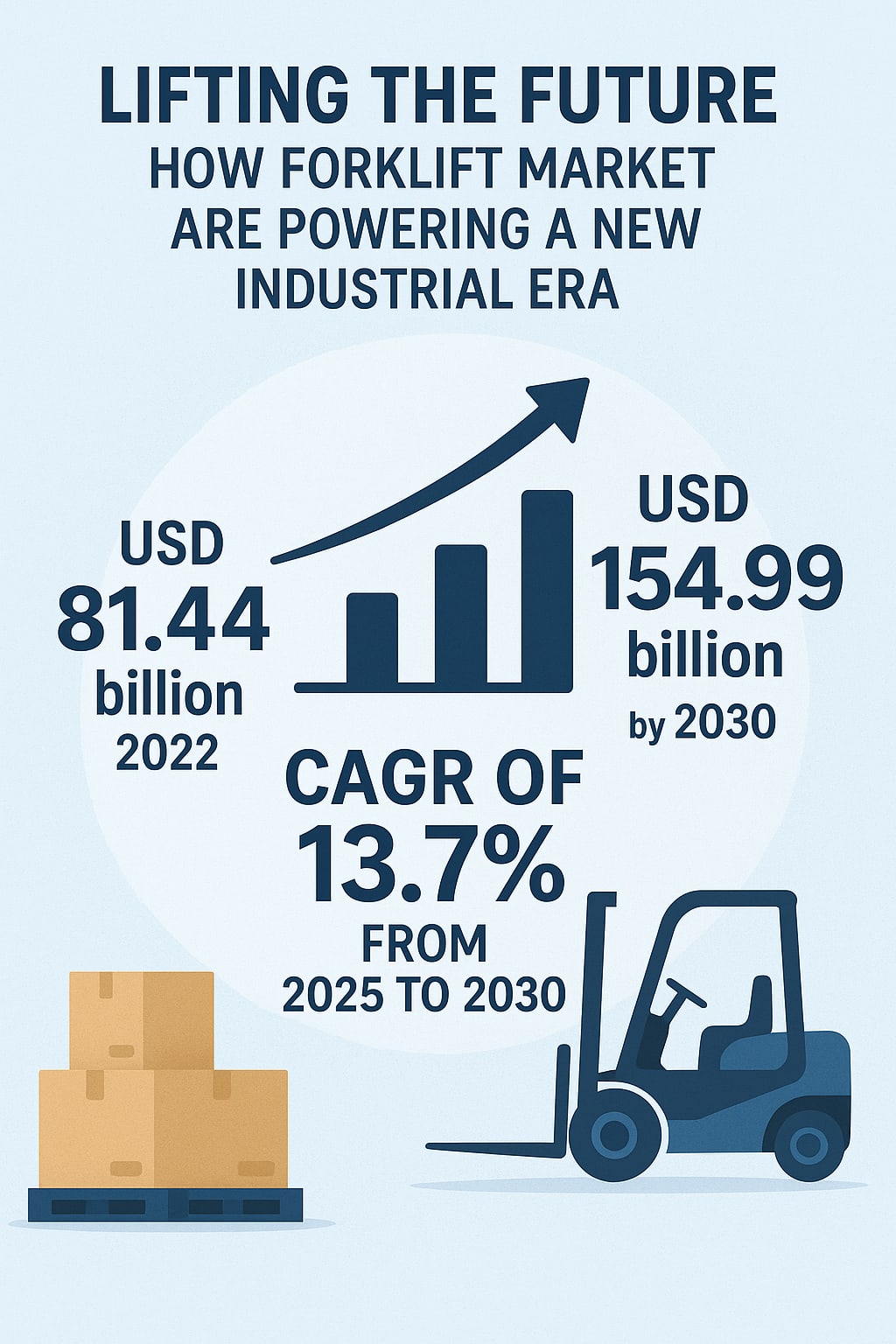
The forklift market is set to grow at a compound annual growth rate (CAGR) of 13.7% from 2025 to 2030, building on its 2025 valuation of USD 81.44 billion.

Warehouses, ports, and factories worldwide have depended on forklifts as the quiet workhorses that transport massive materials and sustain supply chain operations. The current forklift market faces a major transformation which propels industrial efficiency and innovation into an unprecedented era.
The Forklift Market at a Glance
The worldwide forklift market is experiencing significant growth with projected revenues surpassing $154.99 billion by 2030 due to industrial expansion and the rise of e-commerce combined with increased logistics and warehousing demands. These machines now function beyond heavy lifting tasks by becoming intelligent while enhancing efficiency and playing essential roles within digital supply chains.
Forklift Market - Recent Developments
The New Albany facility for sales and service by Crown Equipment Corporation commenced operations in August 2024. The new facility will provide area customers with material handling and warehouse solutions. Regional businesses will receive essential equipment and services from the facility which will help them to improve productivity and uptime while ensuring their material handling operations and supply chains operate efficiently.
August 2024 marked the launch of SANY's SCPE350 35-ton electric forklift truck at Zhuhai Industrial Park as its highest capacity model to date. The SCPE350 produces impressive results with full-load speeds reaching 28 km/h while lifting at 350 mm/s when not loaded and delivers quick reactions in less than 400 ms. Although it handles heavy loads the machine uses only 2.5 kWh of electricity per task and delivers energy-efficient performance that saves approximately USD 28,571 annually when compared to fuel-powered models. The 750V double-gun charging configuration enables a full battery charge in just 1.5 hours and supports continuous operation for 10 hours. The smart client system features an HD screen which enables users to monitor operations live and perform both fault diagnosis as well as historical troubleshooting to guarantee seamless maintenance.
Beyond Muscle: The Rise of Smart Forklifts
Modern forklifts come equipped with advanced features:
• Automation and Robotics: The autonomous forklifts operate through warehouse aisles with accuracy which leads to decreased labor expenses and fewer accidents.
• Electric Powertrains: Forklifts that run on battery power reduce emissions while saving money than their diesel counterparts.
• Telematics and IoT Integration: Analyzing real-time data from forklift operations helps companies manage their vehicle fleets more effectively.
• Safety Enhancements: The use of sensors together with artificial intelligence assistance to operators results in enhanced workplace safety.
The advancements enable manufacturing and retail sectors to achieve operations that are faster and safer while promoting sustainability.
Driving Demand: Trends Fueling Market Growth
• E-commerce Expansion: The surge in online shopping creates market demand for warehouse equipment that operates efficiently.
• Supply Chain Modernization: Complex global logistics demands push companies to search for material handling solutions that offer flexibility.
• Sustainability Initiatives: Sustainable warehouse practices promote the wider use of electric and low-emission forklift equipment.
• Urban Warehousing: Nimble compact forklifts become essential for operations in space-constrained urban fulfillment centers.
Regional Market Highlights
• Asia-Pacific: Industrial expansion across China, India, and Southeast Asia drives the rapid development of the fastest-growing region.
• North America: Focus on automation and sustainability in warehousing.
• Europe: Environmental regulations in Europe enforce the transition towards electric forklift technology.
Challenges on the Horizon
The forklift market encounters obstacles like high initial investment costs for sophisticated machinery and skilled workforce requirements while supply chain disruptions impact production and distribution despite optimistic growth projections.
Looking Forward: Forklifts in the Industrial Future
A fully automated supply chain will rely on future forklifts as essential components. Smart warehouse management integration together with AI-driven maintenance predictions and autonomy improvements will create forklifts that operate with unmatched intelligence and efficiency.
Forklifts play a critical role in both manufacturing logistics and industrial progress as they evolve to operate entire industrial sectors from heavy loads transportation.
About the Creator
Silvie Karson
Passionate storyteller exploring the world of trends. With a background in digital marketing, I craft compelling narratives that inform and inspire. Whether diving into deep-dive features, growth analysis, or trend analysis.
Keep reading
More stories from Silvie Karson and writers in Journal and other communities.
Industry Reimagined: The Billion-Dollar Smart Manufacturing Market
The manufacturing industry has traditionally supported the world's economic structure yet it's experiencing deep systemic changes. Smart manufacturing represents an industry revolution where automation, data analytics and artificial intelligence together transform the production, distribution and enhancement of products.
By Silvie Karson8 months ago in Journal
What Milwaukee Teams Overlook During App Planning Phases?
Most app projects in Milwaukee do not fail because of poor execution. They struggle because early planning feels productive while leaving the hardest questions unanswered. Whiteboards fill up. Features get approved. Timelines look reasonable. Momentum builds. What is missing rarely feels urgent at that stage.
By Samantha Blake6 days ago in Journal


Comments (1)
I love how you explained this content. Thank you, it helps me a lot.