
Life Lessons on the Field: How Desmond Gumbs Turns Raw Talent into Relentless Leadership
The Friday-night lights burned across the California sky.


The crowd was loud, the band was fierce, and the scoreboard told a story no one wanted to read—down by two touchdowns, one quarter left. On the sideline stood a wide receiver, helmet in hand, breathing heavy. Fast. Gifted. But uncertain.
Then came a calm voice that cut through the chaos.
“Speed wins games,” said Desmond Gumbs, “but communication wins people. Find your voice, and you’ll find your game.”
That single sentence would mark the beginning of a transformation of a player, of a mindset, and of a team.
The Coach Who Measures Wins in Character
For Desmond Gumbs, football has never been only about points or plays. As the Athletic Director and head Sports Coach at Lincoln University in California, he has built a reputation for shaping athletes who are as strong off the field as they are on it. His programs emphasize accountability, education, and resilience—the foundation for lifelong success.
From his earlier years turning around Oakland High’s 3-26-1 record to leading a new Athletic Program, Gumbs has carried one constant philosophy: you can teach anyone to run faster or hit harder, but true coaching begins when you teach them to think, to communicate, and to lead.
He likes to remind his athletes, “A game’s just a moment, but character lasts a lifetime.”
A Player on the Edge of Potential
The receiver—let’s call him Marcus—had raw talent that drew scouts and envy alike. But he lacked the one thing Coach Gumbs valued most: a voice. In team huddles he stayed silent; in close games he played safe. When others looked to him for guidance, he looked away.
Coach Gumbs didn’t see weakness. He saw untapped potential.
He invited Marcus to a post-practice session—not to discuss plays, but to talk. The meeting was simple: no drills, no yelling, just a conversation about who Marcus wanted to become.
That talk led to something bigger. Gumbs assigned Marcus a small leadership role—organizing warm-ups, running receiver drills, calling out cadence. At first, Marcus stumbled. But repetition builds rhythm, and rhythm builds confidence.
Workshops That Teach Leadership, Not Just Plays
Every Friday before game day, Gumbs runs what his team calls “Life Huddles.” These sessions combine leadership training, goal-setting, and peer accountability. Players discuss not only tactics but grades, stress, and communication breakdowns.
As both a Life Coach and Motivational Speaker, Gumbs uses real-world exercises:
Public speaking drills where athletes deliver short motivational talks to their teammates.
Role rotations, making defensive players lead offensive meetings to strengthen empathy and communication.
Reflection journals, where athletes write one lesson from sports that applies to life.
Marcus found his turning point in those sessions. The first time he stood in front of the team, his voice shook. The second time, he laughed. The third time, he commanded attention. By midseason, Gumbs saw what he’d hoped for—leadership forming not from authority, but from authenticity.
The Moment Everything Changed
It came on a night heavy with tension. The Lions were down 21-7 at halftime. The locker room was silent, filled with doubt. Then Marcus stood up.
He didn’t give a speech rehearsed from movies or borrowed from coaches. He spoke about responsibility—how every player owned a piece of the game and how they still had time to write the ending. “We’ve been here before,” he said, “but this time we know who we are.”
The second half was electric. The team fought back, drive by drive, play by play. When the final whistle blew, Lincoln University walked off the field with a 28-24 victory, their biggest comeback of the season.
Coach Gumbs didn’t celebrate the win immediately. He looked at Marcus, nodded, and simply said, “That’s what leadership sounds like.”
Integrating Life Skills Into the Athletic Program
Moments like that became part of the Athletic Program’s DNA at Lincoln University. Under Gumbs’ leadership, the program adopted a comprehensive life-skills framework alongside athletic training.
Athletes now complete a leadership curriculum that includes communication workshops, community-service projects, and mentoring younger students. The idea is simple but transformative: the habits that win games discipline, teamwork, focus are the same habits that build successful lives.
Gumbs’ role as Athletic Director ensures these values extend across every sport, from football to basketball and track. He holds his staff to the same standard: coaching the person, not just the position.
Beyond the Whistle: When Sports Become a Life Classroom
For Gumbs, the real scoreboard is long-term growth. He tracks not just wins, but graduation rates, scholarships earned, and career success stories. Dozens of his former players have become coaches, teachers, and community leaders continuing the cycle of mentorship he started.
Marcus followed that path too. He earned a scholarship to pursue sports management, later returning to volunteer at Lincoln University’s summer camps. When he speaks to younger athletes, he echoes his coach’s mantra:
“You don’t need the loudest voice—you need the truest one.”
His story is now a teaching tool in Gumbs’ workshops, proving that leadership can be learned when guided by purpose and patience.
The Psychology Behind the Coaching
What separates Desmond Gumbs from many seasoned coaches is his integration of psychology and motivation into athletic training. He views confidence as a skill, not a trait, and communication as a muscle that must be trained.
He uses visualization exercises asking players to picture their best selves before stepping onto the field and post-game reflections to channel emotion into learning. His method blends the tactical expertise of a Sports Coach with the introspection of a Life Coach and Motivational Speaker, creating athletes who are mentally resilient and emotionally aware.
It’s an approach rooted in empathy and structure, two qualities that define sustainable success in sports and beyond.
Legacy of a Coach, Vision of a Leader
Walk across Lincoln University’s athletic grounds today and you’ll see more than training drills you’ll see discussions, mentoring circles, and teammates teaching teammates. That’s the culture Desmond Gumbs built: a living ecosystem of growth.
Parents notice it in their kids’ confidence; teachers notice it in their discipline; teammates notice it in their unity.
The results speak loudly: improved team GPA, higher scholarship placement, and a community that rallies behind its athletes not just for victories, but for values.
As one assistant coach put it, “Coach Gumbs doesn’t just build players he builds people who make the world better.”
The Final Lesson
Years after that first conversation under the Friday-night lights, Marcus still carries his coach’s words like armor. The crowd, the scoreboard, the pressure, those come and go. What remains is what Desmond Gumbs teaches every athlete who crosses his field:
“A game can change your season. Character can change your life.”
Through discipline, communication, and courage, he proves that leadership isn’t a gift, it's a choice.
And that’s why, long after the cheers fade, his lessons keep echoing where it matters most off the field, in the game of life.
About the Creator
Meet Desmond Gumbs: The Driving Force Behind Lincoln Football
Desmond Gumbs is the head football coach at Lincoln University in California. He is dedicated to making the football team even better and has a lot of experience. He leads with passion, shaping players into champions.
Keep reading
More stories from Meet Desmond Gumbs: The Driving Force Behind Lincoln Football and writers in Journal and other communities.
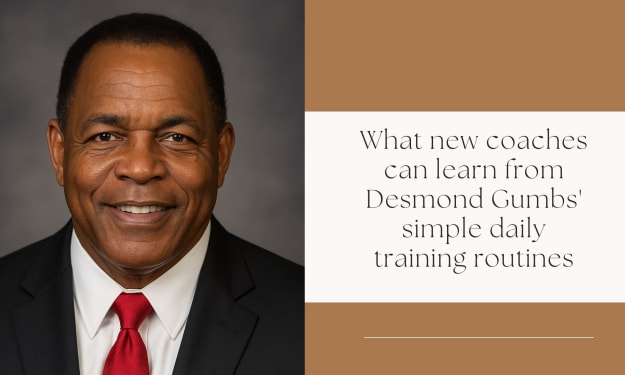
What New Coaches Can Learn From Desmond Gumbs' Simple Daily Training Routines
As a new coach, you're inundated with information. You're juggling X's and O's, player personalities, parent expectations, and the front office. It's a whirlwind of complex strategies and logistical nightmares. We often believe that to succeed, we need intricate plans and revolutionary drills.
By Meet Desmond Gumbs: The Driving Force Behind Lincoln Football3 months ago in Journal
Piergiorgio Corallo: when rock turns gentle
Piergiorgio Corallo is not an artist who rushes to occupy space. Not because he lacks things to say, but because he seems careful about when and how to say them. In a time when visibility is often confused with relevance, Corallo moves differently, almost laterally. In via di sviluppo is an album that exposes uncertainty, internal tension, and emotional imbalance, yet its author keeps a measured public presence, almost deliberately restrained. It’s a position that feels increasingly rare, especially within independent music scenes shaped by constant exposure.
By The Global Verge2 days ago in Journal



Comments
There are no comments for this story
Be the first to respond and start the conversation.