
Latin America’s Money Engine: Brazil Accounts for 14.92% of the Regional Fintech Investment Share
While Mexico and Colombia are growing rapidly in the "unbanked" sectors, Brazil leads in "mature" fintech verticals like digital lending, InsurTech, and investment platforms.

The financial landscape of Latin America is undergoing a seismic shift. For decades, traditional banking giants held an unshakeable monopoly over the region's economy. Today, that monopoly is dissolving, replaced by agile, digital-first solutions that prioritize accessibility and speed. At the center of this revolution lies a single, powerful engine: Brazil.
According to the latest market intelligence from the IMARC Group, the brazil fintech market has reached a valuation of USD 5.5 billion in 2025. More importantly, analysts forecast this figure to nearly quadruple, hitting USD 19.1 billion by 2034. This trajectory represents a robust CAGR of 14.92% during the forecast period (2026-2034). This specific 14.92% figure is more than just a growth rate; it is the "heartbeat" of the entire Latin American ecosystem, signaling stability and maturity in a region often characterized by volatility.
While neighboring markets like Mexico and Colombia are sprinting to catch up, Brazil remains the heavyweight champion, providing the infrastructure, regulatory blueprints, and investment returns that drive the wider continent.
What Data Confirms Brazil as the Powerhouse of Latin American Fintech?
The data reveals a massive growth trajectory; Brazil's market is set to triple in value by 2034, driven by a 14.92% annual growth rate that outpaces traditional banking sectors.
To understand Brazil's dominance, we must look at the context of the wider region. The Latin America fintech market as a whole is valued at USD 15.23 billion in 2025. Simple math tells us that Brazil alone accounts for roughly 36% of the entire regional market value. This dominance is not accidental. It is the result of a "perfect storm" of high mobile penetration, a massive unbanked population hungry for credit, and a financial culture that rapidly adopts new technologies.
The projected growth to USD 19.1 billion is fueled by deep market penetration. Unlike early-stage markets where growth comes from simply signing up new users, Brazil's 14.92% CAGR is driven by "share of wallet" - users are not just opening accounts; they are moving their mortgages, insurance, and investments onto these platforms.
How Have Regulatory Sandboxes and "Pix" Fueled this 14.92% Growth?
The Central Bank of Brazil (BCB) created a pro-innovation environment with "Pix" (instant payments) and Open Finance regulations, drastically lowering the barrier to entry for new fintechs.
You cannot discuss Brazilian fintech without mentioning Pix. Launched by the Central Bank in late 2020, this instant payment system has become the most successful of its kind in the world. It eliminated the need for cash and expensive wire transfers, effectively creating a digital rail that every fintech could ride for free. This infrastructure allowed startups to bypass the costly card networks of legacy banks, redirecting those savings into innovation and customer acquisition.
Simultaneously, Brazil’s aggressive Open Finance framework mandated that large banks share customer data (with consent) with third-party competitors. This leveled the playing field overnight. A small fintech startup could now offer a personalized loan with better terms than a massive bank, simply because they had access to the same credit history data.
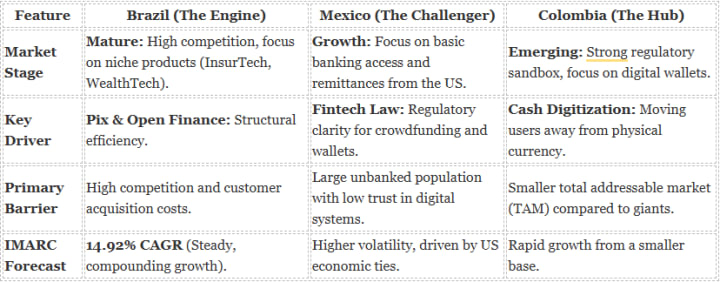
Brazil vs. The Rest: How Does the Market Compare Regionally?
While Mexico and Colombia are growing rapidly in the "unbanked" sectors, Brazil leads in "mature" fintech verticals like digital lending, InsurTech, and investment platforms.
Investors often lump Latin America into a single basket, but the markets are distinct. Brazil is the mature "Engine," while others are in the high-velocity "Discovery" phase.
Which Segments Are Attracting the Most Capital in Brazil?
Digital Payments continue to dominate transaction volume, but Digital Lending and InsurTech are seeing the highest ROI (Return on Investment) potential.
The 14.92% CAGR is not evenly distributed. The "easy wins" in basic payments have been claimed. The new frontier - and the new capital - is flowing into complexity:
Digital Lending: Brazil has historically had some of the highest interest rates in the world. Fintechs using AI to assess risk are able to undercut banks significantly, unlocking credit for millions of SMEs and consumers.
InsurTech: The insurance market in Brazil was notoriously bureaucratic. New platforms are allowing users to insure a car for a single day or a phone for a single trip, introducing "micro-insurance" models that fit the local economy.
Blockchain & Crypto: Brazilians use stablecoins as a hedge against inflation and for cheaper cross-border transfers, driving massive volume on crypto-native platforms.
What Challenges Could Slow Down this 14.92% Momentum?
Cybersecurity threats and the need for talent retention are the primary hurdles that could dampen growth if not addressed by the next wave of startups.
Growth always invites risk. As the transaction volume swells to billions of dollars, Brazilian fintechs have become prime targets for cybercriminals. The same "instant" nature of Pix that users love also makes fraud instant and irreversible. Consequently, a significant portion of the projected investment over the next decade will be diverted into Cybersecurity and Identity Verification (IDV) technologies.
Additionally, the "Brain Drain" poses a threat. Brazilian developers are world-class, and US companies frequently hire them remotely, driving up the cost of talent for local startups.
What Is the Forecast for the Latin American Fintech Ecosystem by 2034?
The region is forecasted to reach USD 54.01 billion, with Brazil serving as the central hub for M&A (Mergers and Acquisitions) and cross-border expansion.
The IMARC Group forecasts the total regional market to hit USD 54.01 billion by 2034, growing at a CAGR of 15.11%. Brazil's specific 14.92% growth is the ballast for this ship.
In the coming decade, we expect to see "The Brazilian Export." Successful Brazilian fintechs, having conquered the hardest market in the region, will expand aggressively into Mexico, Colombia, and Argentina. We are already seeing this with giants like Nubank. The future isn't just about Brazilian companies growing in Brazil; it's about Brazilian companies becoming the pan-regional infrastructure for all of Latin America.
Conclusion
The Brazil fintech market is no longer just a "promising opportunity"; it is a proven industrial engine. With a valuation racing toward USD 19.1 billion and a steady 14.92% CAGR, it offers a rare combination of high growth and structural stability.
For investors and founders, the message is clear: Latin America is rising, and Brazil is the engine pulling the train. The question is not whether the market will grow, but who will build the solutions that sustain it.
About the Creator
Joey Moore
I'm Joey Moore, a seasoned Research Analyst with 5+ years of experience in market research. Expert in data analysis, strategic planning, and industry insights. Proven track record in delivering actionable reports.
Keep reading
More stories from Joey Moore and writers in Journal and other communities.
SMEs vs Enterprise: Breaking Down Europe Digital Asset Management Growth Sectors
In today’s hyper-connected digital economy, content acts as the primary currency driving revenue. However, for many businesses across Europe, managing that currency has become a logistical nightmare. Marketing teams frequently drown in disorganized folders, duplicate files, and copyright confusion. Consequently, this organizational chaos explains why the Europe digital asset management market is witnessing unprecedented growth.
By Joey Mooreabout 3 hours ago in Journal
~ Fired ~
— Ai Intrusion ~ Are you Next ~ Is Ai Evolution after your job? — Few workplaces haven't been affected. Ai is in supermarkets, at doctors' offices, and even monitoring farms. I just can't think of anything this machine is not getting into, can you? For instance: Education ~ Law and Tech jobs will one day have a major influence or be taken over by these inanimate machines, with accuracy and vigor. From mechanics' diagnoses to a wide variety of everyday jobs, including fast food workers, with this input having the ability to cut their unnecessary work hours. I'm certain all of us have been touched by this with our short stories and colorful headings, have you? Even comments are very questionable 'Non-Robot' insertions.
By Jay Kantor3 days ago in Journal




Comments
There are no comments for this story
Be the first to respond and start the conversation.