
Kendall Jenner’s Pepsi Ad vs. Palestine: The Hypocrisy of Empty Activism
Why the diffence

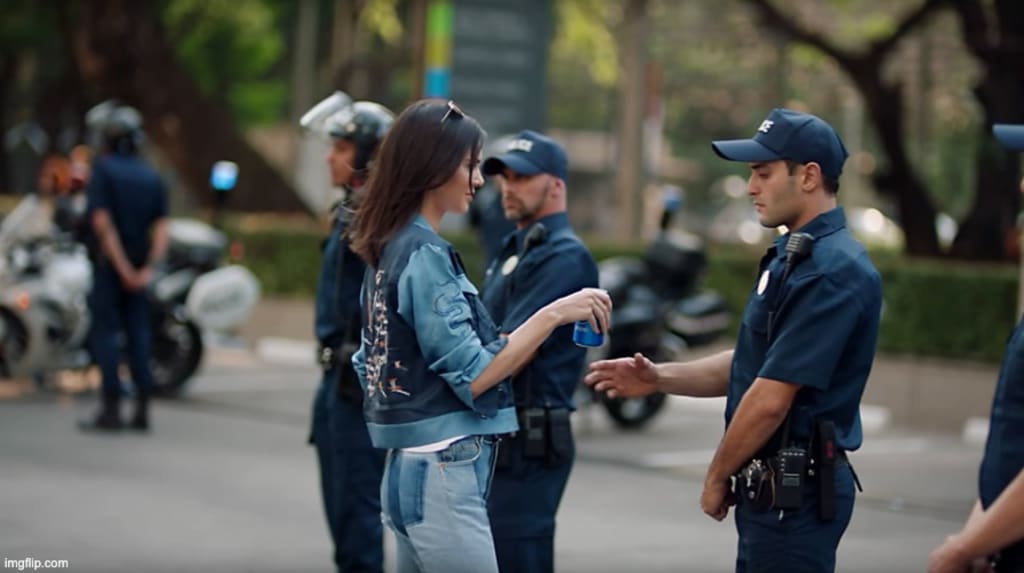
In 2017, Kendall Jenner starred in what would become one of the most infamous commercials of the decade: the Pepsi protest ad. The ad depicted Jenner leaving a glamorous photoshoot to join a protest, where she eventually hands a can of Pepsi to a police officer—implying that systemic injustice could be solved with soda and smiles. The backlash was immediate. Critics accused Pepsi and Jenner of trivializing movements like Black Lives Matter, reducing serious struggles for justice to a shallow marketing stunt.
Pepsi eventually pulled the ad, and Jenner tearfully apologized. But in hindsight, that commercial wasn’t just a poorly executed campaign. It revealed a bigger truth: the culture of empty activism that dominates celebrity branding. It showed us how Hollywood and corporate PR can embrace the aesthetic of protest while steering clear of the messy realities of injustice.
Nowhere is this hypocrisy clearer than in conversations about Palestine.
The Pepsi Ad: A Blueprint for Performative Activism
The reason the Pepsi ad stung so badly was because it felt familiar. It mirrored a trend in celebrity culture: embrace the look of social justice without committing to its substance. The ad’s protesters held vague signs, with no clear cause attached. The struggle was sanitized into a photo op, a perfect Instagram-ready moment.
Kendall Jenner, who comes from one of the most powerful entertainment families in America, was cast as the savior who could “fix” injustice with a smile and a soft drink. It was a fantasy where no one risked anything, and systemic oppression could be solved without discomfort.
That same dynamic is at play when celebrities selectively choose which causes to support. They often attach themselves to movements that are trendy, brand-safe, and celebrated by corporations—while avoiding issues, like Palestine, that are politically charged and financially risky.
Where Is Kendall Jenner on Palestine?
In the years since the Pepsi ad, Kendall Jenner has maintained a largely apolitical public image. She posts about fashion campaigns, vacations, and her tequila brand, but rarely touches global issues. Unlike her sister Bella Hadid—who has openly marched for Palestine and spoken out against Israeli occupation—Kendall has remained silent.
This silence becomes glaring when contrasted with the Pepsi ad. Jenner was comfortable embodying the aesthetic of protest when it was fictional, brand-funded, and ultimately harmless. But when real people are fighting for liberation, and when her own family members have put their reputations on the line, Jenner has nothing to say.
For many fans, that silence feels like hypocrisy. It’s one thing to avoid politics altogether. It’s another to literally profit from an image of activism while ignoring one of the most pressing justice issues of our time.
Why Silence on Palestine Persists
Kendall Jenner isn’t unique. Many celebrities, influencers, and public figures shy away from speaking about Palestine, even while eagerly championing other causes. There are several reasons:
Corporate Fear
Speaking about Palestine is often deemed “too political” in Hollywood. Stars with sponsorships and global brand deals risk losing contracts if they express solidarity.
PR Coaching
Celebrity management teams encourage silence on controversial issues, pushing for “safe” activism instead. Palestine rarely makes that list.
Fear of Backlash
Stars worry about being labeled antisemitic or facing online harassment if they criticize Israeli policies. The risks feel higher than with other causes.
Comfort in Neutrality
For celebrities like Kendall, who are insulated by wealth and privilege, silence is the easiest option. Neutrality allows them to maintain broad appeal and avoid alienating anyone.
But neutrality is not neutral. In the face of oppression, silence always benefits the oppressor.
Bella Hadid vs. Kendall Jenner: A Family Contrast
The comparison between Kendall Jenner and her sister Bella Hadid illustrates the divide perfectly. Bella, with her Palestinian heritage, has used her platform to amplify Palestinian voices and demand justice—even as she admits it has cost her modeling jobs. She has marched in protests, shared resources, and spoken candidly about the pressure to stay quiet.
Kendall, meanwhile, represents the safer celebrity path: staying out of politics and protecting her brand. The Pepsi ad shows she was willing to borrow the look of activism when it benefited her career, but unwilling to risk anything when real lives are on the line, that's why She supports liberal movement like that pepsi ad and the controversial "pride" movement, She knows where the corporations put their money(often bad cause)
This family contrast underscores the broader point: celebrity activism often depends less on values and more on calculated risk.
The Broader Problem of Empty Activism
Kendall Jenner’s Pepsi ad isn’t just a misstep from the past—it’s a symbol of a larger cultural problem. We live in an era where brands and influencers eagerly embrace the language of social justice while avoiding its substance.
The Pepsi ad is a warning: when activism becomes a marketing tool, it risks losing its meaning. And when celebrities treat protest as an accessory, it minimizes the real struggles of people risking their lives for freedom.
Fans Notice the Silence
Social media has shifted the balance of power. Fans are sharper than ever at spotting hypocrisy. They remember who spoke up during moments of crisis, and who stayed silent. They call out influencers who use social justice aesthetics for clout while ignoring real issues.
Kendall Jenner’s silence on Palestine hasn’t gone unnoticed. For many, it confirms what the Pepsi ad foreshadowed: a willingness to wear activism as an accessory, but not to live it when it counts.
Conclusion: Silence Isn’t Neutral
The Pepsi ad was pulled years ago, but its legacy lives on as a cautionary tale. It reminds us how hollow activism can be when stripped of risk and substance. Kendall Jenner embodied that hollowness then—and her silence on Palestine embodies it now.
Empty activism is worse than no activism. It suggests that justice is a photo op, that oppression can be softened into branding. But real activism costs something. It risks backlash, contracts, and reputations. Bella Hadid shows that it’s possible to speak anyway. Kendall Jenner shows what happens when activism is treated like a prop.
The choice between them isn’t just about family—it’s about what kind of world we want to live in. One where justice is commodified for ad campaigns, or one where voices are used, no matter the cost, to stand with the oppressed.
About the Creator
Keep reading
More stories from Herald Post Mail and writers in Journal and other communities.
From DJ Khaled to Bella Hadid: Why Some Celebrities Speak Up for Palestine and Others Stay Silent
In the age of Instagram activism and viral hashtags, silence can be louder than words. When global crises unfold, fans often look to celebrities not just for entertainment, but for leadership, solidarity, and empathy. Nowhere is this more apparent than in conversations about Palestine. Some celebrities—like Bella Hadid—have risked their careers and reputations to speak boldly for Palestinian rights. Others, like DJ Khaled, with deep cultural ties to the region, remain silent, and that silence speaks volumes.
By Herald Post Mail5 months ago in Journal
Electronic Waste Recycling Services in San Diego, CA
Living in a vibrant city like San Diego comes with a beautiful contradiction: our passion for the latest technology and our deep commitment to preserving the natural environment. This leaves many of us wrestling with a cabinet full of old phones, a garage holding a retired desktop computer, or an office storage room filled with obsolete equipment. Thankfully, a robust industry of professional electronic waste recycling services has emerged locally to solve this exact problem. These services provide the crucial link between our unwanted gadgets and their next life, ensuring disposal is handled with expertise, security, and environmental integrity.
By May Alroomi5 days ago in Journal


Comments
There are no comments for this story
Be the first to respond and start the conversation.