
By Habib
It was the summer of 2009 when Claire Bennett, a young American journalist, arrived with her camera and notebooks, determined to document the human side of the war. She had covered conflict zones before Iraq, Syria but something about Afghanistan, especially the South, felt different. There was beauty in the ruins, resilience in the silence, and danger lurking behind every wall.
Her fixers had warned her about going too far from the secured green zone. But Claire was stubborn. “If I wanted safe,” she’d said, “I’d be writing for fashion magazines in New York.”
That’s how she ended up in a dusty village outside Kandahar city, interviewing widows and farmers caught between the American military, the Afghan army, and the Taliban. But it wasn’t bullets that changed her life. It was a red rose.
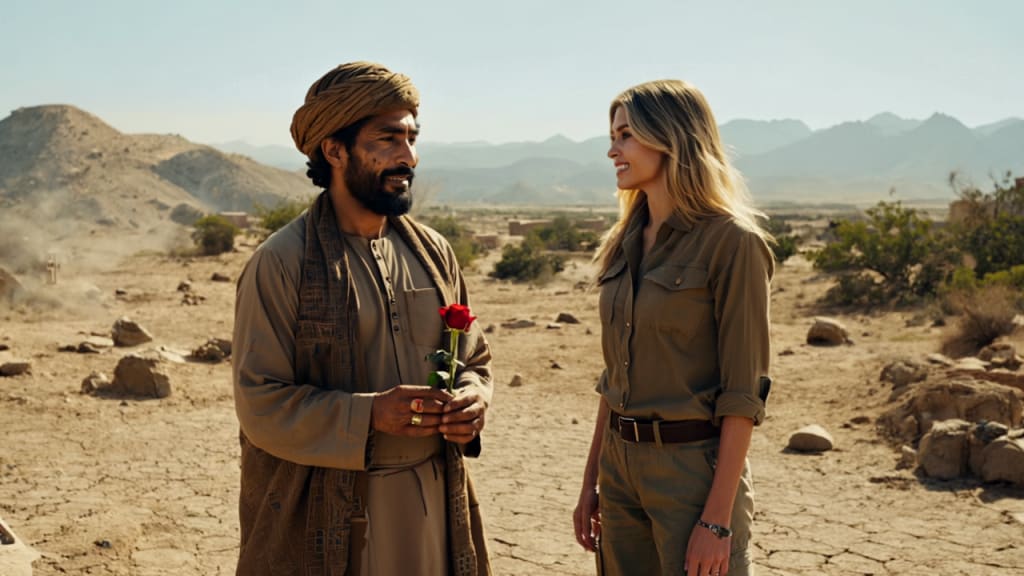
She had just finished interviewing an old woman whose son had been killed in a drone strike, when a man approached. He wore a long brown robe and turban, his beard dark and thick, his eyes surprisingly gentle. In his hand, he held a single red rose.
Claire’s body tensed. Her interpreter whispered, “He is Talib. We must go.”
But the man raised the rose and said in soft Pashto, “No harm. Only a gift.”
Claire didn’t move. Her heart raced. This man was everything she had been warned about. But his presence wasn't threatening. In fact, it was almost poetic.
The man extended the rose to her. “You listen to our people. You see what others do not. You are not blind.”
Claire took the rose.
That moment was the beginning.
________________________________________
His name was Ahmad. Once a teacher, he had been swept into the Taliban after American forces destroyed his school and killed his brother. Like many others, he had chosen a side not out of ideology, but out of grief. But even in war, Ahmad had never lost his humanity.
Over the next few weeks, Claire returned to the village under the guise of journalistic work, but the truth was more complicated. She and Ahmad began to talk first in the open, then in secret, behind crumbling stone walls and abandoned houses. He would bring her books in Dari and poetry by Rumi. She would tell him about New York and snow and how the ocean sounded at night.
It wasn’t long before they fell in love the kind of forbidden, impossible love that only blooms in the ashes of war.
“I should not love you,” Ahmad whispered one night. “But I do.”
“I know,” Claire replied. “And I don’t care.”
________________________________________
But love in a war zone is fragile. Secrets can only be kept for so long.
One night, an American patrol intercepted Claire’s vehicle returning from the village. Her presence beyond the green zone was a violation. Suspicion grew. CIA officers questioned her. They feared she had been compromised that she was being used by insurgents.
Ahmad, too, was no longer safe. His fellow fighters began to doubt his loyalty. They had seen him talking to the foreign woman too many times. Whispers turned to threats.
Their final meeting came on a cool morning as the sun rose behind the mountains. They met at the ruins of an old fort.
“We cannot meet again,” Ahmad said, his voice cracking. “They know.”
Claire’s eyes brimmed with tears. “Come with me. Escape. I can get you out.”
He smiled, that gentle, heartbreaking smile she would remember forever. “My place is here. I cannot leave my people. But you... you must go. Live. Be free. Tell our story.”
He handed her another rose, this one slightly wilted from the dry wind.
“Promise me you will not forget.”
“I could never,” she whispered.
They kissed just once and then turned away from each other, hearts heavy with love that could never be.
________________________________________
Claire left Afghanistan shortly after. Her story was never published in full too controversial, too dangerous. But years later, in a quiet bookstore in Brooklyn, a novel appeared under a pseudonym. Its title: Kandahar Rose.
It told of a woman, a man, and a flower exchanged in a desert of bullets.
Some said it was fiction.
But Claire knew the truth. And somewhere, perhaps still among the mountains, Ahmad remembered too.
Because love, even in war, never truly dies.
________________________________________
The End.
About the Creator
How Much Does It Cost to Start an Outpatient Rehab Treatment Facility
Introduction to Outpatient Rehab Facility Costs Establishing an outpatient rehabilitation treatment facility requires a nuanced understanding of both healthcare delivery and business economics. Unlike residential centers, outpatient programs typically involve lower capital intensity, yet they still demand substantial upfront investment. Costs vary widely based on geography, service scope, and regulatory rigor. A modest facility may require a few hundred thousand dollars to launch, while a comprehensive center offering multiple therapies can exceed seven figures. Prudent financial forecasting at the outset reduces fiscal turbulence later and creates a foundation for sustainable operations.
By Fida Hassain3 days ago in Journal


Comments (2)
Amazing
Wow