
Japanese Stocks Soar to Record After Sanae Takaichi’s Landslide Election Win
Markets cheer a decisive political mandate as investors bet on pro-growth reforms, fiscal stability, and a stronger strategic vision for Japan’s economy.
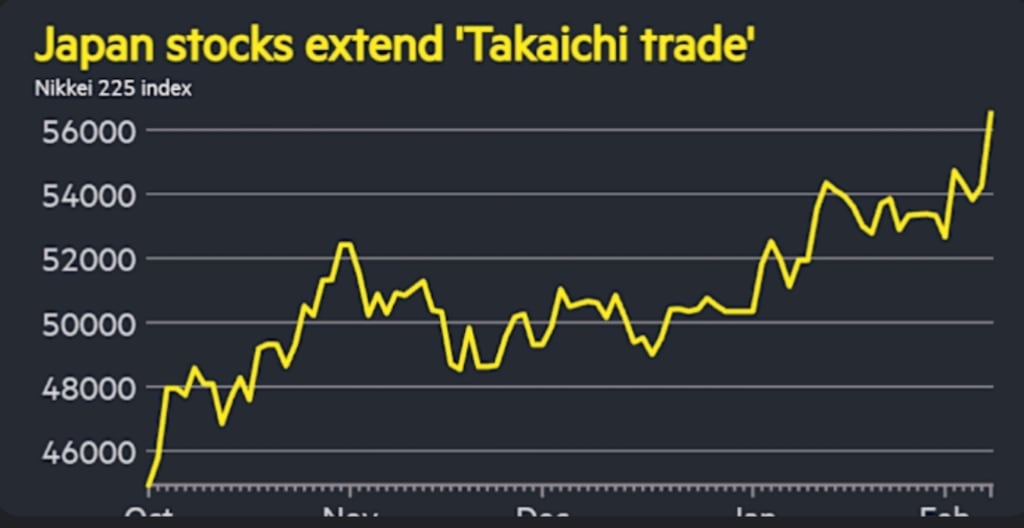
Tokyo: Japanese equities surged to fresh all-time highs after Sanae Takaichi secured a landslide victory in the national election, delivering one of the strongest political mandates seen in Japan in decades. The decisive outcome removed months of uncertainty, triggering a wave of optimism across financial markets and reinforcing investor confidence in Japan’s economic direction.
The benchmark Nikkei 225 and the broader Topix index both rallied sharply in early trading following the election results, driven by gains in banking, technology, defense, and industrial stocks. Analysts described the market reaction as a clear endorsement of Takaichi’s policy platform, which emphasizes economic growth, supply chain resilience, technological competitiveness, and a more assertive fiscal stance.
A Clear Mandate Calms Markets
Elections in Japan are often followed by cautious market responses, especially when results point to coalition negotiations or fragile parliamentary arithmetic. This time, however, Takaichi’s landslide win sent a different signal. With a strong majority behind her, investors see a reduced risk of policy paralysis and a higher likelihood that long-delayed reforms will finally move forward.
“The scale of the victory matters as much as the victory itself,” said a Tokyo-based equity strategist. “Markets are pricing in political stability, policy continuity, and a leadership that can actually execute its agenda.”
That stability is particularly attractive to global investors, many of whom have increased exposure to Japanese equities over the past year as corporate governance reforms, shareholder-friendly policies, and earnings growth boosted the market’s appeal.
Pro-Growth Policies Take Center Stage
At the heart of the rally is confidence in Takaichi’s economic vision. During the campaign, she positioned herself as a pro-growth conservative, advocating targeted fiscal spending, strategic industrial policy, and stronger support for domestic manufacturing and innovation.
Her proposals include incentives for semiconductor production, expanded investment in defense and cybersecurity, and measures to strengthen Japan’s energy security. These policies resonated strongly with investors, especially as global supply chains remain fragile and geopolitical tensions continue to reshape trade and investment flows.
Export-oriented companies, particularly in electronics, machinery, and automotive sectors, led the rally. Defense-related stocks also jumped on expectations of increased government spending aligned with Japan’s evolving security posture.
Yen Dynamics and Monetary Policy Expectations
The stock market surge comes amid ongoing debate about the future of Japan’s ultra-loose monetary policy. While the Bank of Japan has begun cautiously adjusting its stance, Takaichi has signaled support for maintaining accommodative conditions until inflation and wage growth become firmly entrenched.
This perceived alignment between the government and the central bank has reassured investors worried about abrupt policy shifts. A relatively weaker yen continues to support exporters’ earnings, further underpinning equity valuations.
“Markets see a steady hand on monetary policy,” noted an economist at a major Japanese brokerage. “That reduces the risk of a shock that could derail the equity rally.”
Foreign Investors Pile In
Foreign funds were among the biggest buyers following the election results, extending a trend that has seen international investors return to Japan after years of underweight positions. Many global asset managers view Japan as a compelling alternative amid volatility in U.S. and European markets.
Japan’s improving corporate governance, including higher dividends, share buybacks, and pressure on companies to improve capital efficiency, has made the market increasingly attractive. Takaichi’s win reinforces expectations that these reforms will continue, if not accelerate.
“The political clarity is a big plus,” said a Singapore-based fund manager. “It makes Japan easier to justify in global portfolios.”
Risks Beneath the Optimism
Despite the celebratory mood, analysts caution that challenges remain. Japan still faces long-term structural issues, including an aging population, labor shortages, and a massive public debt burden. While markets are betting that decisive leadership can help address these problems, execution will be key.
There are also questions about how aggressive fiscal policies might impact government finances over time, especially if global interest rates remain elevated. Any signs of policy missteps or rising inflation pressures could temper investor enthusiasm.
Moreover, geopolitical risks in the region, particularly involving China and broader Asia-Pacific security dynamics, remain an ever-present factor for Japanese markets.
A New Chapter for Japanese Markets
For now, sentiment is unmistakably bullish. Takaichi’s landslide victory has given investors what they value most: certainty. With a strong mandate and clear economic priorities, the new government is seen as well-positioned to push through reforms that could sustain Japan’s market revival.
The record-breaking rally reflects more than just short-term political relief; it signals growing belief that Japan is entering a new phase of economic confidence. If the government can translate electoral momentum into tangible policy outcomes, Japanese stocks may not only hold their gains but continue to set new benchmarks in the months ahead.
As trading desks in Tokyo buzzed with activity, one theme dominated conversations: for the first time in years, Japan’s political and market narratives appear aligned. And for investors, that alignment is proving to be a powerful catalyst.
About the Creator
Keep reading
More stories from Sadaqat Ali and writers in Journal and other communities.
Africa’s Most Industrialised Country Takes Step Toward Trade Deal With China After U.S. Trade Setback
In a striking development reshaping Africa’s global trade dynamics, South Africa — the continent’s most industrialised economy — has taken a significant step towards a new trade agreement with China amid growing economic friction with the United States. The move reflects South Africa’s broader strategy to diversify its export markets, deepen engagement with China, and cushion its industries from punitive international tariffs that have targeted local exports in recent months.
By Sadaqat Ali4 days ago in Journal
Careers at Risk Because of Artificial Intelligence
Artificial intelligence is growing faster than most people expected. Just a few years ago, AI was mainly used by large technology companies. Today, it is being used in offices, schools, hospitals, and even small online businesses. While AI is creating new opportunities, it is also slowly replacing certain jobs.
By Shafi Khan5 days ago in Journal
Blessed 33
So I woke up on the morning of February 5, 2026 and guess what and you know what I realized? It’s my 33rd birthday. Do you know what that means? Yes, technically I’m getting old, but what I couldn’t have guessed was this would be one of the best days of my life.
By Joe Patterson5 days ago in Confessions


Comments
There are no comments for this story
Be the first to respond and start the conversation.