
India rail crash probe focuses on track management system
NEW DELHI, June 4 (Reuters) - Investigators are probing an electronic track management system that they suspect malfunctioned and caused India’s deadliest train crash in more than two decades, railways officials said on Sunday. At least 275 people were killed on Friday when a passenger train hit a stationary freight train, went off the tracks and hit another passenger train passing in the opposite direction in the eastern state of Odisha.

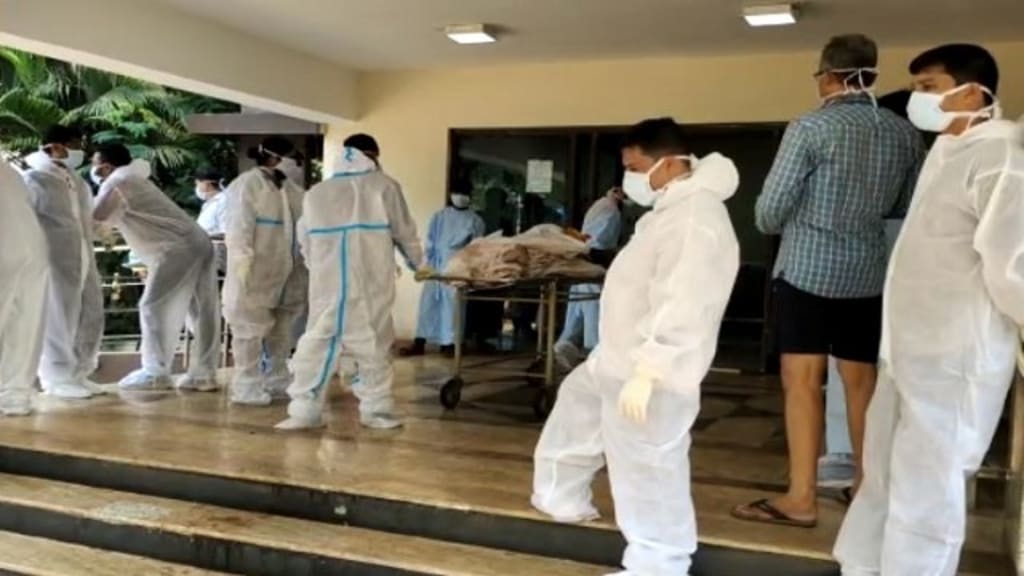
In their first detailed briefing on the crash, Indian Railways officials said that failure of the track management system was the main focus of investigations.
The computer-controlled track management system, called the “interlocking system”, directs a train to an empty track at the point where two tracks meet, Sandeep Mathur, principal executive director for signalling, told reporters.
It also coordinates and controls the signal to an oncoming train, indicating whether the train has to move straight or switch to a new track, he said.It is supposed to be tamper-proof, error-proof. It is called a fail-safe system, even if it fails the signal will turn red and the train will be stopped,” said Jaya Varma Sinha, a member of the Railway Board that runs the giant state monopoly.
“However, as it is being suspected, there was some kind of a problem in the system.”
Explaining the sequence of events that led to the crash at Bahanaga station in Balasore district, Sinha said the Coromandel Express heading to Chennai from Kolkata moved out of the main track, entered a loop track – a side track used to park trains – at a speed of 128 kph (80 mph) and crashed into a freight train carrying iron ore that was parked on the loop track.The crash caused the engine and the first four or five coaches of the Coromandel Express to jump the tracks, topple and hit the last two coaches of the Yeshwantpur-Howrah train heading in the opposite direction on the second main track, she saidThe interlocking system should not have allowed the Coromandel Express to take the loop track, Sinha said.
She said she had spoken to the injured driver of that train and he had told her that he was within the speed limit and had not jumped a signal and all of this would be verified by systems that record track and train details, she said.
She did not name the driver.
There are many “possibilities of what can go wrong,”, Sinha said.
This could include someone digging in the area through which cables of the electronic system pass and damaging them in the process, or a short-circuit, or a machine failing.
“99.9% there is no possibility of the machine failing but there is a 0.1% chance of failure,” she said. “That possibility is always there in all kinds of systems.”
She did not name the supplier or manufacturer, or the age of the system. But said it is in use across almost the entire Indian railway network.The bodies that have reached Bhubaneswar have been kept at the following hospitals, namely:
A. AIIMS, Bhubaneswar
B. AMRI, Bhubaneswar
C. SUM Hospital, Bhubaneswar
D. Capital Hospital, Bhubaneswar
E. KIMS Hospital, Bhubaneswar
F. Hi-Tech Hospital, Bhubaneswar
The photos of the unidentified bodies are also available in the website of State Government: www.bmc.gov.in
All concerned are requested to Contact Railways in the Following Helpline Numbers for any assistance:
Bhubaneswar- 0674 – 2534027
Cuttack- 8455889917
Khurda Road- 0674 – 2492245 & 8455887999
State Government- 1929
Reports say that, as many as 120 bodies have been received so far at AIIMS Bhubaneswar. As per info more 15 ambulances are on their way to AIIMS carrying around 30 bodies. Till now the total dead body count in AIIMS is 120.
According to reports, most of the survivors of the Coromandel Express train crash have returned to their destinations on June 4, 2023. It is noteworthy that, many survivors required medical attention.
A special train to Howrah in West Bengal brought survivors from Odisha. Many survivors have recounted the dark memories from the fateful night of June 2, 2023 (Friday).
It is worth mentioning that the entire world has mourned the terrible Odisha train tragedy that occurred at Bahanga station in Balasore district of Odisha on Friday evening. In this accident as many as 275 people have lost their lives and at least 1175 people have been injured.
Meanwhile, restoration work is underway at the site where the horrific train accident took place. More than 7 Poclain Machines, 2 Accident Relief Trains, and 3-4 Railway and Road Cranes have been deployed for early restoration.
About the Creator
Dios News
Dios News - All News at One Place
Autonomy Is The Real Privilege
Good morning, freedom-seekers! Today we’re gonna be looking at autonomy. A strange word, I know; one many would probably look at blankly and run away from on sight. We’re gonna figure out what it actually means, consider how it’s achieved, and decipher just how deeply most of us are tangled up in dependence without realising it.
By That ‘Freedom’ Guy2 days ago in Humans



Comments
There are no comments for this story
Be the first to respond and start the conversation.