
In a First, Ukraine Says It Struck a Russian Submarine in a Black Sea Port Using Underwater Drones
A Historic Underwater Drone Strike Signals a New Era in Naval Warfare

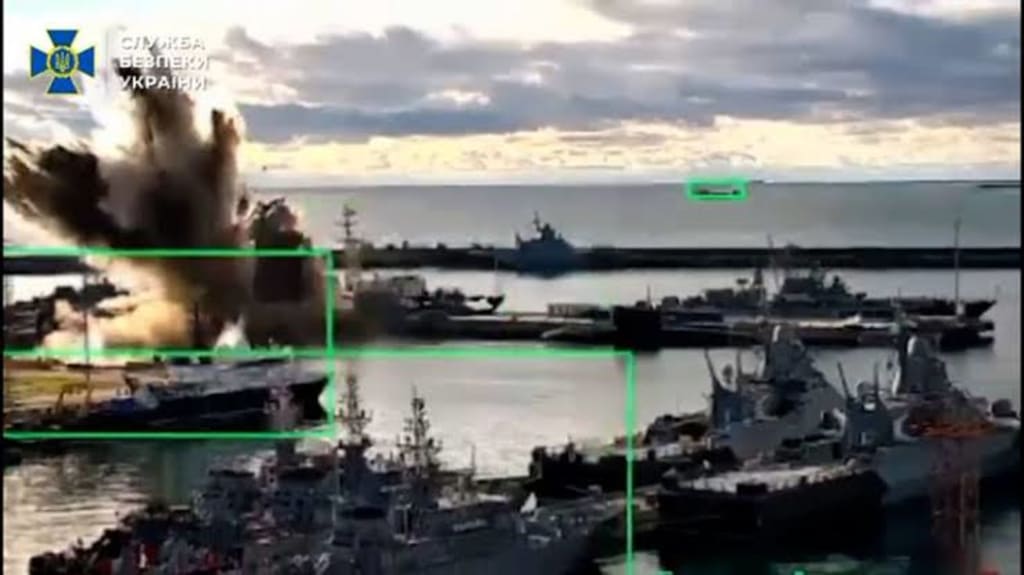
Kyiv claims a historic naval strike that could reshape modern maritime warfare and tilt the balance in the Black Sea conflict
Ukraine has claimed a significant and unprecedented military achievement, announcing that it successfully struck a Russian submarine stationed at a Black Sea port using underwater drones. If confirmed, the operation would mark the first known instance of a submarine being targeted and hit by unmanned underwater vehicles during an active conflict, signaling a major shift in how naval warfare may be conducted in the future.
According to Ukrainian officials, the strike was carried out using domestically developed underwater drones designed to penetrate heavily guarded maritime zones. The targeted submarine was reportedly docked at a Russian-controlled port in the Black Sea, an area Moscow has long considered strategically secure. While Russia has not officially confirmed the damage, the claim itself has drawn international attention and sparked debate among military analysts.
A New Chapter in Naval Warfare
Underwater drones, also known as unmanned underwater vehicles (UUVs), are not entirely new to military planning. However, their use in direct combat against high-value naval assets such as submarines represents a notable escalation. Traditionally, submarines are among the most difficult military assets to detect and attack, especially when protected within port facilities guarded by sonar systems, patrol vessels, and underwater defenses.
Ukraine’s alleged success suggests that modern conflicts are entering an era where relatively low-cost, unmanned systems can challenge even the most advanced and expensive military platforms. Defence experts say this development could force navies worldwide to rethink port security, submarine protection, and the broader balance between offense and defense at sea.
Why the Black Sea Matters
The Black Sea has been a critical theater since the start of the Russia-Ukraine war. Control over its waters affects trade routes, grain exports, energy infrastructure, and military logistics. Russia’s Black Sea Fleet has played a key role in enforcing blockades, launching missile strikes, and projecting power along Ukraine’s southern coastline.
Ukraine, with a much smaller navy, has relied heavily on asymmetric tactics to counter Russia’s maritime dominance. From missile strikes on warships to the innovative use of surface and aerial drones, Kyiv has repeatedly demonstrated its ability to inflict damage without matching Russia ship-for-ship. The reported submarine strike fits squarely into this strategy.
What Makes This Strike Significant
Submarines are not just tactical assets; they are strategic tools. They can launch cruise missiles, gather intelligence, and operate stealthily over long periods. Damaging or disabling even one submarine can reduce an adversary’s operational flexibility and serve as a psychological blow.
If Ukraine’s claim proves accurate, it would highlight several key points:
Vulnerability of ports: Even well-defended naval bases may no longer be safe from unmanned underwater attacks.
Effectiveness of innovation: Ukraine’s growing expertise in drone warfare continues to offset its conventional disadvantages.
Escalation risks: Such strikes may prompt Russia to respond more aggressively or invest heavily in counter-drone technologies.
Russia’s Likely Response
Moscow has so far remained cautious in its public reaction, a pattern seen after previous Ukrainian claims involving high-profile targets. In the past, Russia has sometimes downplayed damage or delayed acknowledgment. Analysts expect that if the submarine suffered serious harm, Russia may tighten port security, redeploy naval assets, or increase strikes on Ukrainian military infrastructure.
There is also the possibility that Russia will accelerate its own development and deployment of underwater drones, contributing to a growing underwater arms race.
Broader Implications for Global Security
Beyond the immediate conflict, the reported strike carries global implications. Navies around the world are watching closely, particularly those operating submarines or maintaining strategic ports. The use of underwater drones raises questions about international maritime law, port security standards, and the future role of unmanned systems in warfare.
Smaller nations may see this as proof that technological innovation can level the playing field against larger military powers. At the same time, it increases concerns about the proliferation of such technologies and their potential use beyond conventional battlefields.
A Symbol of Ukraine’s Evolving Strategy
For Ukraine, the announcement serves both military and symbolic purposes. It reinforces Kyiv’s narrative of resilience, ingenuity, and determination in the face of a larger adversary. Each successful strike using drones strengthens Ukraine’s position not only on the battlefield but also in diplomatic efforts to secure continued Western support.
As the war continues, the line between science fiction and reality in military technology grows increasingly thin. Whether fully confirmed or not, Ukraine’s claim of striking a Russian submarine with underwater drones underscores a simple truth: modern warfare is changing fast, and the depths of the sea are no longer beyond reach.
About the Creator
Fiaz Ahmed
I am Fiaz Ahmed. I am a passionate writer. I love covering trending topics and breaking news. With a sharp eye for what’s happening around the world, and crafts timely and engaging stories that keep readers informed and updated.
Keep reading
More stories from Fiaz Ahmed and writers in Journal and other communities.
Ukraine Drops NATO Bid: Will Kyiv Get Security Guarantees from the West?
Ukraine’s reported decision to step back from its long-held ambition to join NATO has sent shockwaves through diplomatic circles and raised urgent questions about the country’s future security. For years, NATO membership was seen by Kyiv as the ultimate safeguard against Russian aggression. Now, as the war drags on and geopolitical realities harden, Ukraine appears to be recalibrating its strategy. The key question remains: if NATO membership is off the table, what kind of security guarantees can the West realistically offer?
By Fiaz Ahmed about a month ago in Journal
I Stopped Chasing Motivation and Focused on Systems.
Motivation feels good. It also fades fast. You wake up inspired one day and stuck the next. I learned this the hard way. I waited for the right mood before I worked. Progress stayed slow. Results stayed random. Everything changed when I stopped chasing motivation and built systems instead.
By Wilson Igbasi2 days ago in Journal
Miss Persephone's Manual to a Seemingly Ordinary Life
Miss Persephone was found at the dining table, her blue eyes swollen, her tears arriving and retreating like the tides of the ocean. Earlier that day, her family had visited her in the retirement home where she had lived for eight years. It was her eightieth birthday.
By Imola Tóth3 days ago in Fiction



Comments
There are no comments for this story
Be the first to respond and start the conversation.