
How to Introduce Yourself and Own the Room!
The Art of Unforgettable First Impressions

Introduction: The 7-Second Test
They say you never get a second chance to make a first impression. Wrong. You don’t even get a chance—you get a window. Seven seconds. That’s it.
Seven seconds to own the room. Seven seconds to plant your flag in the ground of someone else’s mind. Seven seconds to answer the unspoken questions racing through their heads:
Who is this person?
Why should I care?
Are they credible?
Can they help me?
If you stumble, you’re forgotten. If you mumble, you’re dismissed. But if you master the art of the introduction? You don’t just enter the room. You own it.
Let’s break down the science—and the art—of unforgettable introductions. Not the weak, limp-handshake kind. The ones that spark curiosity, open doors, and make people whisper, “Who was that?” after you leave.
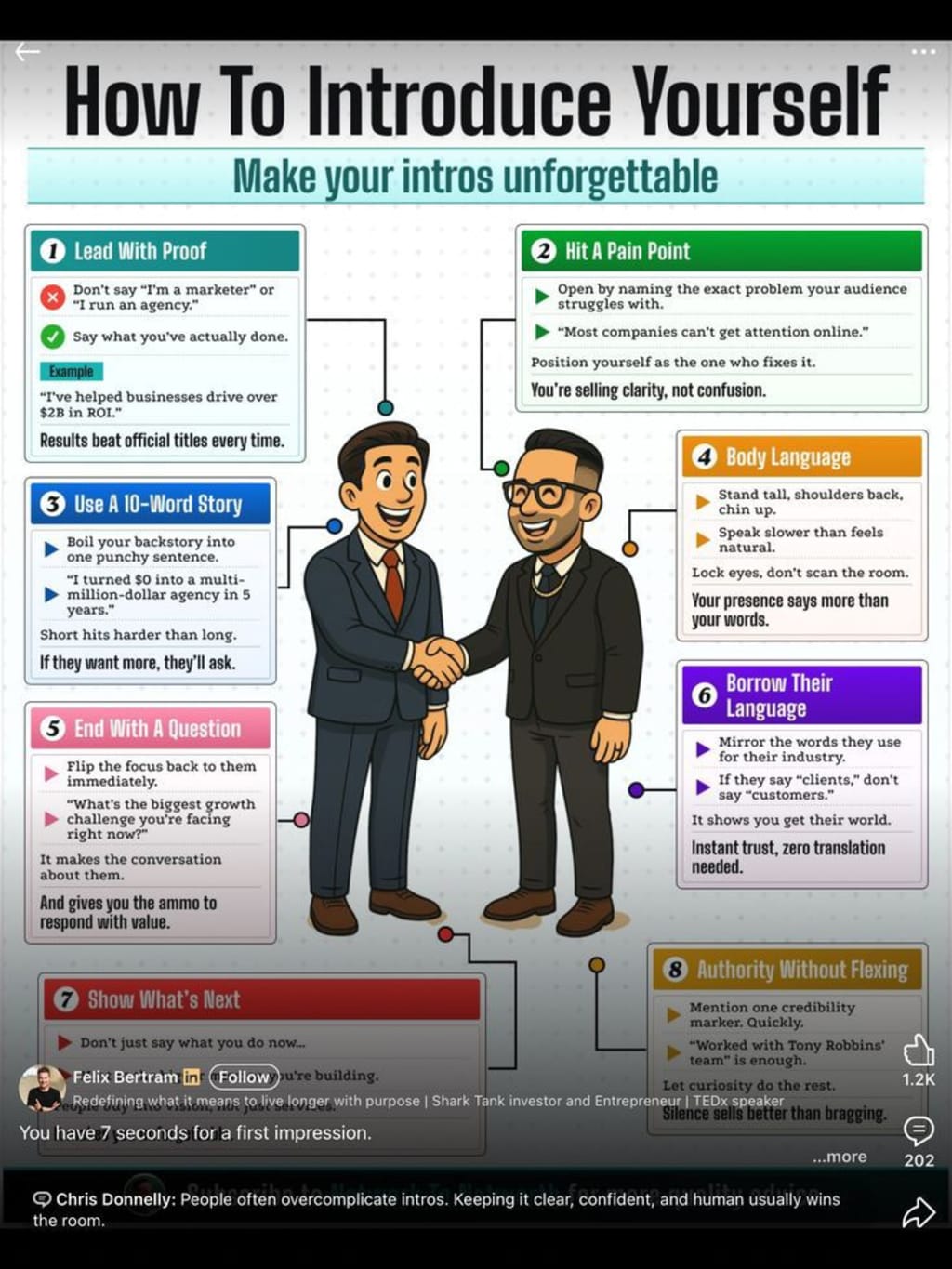
1. Lead With Proof: Titles Bore, Results Roar
Here’s the truth: nobody cares about your title.
“I’m a marketer.” Boring.
“I run an agency.” Forgettable.
But say: “I’ve helped businesses drive over $2B in ROI”—and suddenly, heads turn. Why? Because proof beats position every single time.
Humans are wired to respect results. Titles are assigned. Results are earned. That’s why the entrepreneur who grew a side hustle into a $10 million empire commands more attention than the executive who inherited their role.
Lesson: Don’t tell me what you are. Tell me what you’ve done. And do it in a way that makes me curious for more.
2. Hit a Pain Point: Sell Clarity, Not Confusion
Every powerful introduction begins with their pain, not your resume.
“Most companies can’t get attention online.” Boom. Suddenly, you’ve described the elephant in the room. And if you can name the problem clearly, you earn the right to propose a solution.
When you lead with a pain point, you’re not selling yourself—you’re selling clarity. People don’t buy titles. They buy relief. They buy certainty. They buy someone who says: “I see your problem, I understand it, and I fix it.”
3. Use a 10-Word Story: Compression Creates Curiosity
Your backstory doesn’t need a Netflix documentary. It needs 10 words.
“I turned $0 into a multi-million-dollar agency in 5 years.”
Short. Punchy. Memorable.
Compression creates curiosity. The fewer words you use, the more they want to know. If they want details, they’ll ask. And if they don’t, at least you didn’t bore them.
Rule of Thumb: If your story doesn’t fit in an elevator ride, it’s not a story. It’s a hostage situation.
4. Body Language: Your Mouth Lies, Your Body Doesn’t
Stand tall. Shoulders back. Chin up. Lock eyes.
Before you even say a word, your body has already introduced you. It tells the room whether you’re confident or insecure, whether you belong or you’re apologizing for existing.
Here’s the catch: nerves will trick you into rushing. Don’t. Speak slower than feels natural. Pause. Let silence work for you. Silence is the punctuation of power.
Presence always precedes persuasion.
5. End With a Question: Flip the Spotlight
Weak introductions end with awkward silence. Powerful introductions end with curiosity.
Ask: “What’s the biggest growth challenge you’re facing right now?”
Suddenly, the spotlight flips. It’s not about you anymore. It’s about them. And when they answer, they hand you ammunition to respond with value.
People don’t remember what you said. They remember how you made them feel. Ask the right question, and you’ll make them feel seen, understood, and valued.
6. Borrow Their Language: Speak Their World
Language builds bridges. Or walls.
If they say “clients,” and you say “customers,” you’ve already missed a step. If they say “revenue,” and you say “sales,” the translation gap widens.
Mirror their language. Speak their world. Not only does it show respect, it creates instant trust. You’re no longer an outsider trying to sell. You’re an insider who gets it.
7. Show What’s Next: Ambition is Magnetic
Don’t just tell me what you do now. Tell me where you’re going.
“I’m helping X expand globally by 2026.”
That’s not just a statement. That’s a magnet. People are drawn to ambition. They want to be around builders, creators, visionaries. When you talk about the future you’re building, you invite others to imagine themselves in it.
Ambition isn’t arrogance. It’s energy. And energy is contagious.
8. Authority Without Flexing: Whisper, Don’t Shout
Authority is best served in whispers, not screams.
“Worked with Tony Robbins’ team.”
“TEDx speaker.”
That’s all you need. One marker of credibility. Delivered quickly. Then shut up. Let curiosity do the heavy lifting.
Silence sells better than bragging. Because true authority doesn’t need fireworks—it just needs recognition.
The Psychology of First Impressions: Why This Works
Science tells us that within 7 seconds, people decide:
Are you trustworthy?
Are you competent?
Are you someone worth remembering?
Your introduction isn’t just words. It’s an audition. And the stakes are high.
That’s why the formula works: proof, pain, story, body, question, language, ambition, authority. Each element chips away at doubt and builds a bridge toward trust.
If you’re searching for:
How to introduce yourself professionally
Networking tips for entrepreneurs
How to make unforgettable first impressions
Effective elevator pitch strategies
Communication skills for business leaders
…this article gives you the blueprint. And not just theory—the battle-tested, boardroom-proven method to introduce yourself in a way that makes people lean in, not lean out.
Case Studies: When Introductions Changed the Game
The Investor Pitch: A startup founder began with, “We’ve saved companies $10 million in logistics costs in 2 years.” Within 30 seconds, investors wanted a meeting. Why? Proof, not fluff.
The Networking Event: Instead of, “I’m a consultant,” one attendee said: “I help family-owned businesses scale without losing their soul.” People didn’t just nod. They pulled out business cards.
The Job Interview: A candidate started with: “In my last role, I grew sales by 300%.” Before HR even asked the second question, the hiring manager leaned forward. Results beat resumes.
Don’t Introduce, Intrigue
Your introduction isn’t an autobiography. It’s a spark. A seed. A promise.
The goal is not to tell your whole story. The goal is to make them want the next chapter.
So the next time someone says, “Tell me about yourself,” don’t reach for a title. Reach for proof. Don’t fumble for small talk. Hit their pain point. Don’t ramble. Tell a 10-word story.
Stand tall. Speak slow. End with a question. Mirror their language. Share your vision. Drop one authority marker.
Then shut up. Smile. And watch them lean in.
Because unforgettable introductions don’t just start conversations. They start opportunities.
About the Creator
Omasanjuwa Ogharandukun
I'm a passionate writer & blogger crafting inspiring stories from everyday life. Through vivid words and thoughtful insights, I spark conversations and ignite change—one post at a time.
Keep reading
More stories from Omasanjuwa Ogharandukun and writers in Journal and other communities.
Minor Ocean Overwash and Coastal Flood Advisory for Hatteras Island – What You Need to Know (September 9, 2025)
Introduction: A Morning Wake-Up Call on Hatteras Island On the morning of September 9, 2025, Hatteras Island residents and visitors woke up to a familiar but unsettling scene: waves pushing seawater across parts of N.C. Highway 12, salt spray dancing in the air, and an advisory from the National Weather Service (NWS) warning of minor coastal flooding.
By Omasanjuwa Ogharandukun4 months ago in Journal
Understanding the DTF Printing Process: What Is Direct to Film Printing and How It Works at Home
The DTF printing process, short for Direct to Film printing, has become a popular method in the custom apparel and textile industry due to its flexibility and accessibility. Unlike traditional printing techniques, DTF printing allows designs to be transferred onto a wide variety of fabrics with consistent results. This article explains what DTF printing is, how the direct to film print method works, the complete DTF transfer process, and whether DTF printing at home is a practical option.
By Adria Hargrave7 days ago in Journal



Comments
There are no comments for this story
Be the first to respond and start the conversation.