
How AI Quietly Changed My Everyday Life
From morning alarms to creativity — how artificial intelligence became my invisible companion.

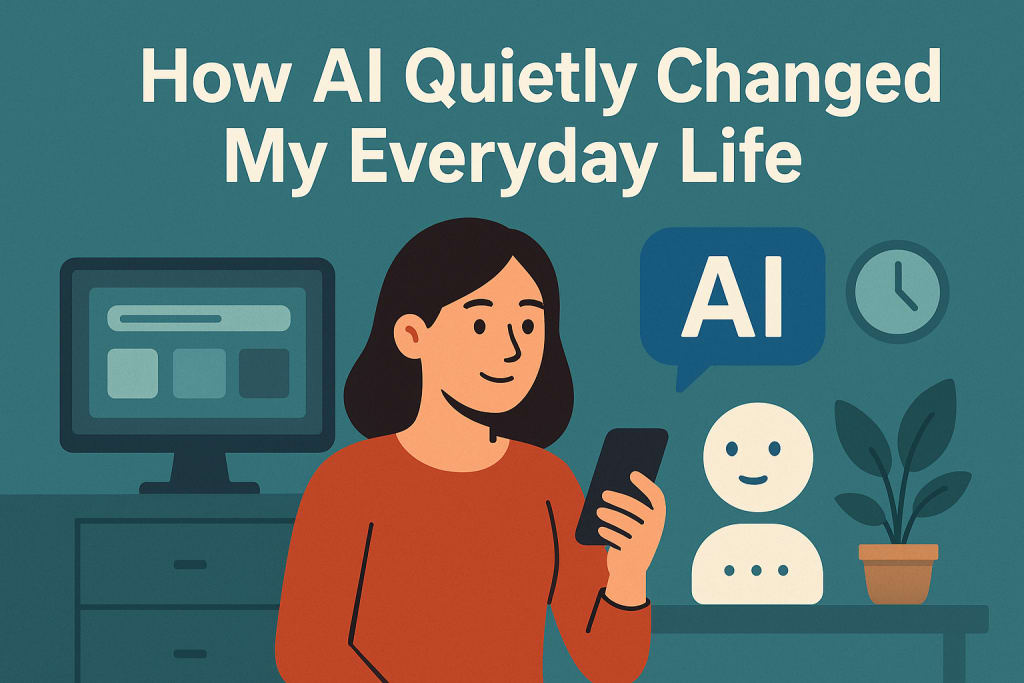
- AI: The Silent Revolution Transforming Our Everyday Lives
✨ Introduction — The Invisible Companion
Without realizing it, we’ve let Artificial Intelligence quietly seep into every corner of our daily routines. A few years ago, AI sounded like something from a futuristic sci-fi movie — distant, abstract, maybe even scary.
Now, it wakes us up with our smart alarm, suggests what we should eat based on our diet history, and even curates the videos we watch before bed.
AI has become an invisible companion — it doesn’t speak much, but it listens, learns, and helps more than we ever imagined.
🧠 Redefining the Way We Learn
Education is one of the spaces AI has transformed most dramatically.
In the past, learning meant textbooks, teachers, and handwritten notes. Today, tools like ChatGPT, Gemini, and Copilot have made learning deeply interactive.
Personally, I’ve realized that I no longer spend hours scrolling through Google results — I can simply ask a question and receive a clear, tailored explanation in seconds.
AI isn’t just giving us information; it’s teaching us how to think, how to ask better questions, and how to develop ideas. This shift has empowered an entire generation to become self-learners — curious, independent, and fast-adapting.
💼 A New Era of Work
AI has completely reshaped how we define “work.”
The traditional 9-to-5 office routine is slowly fading. For many, a laptop and a stable internet connection are all it takes to build a career.
Tools like Notion AI, Canva Magic Write, and ChatGPT have become powerful productivity partners.
A content writer who once managed to produce three articles a week can now finish eight — not by cutting corners, but by thinking and writing more efficiently.
But this doesn’t mean people are becoming replaceable. AI can generate ideas, but it still takes human emotion and perspective to make those ideas meaningful.
In a way, AI hasn’t taken our jobs — it’s just changing what being “good at our job” means.
🧍 Relationships and Communication — A Digital Evolution
AI is also transforming how we connect with others.
From virtual therapists to AI chat companions, technology is offering emotional support in ways we didn’t think possible.
For some, these tools reduce loneliness and improve mental health. For others, they raise questions about authenticity and emotional dependence.
This duality teaches us something profound — AI doesn’t create emotion; it mirrors it.
It reflects who we are, what we need, and how we express care in the digital age.
🌍 Culture and Creativity in the Age of Algorithms
AI is democratizing creativity.
Music, art, and storytelling are no longer limited to those with years of training.
Today, anyone can use AI music generators or art tools to compose songs, paint, or write — instantly.
This has made creativity more accessible than ever, but it’s also forcing us to redefine originality.
AI shows us that creativity isn’t just about creating something from scratch — it’s about collaboration between human imagination and machine precision.
We’re entering an era of co-creation — a partnership between art and algorithm.
⚖️ Fear, Ethics, and the Future of Work
With every new AI breakthrough, a familiar fear returns: Will AI take our jobs?
The answer isn’t simple.
Yes, some tasks will be automated — repetitive, mechanical ones.
But AI will also create new roles: prompt engineers, data curators, ethical modelers, and more.
The real challenge isn’t to compete with AI, but to collaborate with it.
The future belongs to those who can blend creativity with technology — who can think beyond what AI can calculate.
💡 My Personal Experience
When I first started using ChatGPT, I honestly felt like I was cheating.
It could write faster, think broader, and explain things more clearly than I could at times.
But soon I realized that AI isn’t replacing creativity — it’s amplifying it.
When I get stuck on a project or can’t organize my thoughts, I brainstorm with AI. The process doesn’t make me lazy; it makes me more curious, more reflective.
Working with AI has taught me that creativity isn’t just about producing something new — it’s about seeing old things in a new light.
🚀 The Human Chapter of the AI Story
AI is transforming our jobs, our education, and our relationships — but one thing remains untouchable: our humanity.
Machines can learn, write, paint, and even compose music, but they can’t feel.
Empathy, curiosity, and emotion are still deeply human — and that’s what gives meaning to everything AI helps us build.
So the future isn’t something to fear; it’s something to embrace.
AI isn’t a rival. It’s a partner — one that reflects the best of our intelligence, and challenges us to keep growing.
❤️ Final Thoughts
We’re living in an era where humans and machines are learning to think together.
The key to thriving in this new age isn’t resisting change — it’s continuing to learn.
Because at the end of the day, AI may be intelligent, but it’s we humans who give it purpose.
Maybe that’s what progress really means — not machines replacing us, but helping us become better versions of ourselves
💡 Author’s Tip:
If you enjoyed this story, please leave a ❤️ or share it with someone curious about how AI is changing our world. Every read, like, and comment helps independent writers like me keep creating thoughtful stories. Thank you for supporting real voices on Vocal! 🙏
About the Creator
Shakil Sorkar
Welcome to my Vocal Media journal💖
If my content inspires, educates, or helps you in any way —
💖 Please consider leaving a tip to support my writing.
Every tip motivates me to keep researching, writing, sharing, valuable insights with you.
Keep reading
More stories from Shakil Sorkar and writers in Journal and other communities.
Top 10 AI Business Ideas to Start in 2025 (No Coding Needed)
AI is no longer just for tech experts. In 2025, anyone can start an AI-powered business—even without coding skills. Thanks to no-code platforms and powerful AI tools, entrepreneurs are creating profitable ventures in content creation, marketing, education, and more.
By Shakil Sorkar10 months ago in Journal
Author’s Advice
If you would’ve asked me 20 years ago did I know I’d become a writer and an author, I would’ve said “nope, ain’t happening”. As fate would have it I did become an author and I can honestly say I’m loving it so far. It really does feel good to be a writer. I’ve learned a lot on this journey and I feel like with even me being as new to this world as I am, there’s some wisdom I need to share with every other aspiring author.
By Joe Patterson2 days ago in Journal
Russian ‘Shadow Fleet’ LNG Tankers Reroute After Blast Sinks ‘Arctic Metagaz’ in Mediterranean
One of Russia’s sanctioned liquefied natural gas (LNG) carriers has sunk in the Mediterranean Sea, prompting remaining vessels tied to the Kremlin’s so‑called “shadow fleet” to halt, delay, or change routing as fears grow about the safety of key shipping corridors. The incident — which Moscow says was caused by a Ukrainian naval drone attack — highlights escalating risks to maritime energy transport as Russia’s energy exports face mounting pressure from conflict and sanctions. The Arctic Metagaz, an LNG tanker linked to Russia’s Arctic LNG 2 export project, was destroyed off the coast of Libya — roughly 150 nautical miles north of Malta — after experiencing powerful explosions and catching fire in early March. Italian and Libyan maritime authorities confirmed the vessel sank following a major blaze that engulfed it late on March 3, though all 30 crew members were safely evacuated by rescue teams. Russia Blames Ukrainian Drones In statements released after the sinking, the Russian Ministry of Transport accused Ukraine of directing a drone attack from the Libyan coast using naval unmanned boats, marking what Moscow described as an act of “international terrorism and maritime piracy.” Ukrainian officials have not publicly commented on the accusation. While state media narratives frame the incident as a deliberate strike on Russian energy infrastructure, independent verification of the attack’s cause remains limited. Some analysts note that Moscow’s sanctioned vessels, often operating outside Western restrictions, have become symbolic targets because of their role in bypassing sanctions aimed at cutting Russia’s energy revenue. A Blow to Russia’s Shadow Fleet Logistics The sinking of Arctic Metagaz has had an immediate impact on the operations of Russia’s “shadow fleet” — a collection of older tankers that transport hydrocarbons for sanctioned energy projects, such as Arctic LNG 2, around the world. The fleet has already been constrained by Western sanctions that limit access to insurance, financing, and port services, leaving only a small number of vessels able to carry cargo. Tracking data shows that several other Russian LNG carriers altered their movements in response to the blast. The Arctic Pioneer, which was transiting north through the Suez Canal at the time of the explosion, appears to have held offshore near Port Said for over 48 hours. Meanwhile, the Arctic Vostok, originally sailing westward across the eastern Indian Ocean, changed course and began heading south, possibly preparing to circumvent the Suez Canal by way of the Cape of Good Hope at Africa’s southern tip. Such deviations represent a rare and costly departure from established Arctic LNG‑to‑Asia routes. Circumnavigating Africa adds thousands of nautical miles — and weeks — to voyages, significantly increasing fuel costs, crew time, and delivery schedules. For a fleet already stretched thin, these disruptions could weaken Russia’s ability to sustain consistent LNG exports. Broader Energy Market Ripples The Arctic LNG 2 project was already running at a fraction of its full capacity due to logistical limitations and sanctions. This latest incident underscores how fragile those supply chains have become and how geopolitics can impact global energy flows far from conflict zones. Analysts warn that if other vessels begin to avoid the Mediterranean entirely, the additional transit time will reduce the number of voyages each tanker can complete in a year, tightening shipments to buyers — especially in East Asia — and potentially driving up LNG prices. Some industry observers say that Russia may have to rely increasingly on direct Arctic routes in summer months or seek alternative buyers closer to its production hubs. However, these options remain limited given fleet size and sanctions constraints. Risks to Shipping and Regional Security The incident also highlights the increasing vulnerability of energy tankers in contested waters. As global geopolitical tensions intersect — from the Ukraine war to Middle Eastern instability — commercial vessels are frequently caught between military actions and international sanctions regimes. Cruise ships, cargo carriers, and LNG tankers alike face heightened risk of unexpected attacks or collateral damage when navigating strategic chokepoints such as the Mediterranean and Suez transit route. Environmental concerns also linger following the sinking. Although LNG tankers carry less oil than typical crude carriers, authorities in the region continue to monitor the site for potential gas release or secondary impacts on marine ecosystems. Meanwhile, shipping insurers and charterers are reassessing risk models for vessels traveling near conflict zones. Looking Ahead For Moscow, the loss of Arctic Metagaz complicates an already strained export strategy and could prompt broader changes in how Russia moves LNG to global markets. Whether remaining tankers will continue to transit high‑risk corridors or adopt longer, safer routes around Africa remains an open question. The decision will hinge on geopolitical developments, insurance availability, and how both Russian and Western authorities respond to this high‑profile maritime incident.
By Fiaz Ahmed 8 days ago in Journal



Comments
There are no comments for this story
Be the first to respond and start the conversation.