
Gun Buybacks
Exploring the efficacy and possible impacts of Gun Buyback programs
Different countries have different rates of gun ownership, and the US is the only one where firearms outnumber human inhabitants. Yemen comes in second with nearly fifty guns for every hundred people, due to the country's ongoing civil war. Serbia ranks third, with this high rate primarily due to legacy conflict from the Yugoslavian Wars throughout the 1990s. They're currently in the process of trying to get off this list by asking its citizens to turn in their firearms.
There were five mass shootings in Serbia from 2001 until May of 2023. However, in May of 2023, two mass shootings happened just one day apart. The first Mass shooting killed eight students and a security guard at a school, and the second Mass shooting killed eight people and wounded 15 a few miles away.
Serbia's president promised to disarm the nation in retaliation. His concept called for a weapons amnesty, commonly known as gun buybacks, which would enable Serbians to turn in illicit firearms for a month. Although it is not Serbia's first amnesty, it was the most effective in the nation's history due to the more than 26 000 guns, 1.3 million rounds of ammunition, and 6,000 explosives that were turned in.
But will removing all these weapons work and how do we know?
One place to look for answers is a country that's tried something similar- Australia.
A young man went to the popular tourist site of Port Arthur, Tasmania, on April 28, 1996, and brought out a semi-automatic rifle before opening fire, killing 35 people and injuring 18. Australia is getting ready to grieve those deaths, and there have been urgent calls for strict new gun legislation. Just 12 days later, Australia signed a National Firearms Agreement that included ten basic provisions, such as registration, licensing, and safety training, but the prohibition on automatic and semi-automatic guns—the weapons most commonly used in mass shootings—was given priority. The deal also contained a one-year gun amnesty to recover these already-in-use newly outlawed guns. It wouldn't be simple to ask Australians to give up their firearms.
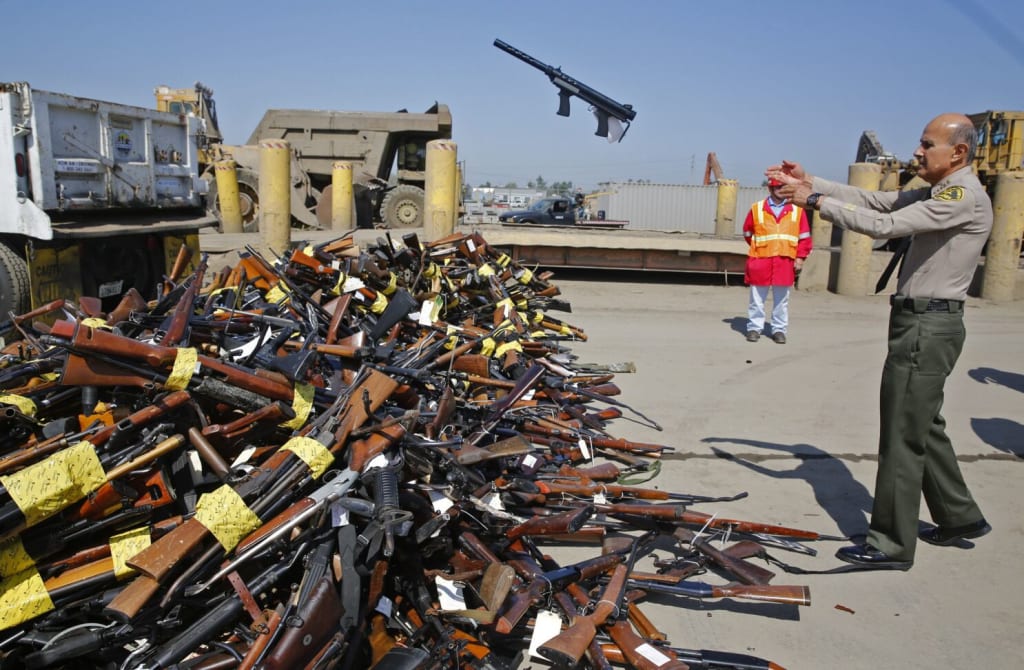
It turns out, the circumstances were ideal, and examining the characteristics of Australia's program might help us see why it was successful. First, following the Port Arthur massacre, tens of thousands of Australians flocked to the streets to call for change. Polls indicated that almost 90% of the population supported them. Second, Australia's firearm amnesty program was national rather than restricted to a few regions, and the government provided equitable compensation for each item turned in. Businesses that were affected even received government aid; the amnesty was voluntary but required with severe penalties for non-compliance. Australia established buyback locations where people may leave off their guns to help with compliance. Once all the weapons had been gathered, they had to be destroyed. To prevent illicit weapons from falling into the hands of the public, this often involved crushing and then melting the material. Australia's 1996 buyback after the amnesty ended removed more than 640,000 firearms from circulation. According to some estimates, that represented around 20% of all the weaponry in Australia.
So did it make a difference?
We might start by examining the frequency of mass shootings between 1980 and 1996. Australia had 14 major shootings, but there have been none in the 18 years following Port Arthur. This was most likely a result of Australia's more extensive firearms laws. Suicides are where the gun buyback program has had the biggest impact, according to our analysis. According to research, there were higher decreases in suicides in the states where more firearms were turned in.
More than 500 gun buybacks are believed to have taken place in 37 States in the United States since the 1980s, but these are small, locally run programs that are voluntary, don't usually come with new firearm restrictions, and while the majority of people support voluntary BuyBacks, they haven't yet won the support of the general public.
Both mass shootings and gun-related fatalities overall are on the rise nationally. Now, let's consider Serbia. The latest amnesty of weapons in Serbia is voluntary and does not include compensation, but it differs from prior amnesties in that it has received more public support and requests to look beyond legislation and consider the culture that led to the situation in the first place. Even in Australia, the majority of gun amnesties are short-lived, and it takes effort and persistence to sustain their efficacy. Gun restrictions are being undermined by a strong gun lobby. Still, other nations may learn from Australia's innovative approach to reducing gun violence.
It might be impossible to duplicate Australia's exact circumstances and apply every lesson, but if Australia is any indication of what's possible, Serbia could change from leading the list of nations with the most guns per person to one that is off the list. If Serbia can do it, perhaps other nations that experience gun violence will be able to do the same.
About the Creator
Amos Adnukia
Growing up in a small town, I developed an insatiable curiosity about the world beyond my immediate surroundings. This has led to my interest in journalism- It has honed my skills in research and storytelling.
Keep reading
More stories from writers in Journal and other communities.
Gold Breaks New Record on Greenland Tariff Threats, with Forecast of $7,000 on the Cards
In a dramatic turn for global financial markets, gold prices have surged to unprecedented levels, driven by escalating geopolitical tensions centered around Greenland and fears of widening trade conflict between the United States and Europe. What was once a speculative spike has quickly morphed into a powerful rally, with gold breaking new records and market analysts now talking about the possibility of prices reaching $7,000 per ounce in the future. The simmering crisis highlights how geopolitical risk can rapidly reshape investor sentiment, asset prices, and risk premia worldwide.
By Salaar Jamaliabout 19 hours ago in Journal




Comments
There are no comments for this story
Be the first to respond and start the conversation.